
Coilover design / durability differences

2013DIBGT

I Hate Wheelhop
Joined
Jun 3, 2013
Posts
333
Reaction score
1
Location
The Ungreat North East
Hello,

I was curious to hear others thoughts on the durabiliy differences between coilovers that use height adjustability by way of machined threads into the shock/strut body verses others that use separate sleeves outside of the body of the shock/strut.

I've seen arguments that talk about coilovers which use machined bodies may be more susceptible to stress risers in the body of the damper verses those that use a separate sleeve and do not require machining of the body of the damper.

How likely and or how common are stress risers, under what circumstance does such a phenomena occur and does one design approach truly see less occurances then the other?

Also, in terms of the rear suspension, what are the benefits of having a "True coilover" (ie..spring over shock) design verses the seemingly more common (at least for mustangs) separate spring and shock design (ie.. AST/MCS/Moton..etc) despite these others still being labeled as coilover kits? The contrast here would be what you see with a Koni/JRI/Penske setup. These last units are what I would consider "True Coilovers".

Thanks for any insight you can provide.
 
Last edited:

Department Of Boost

Alpha Geek
Joined
May 26, 2010
Posts
8,808
Reaction score
31
Hello,

I was curious to hear others thoughts on the durabiliy differences between coilovers that use height adjustability by way of machined threads into the shock/strut body verses others that use separate sleeves outside of the body of the shock/strut.

I've seen arguments that talk about coilovers which use machined bodies may be more susceptible to stress risers in the body of the damper verses those that use a separate sleeve and do not require machining of the body of the damper.

How likely and or how common are stress risers, under what circumstance does such a phenomena occur and does one design approach truly see less occurances then the other?
I've never seen a "coilover" damper body fail. I'm sure it has happened, everything has a small percentage of failure. IMO I don't think it is a concern.

Also, in terms of the rear suspension, what are the benefits of having a "True coilover" (ie..spring over shock) design verses the seemingly more common (at least for mustangs) separate spring and shock design (ie.. AST/MCS/Moton..etc) despite these others still being labeled as coilover kits? The contrast here would be what you see with a Koni/JRI/Penske setup. These last units are what I would consider "True Coilovers".

Thanks for any insight you can provide.

When running a “true coilover” on the rear you will increase effective spring rate in roll (side to side) without increasing it in pitch (fore and aft). So lets say you have exactly the spring rate you want for accelerating in a straight line but you want more spring rate while accelerating off an apex/in the middle of a corner. If you move the springs “outboard” you will achieve this. This would be a way of adding roll rate without using a swaybar/putting a fatter swaybar on.

Depending on the damper design you will have more tire clearance with the springs mounted inboard (stock location).

This is my opinion, and maybe a non point. But I am not a fan of moving the springs outboard without reinforcing the upper mount. The upper mount was made to take the loads of the damper, not the spring. If you start flexing the mount it will goof up your effective/working spring rate and at some point could fail.
 

Whiskey11

SCCA Autoscrosser #23 STU
Joined
Feb 24, 2012
Posts
1,644
Reaction score
4
gmitch basically covered it all. The primary advantage is the increased roll resistance (even at the same spring rate) due to the motion ratio of the rear springs. In the stock location we lose a huge portion of spring rate in roll but get the true rate in pitch motions. That is because in pitch the motion ratio is 1:1 with the suspension, whereas the motion ratio is like .67 in roll due to the spring locations. Bumping the springs out to the shocks increases the in pitch spring rate slightly (1.1:1 motion ratio because the spring is now behind the axle) and move the motion ratio closer to 1:1 in roll.

The only other advantage I can think of is keeping the springs seated in the spring pockets. With the on axle spring setup it is possible with the right/wrong spring combo to have enough movement in the coilover spring to cause it to rattle slightly That noise can be amplified to the chassis depending on what control arms you are using.
 

2013DIBGT

I Hate Wheelhop
Joined
Jun 3, 2013
Posts
333
Reaction score
1
Location
The Ungreat North East
This is my opinion, and maybe a non point. But I am not a fan of moving the springs outboard without reinforcing the upper mount. The upper mount was made to take the loads of the damper, not the spring. If you start flexing the mount it will goof up your effective/working spring rate and at some point could fail.

Thanks for the explanations guys.

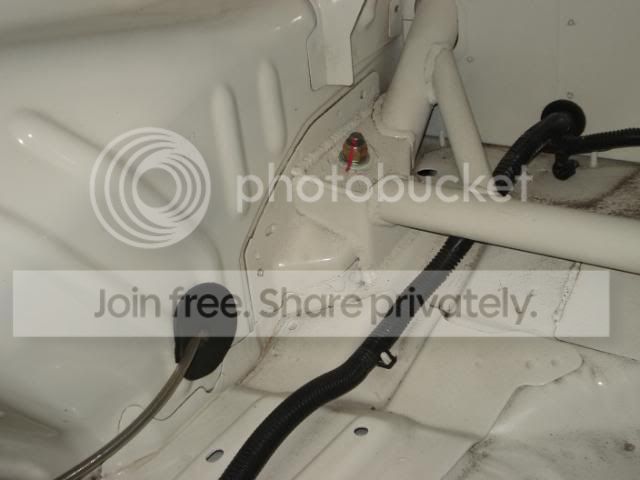
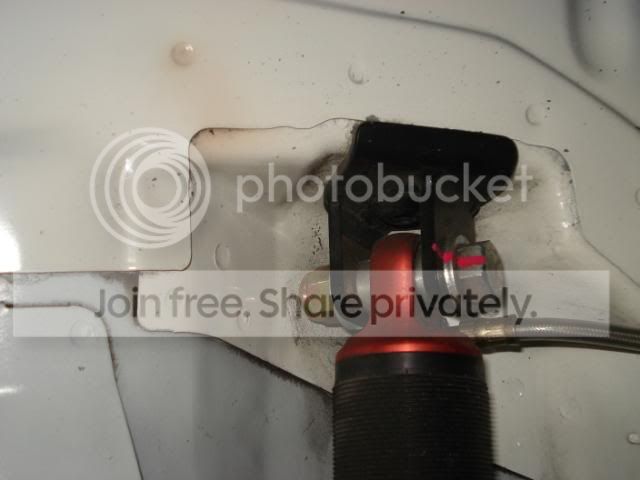
GMITCH -- Out of curiosity, what would you consider adequate reinforcement for the upper shock mount location in the rear? It appears the most common way being used to attach a coilover style device in the rear is by way of an L-Bracket that has a stud which feeds thru the factory hole. From what I've seen that's the extent of the reinforcement though. I guess the thought being that there is now a larger surface area to mount to. Would simply adding a few stich welds along the L-Bracket do the trick or are you thinking more along the lines of boxing off the upper mounting hole area inside the trunk?

Thanks again.
 

Department Of Boost

Alpha Geek
Joined
May 26, 2010
Posts
8,808
Reaction score
31
Thanks for the explanations guys.

GMITCH -- Out of curiosity, what would you consider adequate reinforcement for the upper shock mount location in the rear? It appears the most common way being used to attach a coilover style device in the rear is by way of an L-Bracket that has a stud which feeds thru the factory hole. From what I've seen that's the extent of the reinforcement though. I guess the thought being that there is now a larger surface area to mount to. Would simply adding a few stich welds along the L-Bracket do the trick or are you thinking more along the lines of boxing off the upper mounting hole area inside the trunk?

Thanks again.

Well here is what Ford Racing (well actually Watson who does the chassis) thinks is the way to go. In cases like this where I don't know what to do I tend to copy the people that are doing it, and doing it well. I'm sure Ford has it figured out.

RearremoteMountingandrouting.jpg


RearCoiloverMount.jpg


RearCoiloverMount1.jpg


rearremote.jpg


rearcoilover.jpg
 

csamsh

Senior Member
Joined
Apr 9, 2012
Posts
1,598
Reaction score
3
Location
OKC
Wow that's quite the brace...I wonder if that's all done for purposes of reinforcing the shock mount to take the spring loads, or if part of the intent is for chassis stiffening.
 

zeroescape

Member
Joined
Sep 15, 2012
Posts
163
Reaction score
0
Has anyone ever gotten away with running a coilover system unsupported in the rear? Its a great idea to reinforce it but is there any evidence to how much reinforce is needed?

Will something like the steeda brace sufficiently work. And by sufficiently i mean provide rigidity and not fatigue the mount to the point of failure in a weekend warrior car.


http://www.steeda.com/store/steeda-mustang-rear-chassis-xbrace-555-5093/
 

2013DIBGT

I Hate Wheelhop
Joined
Jun 3, 2013
Posts
333
Reaction score
1
Location
The Ungreat North East
Has anyone ever gotten away with running a coilover system unsupported in the rear? Its a great idea to reinforce it but is there any evidence to how much reinforce is needed?

Will something like the steeda brace sufficiently work. And by sufficiently i mean provide rigidity and not fatigue the mount to the point of failure in a weekend warrior car.


http://www.steeda.com/store/steeda-mustang-rear-chassis-xbrace-555-5093/

Hrrmm, that does look like a decent alternative possibly. I mean, it certainly can't be worse then not doing anything at all to reinforce that area I would think.
 

PLee

Member
Joined
Dec 9, 2010
Posts
258
Reaction score
0
Location
Livonia, MI
FWIW, I was told by a Ford Racing friend that strengthening the upper pocket was not absolutely necessary... But personally, I would still do it as a means or prolonging the car's life.

Not sure the Steeda X brace would be an appropriate "bolt-in" solution- the angles just look wrong to me; too close to horizontal to assist with any vertical load. But honestly, if you're going to track the car and willing to dump some cash on some coilovers, you can't be afraid of doing a little welding on the car...
 

908ssp

Senior Member
Joined
May 22, 2010
Posts
1,123
Reaction score
0
Location
Michigan
FWIW, I was told by a Ford Racing friend that strengthening the upper pocket was not absolutely necessary... But personally, I would still do it as a means or prolonging the car's life.

Not sure the Steeda X brace would be an appropriate "bolt-in" solution- the angles just look wrong to me; too close to horizontal to assist with any vertical load. But honestly, if you're going to track the car and willing to dump some cash on some coilovers, you can't be afraid of doing a little welding on the car...


Your correct the Steeda brace is a brace in name only it does nothing to strengthen the chassis and is useless for coil over strengthening. It is really just easier to leave the springs where they are. Adding a larger sway bar for roll stiffness or adjusting panhard bar or Watts link locations are good alternative tuning methods.
 

DRock

Senior Member
Joined
Jun 22, 2009
Posts
2,098
Reaction score
4
That Steeda on just seems almost liek it wouldnt affect much...

I bought the Alutec upper and middle rear braces for around $30 when moss muscle was closing them out and to be honest I didnt feel a difference at ll. now this isnt the shock brace one but the other 2 didnt do anything.

If I was to do "true rear coilovers" i would use the Grigs lower brace and through in a decent size brace up top just to have piece of mind.
 

SoundGuyDave

This Space For Rent
Joined
Apr 9, 2007
Posts
1,978
Reaction score
29
Just as a data point, I DID manage to break an AST coil-over strut body, right at the bottom of the threaded section. All it took was a 90+MPH offset-frontal merge with Aarmco... Honestly, the threaded body is a non-issue, as long as it's not backyard-engineered in some province in China.
 

Support us!

Support Us - Become A Supporting Member Today!

Click Here For Details

Back
Top