A pinion angle is only the difference of angles between rear end and drivetrain. If a drivetrain points down in the back by 4 degrees, and the rear points up by 4 degrees, your pinion angle is 0. This is known as equal but opposite. If you take an point the rearend down 2 degrees more, you just created -2 deg of pinion angle.
A pinion angle is only the difference of angles between rear end and drivetrain. If a drivetrain points down in the back by 4 degrees, and the rear points up by 4 degrees, your pinion angle is 0. This is known as equal but opposite. If you take an point the rearend down 2 degrees more, you just created -2 deg of pinion angle.
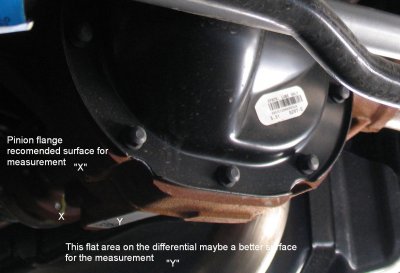
I am curious as to why a the flat area behind the pinion flange wouldn't be a better area for that measurement. In the video, it appeared that the flat area on the V6 diff may be tapered not allowing measurement their. However, I have notice that the area on the GT diff seems to follow the same plain as the pinion flange and may be a better area to take that measurement. What are your thoughts on this? Here's a pic of mine with the areas in question:
I am curious as to why a the flat area behind the pinion flange wouldn't be a better area for that measurement. In the video, it appeared that the flat area on the V6 diff may be tapered not allowing measurement their. However, I have notice that the area on the GT diff seems to follow the same plain as the pinion flange and may be a better area to take that measurement. What are your thoughts on this? Here's a pic of mine with the areas in question:
I have to find the thread but BMR posted about that area and it is 2* off the pinion flange measurement, so you can use it but you have to compensate for it being off 2 degrees. (i think it's 2 degrees upwards)
Ah! So, it does have a bit of a taper. As long as you know that you have to compensate for that 2* positive, it should be a good area for the measurement. I find the area of the pinion flange too uneven and narrow to do this although it obviously works. At some point, I'll be fooling around with this measurement and see what comes of it. Thanks!
So I get all this ,but how would you exp. guys with 1-piece DS feel about a -2 at the trans and dead on zero at the rear. That leaves me with the -2 , but just not sure if having the rear at zero is a good idea. I guess under launch it could rise at rear and be roughly -1 or 0 so maybe I have my answer. Just looking some reassurance before 350 mile trip tomorrow.
Also I know it can vary, but what have some of you others found the 11-12 GT's trans flange to be at with pretty much OEM front stuff?? -2?
Another words my motor has not been moved be any aftermarket stuff or trans with shims or the types of things that can do to alter that OEM setting.
-2 is a pretty common pinion angle, most of our customers run around -1 to -2.
As for your specific angles, -2 seems a little "less" angle than what I have experience with.....but I wouldn't worry about it. There are too many variables at play. The only way to know if that -2 is proper/actual angle...is if you have the car on a drive on lift......and measure the actual lift and it says "0"
Other than "What hole do I stick it in"....this is the most common topic during my 10-5 day job, that I talk about.
Thanks Kelly..........Rear suspension was loaded and front was on A frame. In fact I measured the height to top of my fender wells while the car was just parked in my garage. I had like 27 front and 27-3/4 rear. I made sure when I jacked car to put up, I had the same on all 4 with rear 3/4 higher. So I feel that is right. However I did buy another protractor and have not done all this again and hope it's ok to drive pretty easy on this trip without addressing pinion angles anymore till later.
So, you seen/find more negative angle on these cars, from trans flange on OEM fitment?
What like -3 ? .....I got that once with the protractor and -2 a couple times. Analog type and needle acted like it would catch sometimes.
I will be having another alignment soon at a customers shop and while doing that I will check it again






 Here's a pic of mine with the areas in question: