
at what point is it best to add an intercooler to a whipple 2.3 ? would it make enough of a difference to add an intercooler to a 2.3 that's running only 6-8 lbs of boost ? trying to get opinions on the set up. the car is an auto with exhaust only

You are using an out of date browser. It may not display this or other websites correctly.
You should upgrade or use an alternative browser.
You should upgrade or use an alternative browser.
07 mustang whipple
- Thread starter MYLILSS
- Start date
eighty6gt
Senior Member
- Joined
- May 9, 2011
- Posts
- 4,306
- Reaction score
- 416
Figure out your current IAT's and go from there. No sense adding weight, expense, etc.. if you're sitting at 100 degrees.
BruceH
BBB Big Bore Boss 322
at what point is it best to add an intercooler to a whipple 2.3 ? would it make enough of a difference to add an intercooler to a 2.3 that's running only 6-8 lbs of boost ? trying to get opinions on the set up. the car is an auto with exhaust only
I went with the big boost kit when I wanted more power. Non intercooled I was running 409rwhp easily with a big pulley. Added the big boost kit which contains an intercooler, different tune, and GT500 pumps and started to crank it up a little at a time.
If you have the money sitting around then now is the time to do it. The big boost kits keep going up in price over time. When I did mine it was a little under $2k through an FRPP dealer.
How does the non intercooled FRPP 2.3 whipple kit even work..with 400+ rwhp ?
The iat's, even with low boost, must be outa site. A couple of years ago, Justin at VMP tuned a non intercooled 2.3 whipple. He noted the air coming out of the blower was so hot, it expands, increasing the boost even more.
The iat's, even with low boost, must be outa site. A couple of years ago, Justin at VMP tuned a non intercooled 2.3 whipple. He noted the air coming out of the blower was so hot, it expands, increasing the boost even more.
BruceH
BBB Big Bore Boss 322
How does the non intercooled FRPP 2.3 whipple kit even work..with 400+ rwhp ?
The iat's, even with low boost, must be outa site. A couple of years ago, Justin at VMP tuned a non intercooled 2.3 whipple. He noted the air coming out of the blower was so hot, it expands, increasing the boost even more.
The iat's are really low. Whipple made their own rotors based on their own design for the 2.3. They run cooler than any other pd blowers I'm aware of.
Cruising iat's would be around 120-140 in the summer. They would go up at a stop but come right down once you got going.
This is my actual experience. I watched iats all the time when I was boosted. Going from non intercooled to intercooled lowered iats to about 10-20 over ambient for normal driving. Compare to 50+ over ambient for a little M122 during normal driving.
Whipple spent the money on engineering and rotor design. It's why their blowers run cooler than any other twin screw out there. They were forced to do it when Lysholm held their 1st generation rotors from them but still supplied to KB some years ago. Whipple ended up with superior product and KB kept their supplier designed parts and propaganda.
eighty6gt
Senior Member
- Joined
- May 9, 2011
- Posts
- 4,306
- Reaction score
- 416
If you built a sophisticated methanol injection kit that sprayed directly under the blower outlet you could easily achieve 500 at the wheels with no intercooler, no pumps, no exchanger, etc... however a tank in the trunk and a pump. That would be neat.
*caveat being I only know about how well methanol injection works from 1000's of internet postings I've read. Should drop temps by 10 to... I don't know, 80 degrees?!? No way of knowing.
I wonder if Bruce was on E85. With that you probably wouldn't even need the meth.
*caveat being I only know about how well methanol injection works from 1000's of internet postings I've read. Should drop temps by 10 to... I don't know, 80 degrees?!? No way of knowing.
I wonder if Bruce was on E85. With that you probably wouldn't even need the meth.
BruceH
BBB Big Bore Boss 322
If you built a sophisticated methanol injection kit that sprayed directly under the blower outlet you could easily achieve 500 at the wheels with no intercooler, no pumps, no exchanger, etc... however a tank in the trunk and a pump. That would be neat.
*caveat being I only know about how well methanol injection works from 1000's of internet postings I've read. Should drop temps by 10 to... I don't know, 80 degrees?!? No way of knowing.
I wonder if Bruce was on E85. With that you probably wouldn't even need the meth.
I had methanol with the whipple while non intercooled for a little while. I sprayed before the blower. It would reduce iats but it took a little while because it would remove heat from the blower first. It also took power away and if it wasn't set with the right ramp to come on and progressively spray it would cause misfires.
The way to get more power with meth is to tune for it and add more boost. I was reluctant to be dependent on meth to keep the motor alive so I didn't tune for it.
I didn't run e85 until I was intercooled. With that said I do know (just by casual acquaintance) someone who said he never runs an intercooler with e85 because it isn't needed. E85 won't detonate and it cools the combustion chamber. I'd probably still want an intercooler because I don't have very good access to E85 and mostly run 92 octane pump gas unless something is going on. All of my builds have been survivable with pump gas.

Department Of Boost
Alpha Geek
- Joined
- May 26, 2010
- Posts
- 8,808
- Reaction score
- 31
The iat's are really low. Whipple made their own rotors based on their own design for the 2.3. They run cooler than any other pd blowers I'm aware of.
Cruising iat's would be around 120-140 in the summer. They would go up at a stop but come right down once you got going.
This is my actual experience. I watched iats all the time when I was boosted. Going from non intercooled to intercooled lowered iats to about 10-20 over ambient for normal driving. Compare to 50+ over ambient for a little M122 during normal driving.
Whipple spent the money on engineering and rotor design. It's why their blowers run cooler than any other twin screw out there. They were forced to do it when Lysholm held their 1st generation rotors from them but still supplied to KB some years ago. Whipple ended up with superior product and KB kept their supplier designed parts and propaganda.
What were the IAT's at WOT?
BruceH
BBB Big Bore Boss 322
What were the IAT's at WOT?
Almost always lower with intercooled setups. The highest I ever saw with the non intercooled Whipple was 175 during wot on an 85 degree day. It was immediately after slogging through traffic for about 30 minutes. It came down to about 145 after the initial hit iirc. It's been a long time and it was before I started to log things so I don't have anything to verify my memory with. I was running the next size smaller pulley from a 4", 3.875" iirc. Low boost and a big pulley for a 2.3 whipple.
The highest wot iat I've seen with the intercooled whipple was 117. It was at the end of the 1/4 mile on a 80 degree afternoon. IIRC I was at about 13psi running 92 pump and generating a little over 500rwhp.
IIRC correctly the M122 didn't go much above 135 during wot after the initial hit of hot air that spiked it a little. I'm sure I have it recorded in a post somewhere on this site. It was below the threshold I had set for pulling spark with e85. I never got the M122 to the track though so it might of been a little lower had more fresh air been allowed to go through it.
All of this isn't exactly apples to apples. I had two different motors with the Whipple and an entirely different bore and stroke along with 12:1 with the M122.
BruceH
BBB Big Bore Boss 322
What were the IAT's at WOT?
This log was taken on a nice 60 degree day iirc. Motor was the current 12:1 BBB with 7psi from the M122 and E85 as a fuel. Motor was making 587rhwp at the time.
Edit: For those paying attention this was done on a dyno. I wasn't going 140+ on a public road, never would.

lito
Senior Member
If you built a sophisticated methanol injection kit that sprayed directly under the blower outlet you could easily achieve 500 at the wheels with no intercooler, no pumps, no exchanger, etc... however a tank in the trunk and a pump. That would be neat.
*caveat being I only know about how well methanol injection works from 1000's of internet postings I've read. Should drop temps by 10 to... I don't know, 80 degrees?!? No way of knowing.
The problem with that is distribution.
eighty6gt
Senior Member
- Joined
- May 9, 2011
- Posts
- 4,306
- Reaction score
- 416
Yeah, hence my caveat "sophisticated." Multi nozzles. I'd say 4 would get you there. The air has to go 360 degrees before it gets into the heads, the meth would probably want to go to the bottom of the plenum.
at what point is it best to add an intercooler to a whipple 2.3 ? would it make enough of a difference to add an intercooler to a 2.3 that's running only 6-8 lbs of boost ? trying to get opinions on the set up. the car is an auto with exhaust only
As soon as possible! I started with the non-intercooled kit and while I liked when I first had it, adding the big boot kit was the best thing ever. More power, no power loss on 100+ degree days and every time I drive it I smile. The non-intercooled kit is fun but intercooler and 10-11 lbs boost is amazing. If I ever get my forged engine together I'm looking forward to 13-15 lbs of boost!
The iat's are really low. Whipple made their own rotors based on their own design for the 2.3. They run cooler than any other pd blowers I'm aware of.
Cruising iat's would be around 120-140 in the summer. They would go up at a stop but come right down once you got going.
This is my actual experience. I watched iats all the time when I was boosted. Going from non intercooled to intercooled lowered iats to about 10-20 over ambient for normal driving. Compare to 50+ over ambient for a little M122 during normal driving.
Whipple spent the money on engineering and rotor design. It's why their blowers run cooler than any other twin screw out there. They were forced to do it when Lysholm held their 1st generation rotors from them but still supplied to KB some years ago. Whipple ended up with superior product and KB kept their supplier designed parts and propaganda.
If I have the story correct, FRPP offers 3 options for their 2.3L whipple kits. 1st one is listed at 5-6 psi..and 400 RWHP. 2nd one is listed at 9 psi + 475 CRANK hp. 3rd one is listed at 11 psi + 550 CRANK hp.
1st one doesn't have an intercooler / HE / pump etc. 2 + 3rd option do. Option 3 has the GT-500 pump etc.
Option #1.... but with the IC / HE etc, would result in the lowest IAT's of the bunch.
The whipple rotor pack uses a 3-5 ratio. The K Bell rotors use a 4-6 ratio.
BruceH
BBB Big Bore Boss 322
If I have the story correct, FRPP offers 3 options for their 2.3L whipple kits. 1st one is listed at 5-6 psi..and 400 RWHP. 2nd one is listed at 9 psi + 475 CRANK hp. 3rd one is listed at 11 psi + 550 CRANK hp.
1st one doesn't have an intercooler / HE / pump etc. 2 + 3rd option do. Option 3 has the GT-500 pump etc.
Option #1.... but with the IC / HE etc, would result in the lowest IAT's of the bunch.
The whipple rotor pack uses a 3-5 ratio. The K Bell rotors use a 4-6 ratio.
The non intercooled whipple with a FRPP tune is good for 400 crank hp. I had 366rwhp with it. The Ford tune uses torque control to keep it in check. A custom tune with that same combo resulted in 409rwhp for me with a stock motor. That was all my stock fuel pump would support with the 32lb injectors that come with the kit.
When I went with the big boost kit and FRPP tune with a big 3.650 pulley it made 436rwhp. The big boost kit comes with a 3.250 pulley and will give you about 470-480rwhp with the FRPP tune and a stock motor.
The auto version is something I've never used so I can't really comment on it other than to speculate that Ford is using their knowledge of the torque management programming to keep it in a range that's safe for the auto.
It's been probably about 6 years since I had a discussion with Art Whipple about the FRPP setup. At the time he said that Ford had 2 motors that had blown while using the FRPP tune and that Ford had covered both because it was due to an obvious manufacturing defect. That was back in 2009 but I have to say that I haven't heard of anyone blowing a stock 4.6 3v while using the FRPP Whipple kit with the FRPP tune. That doesn't mean it hasn't happened but it's just not heard of. Put a bad or more aggressive tune on and anything can happen.
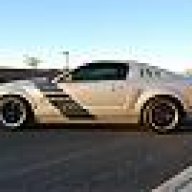
The auto version is something I've never used so I can't really comment on it other than to speculate that Ford is using their knowledge of the torque management programming to keep it in a range that's safe for the auto.
The auto version comes with a larger pulley than the HO kit. Shelby wouldn't tune the HO kit with my automatic because they said the stock 5R would not handle it. I swapped trannies so I could use the smaller pulley and run 11-12 psi.
Going with an intercooled kit was my only option being out in the desert where track side temps can easily top the 130* mark.
Similar threads


- Replies
- 0
- Views
- 545

- Replies
- 6
- Views
- 301


- Replies
- 8
- Views
- 364


Support us!
Support Us - Become A Supporting Member Today!
Click Here For Details