Ground Wire, O2 sensor, or Fuel Filter

sirpowwow

Junior Member
Joined
May 31, 2026
Posts
3
Reaction score
0
Location
Boston MA
I have a 2005 GT and over the last 2 days the check engine light began flashing.

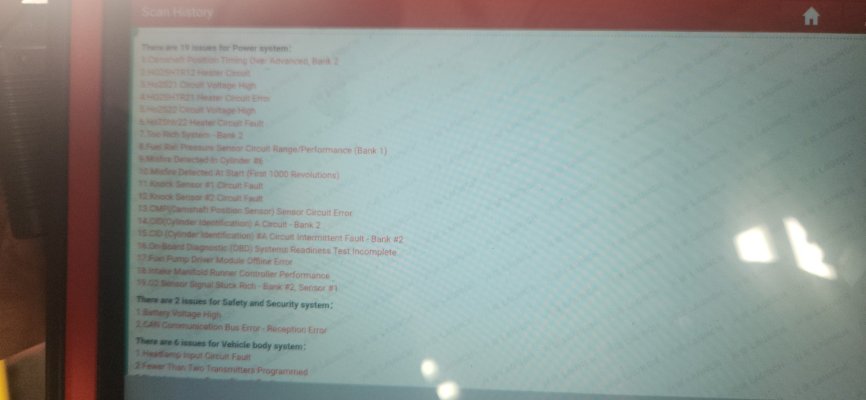
I ran a scan and got so many codes, I'm not sure where to start. Today while driving the check engine light came on and kept flashing. I can start the car but it shuts off within 60 seconds. I was planning to swap out my O2 sensors but I'm beginning to think, due to the voltage errors, its a ground wire issue. I've never seen both O2 sensors failure errors and I've had a few mustangs.

If its an electrical issue, my first guess is alternator replacement however I'm not solid with electrical work. Curious what you lot think is the best place to start?

stang.jpg
 

TexasBlownV8

Formerly TexasBlownV6
Joined
Apr 4, 2008
Posts
5,018
Reaction score
94
Location
Central Texas
All of those are not going to go "bad" at the same time! A ground or voltage supply issue is more likely. If there was recent work such as removing the transmission or headers installed, there is probably engine harness damage and a subsequent fuse is blown.
I would measure voltage at various points and diagnose accordingly. Whatever you do, DO NOT START BUYING AND THROWING PARTS AT ALL OF THESE..unless you want to waste time and money. Figure out what is going on first, or find someone who can diagnose electrical systems with you.
 

Forty61

Senior Member
Joined
Nov 6, 2016
Posts
1,431
Reaction score
1,411
Location
Dallas, TX
I see multiple codes in there showing high voltage, I would personally start by verifying battery voltage with the engine both off and on, confirm all connections at the battery, alternator and all grounds. Go from there.. my gut would say failing alternator.
 

TexasBlownV8

Formerly TexasBlownV6
Joined
Apr 4, 2008
Posts
5,018
Reaction score
94
Location
Central Texas
I see multiple codes in there showing high voltage, I would personally start by verifying battery voltage with the engine both off and on, confirm all connections at the battery, alternator and all grounds. Go from there.. my gut would say failing alternator.
Good point there.
Check the voltage with engine running (and off), and see. If engine off voltage is over 13 volts, it could be a battery problem. If voltage is over 14.5 volts when running, especially if over 15, the alternator is overcharging/over-voltage and that can cause all kinds of issues. It's more common on the 4.0L where there are at least two different alternator / PCM setups for different year models, and the wrong one can create over-voltage and similar issues.
 

sirpowwow

Junior Member
Joined
May 31, 2026
Posts
3
Reaction score
0
Location
Boston MA
Man, I got back to the forum a bit too late. I swapped out the cam position sensor along with the spark plug for cylinder 6. What's strange is now the engine won't turn over! The spark plug looked very burnt on the bottom half, almost as if oil reached it and burned. I'm not great at the electrical side of things, perhaps it's time to learn. So I'm not taking measurements from the wiring harness, just the battery terminals.
 

Forty61

Senior Member
Joined
Nov 6, 2016
Posts
1,431
Reaction score
1,411
Location
Dallas, TX
I would not throw any more parts at it without actually diagnosing something.

To properly check your electrical system you're going to need a decent voltmeter, set to DC voltage. Measure at the battery terminals with everything off and write down your number, I would say then start the car and check it again but you said it won't start now so that needs to be figured out first..

Stick shift or auto? Ignition comes on but motor won't crank or you have no power inside at all?

If diagnosis is not your strong suit post a reply here with details on the car (trans, miles, mods) and what your resting (ignition off) voltage is at the battery as a start. I would also be curious if anything was worked on or changed before that light came on, that would help determine a problem that was introduced or a failure somewhere.
 

Kev555

Member
Joined
Dec 12, 2021
Posts
383
Reaction score
174
Location
Ireland
With that many codes at once its most likely a voltage/electrical issue. i second what forty61 said don't throw any more parts at it until you diagnose the issue. Battery, alternator and earths checked first.
 
Last edited:

sirpowwow

Junior Member
Joined
May 31, 2026
Posts
3
Reaction score
0
Location
Boston MA
So my mechanic says its a timing chain issue and the engine should be swapped. Strange as I put this motor in last March. It's weird. The car there's no dirty oil with would be symptoms of metal getting into engine parts. I'm at a lost as two motor swaps within 1.4 years. I'd love some opinion's here as they gave me a border line ChatGPT response.

My Question: What were the symptoms you saw that lead to timing chain being the culprit? Can we not swap out the timing chain and move to re-synchronization next? Are you seeing damage to other engine components?

Mechanic: :However, based on the symptoms found during the diagnostic process, there is a considerable possibility of internal engine damage caused by the timing failure. The evidence observed includes: * Excessive slack in the timing chains; * Engine timing significantly out of synchronization; * Air blowing back through the intake manifold during cranking; * No-start condition; * This engine model is considered an interference engine, meaning that when timing falls out of specification, there is a possibility of contact between valves and pistons. When this occurs, possible damage may include: * Bent valves; * Cracked or damaged pistons; * Damage to internal cylinder head components. Regarding the "wear" comment, we are not necessarily referring to the previously replaced engine itself or to the engine age. Our concern is primarily related to the wear/failure found in the timing system components, especially due to the extremely loose timing chains observed during inspection. At this time, no excessive metal contamination was identified in the oil, and no visible external damage to the engine block was found. However, this does not eliminate the possibility of internal damage to the valves, pistons, or cylinder heads. As for the probability of the engine operating properly after only replacing the timing components, unfortunately it is not possible to provide an exact percentage without complete teardown and further testing. There is a possibility the engine may run properly after timing correction, but there is also a significant risk that internal damage may already exist and only become evident after full reassembly and engine synchronization. For this reason, we are unable to provide warranty coverage on a partial timing repair alone. The repair process requires extensive front engine disassembly, replacement of timing components, and complete engine timing setup. If bent valves or other internal engine damage are discovered after reassembly, the engine would require additional teardown and repairs. Our labor rate is currently $130 per hour. Based on labor cost, parts cost, and the level of risk involved, our technical recommendation was complete engine replacement, as in many cases this becomes the safest, most reliable, and most cost-effective solution compared to attempting a partial repair without warranty.

Thoughts?

 

Forty61

Senior Member
Joined
Nov 6, 2016
Posts
1,431
Reaction score
1,411
Location
Dallas, TX
All I will say is those codes could point to a timing issue but even a complete timing failure is not going to generate high voltage or electrical codes to other systems in the car like your list shows.
 

Support us!

Support Us - Become A Supporting Member Today!

Click Here For Details

Back
Top