Centric and Stop Tech Rotors and Rust

Hvacmike

Junior Member
Joined
Mar 17, 2012
Posts
26
Reaction score
0
Location
BG Ohio
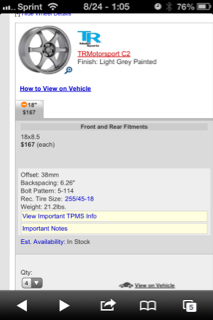
ImageUploadedByTapatalk1377364515.178918.jpgImageUploadedByTapatalk1377364532.355315.jpg

I have these from tire rack. Not to expensive. Pretty light and will fit the 4 piston brembo's.
 

Vorshlag-Fair

Official Site Vendor
Joined
Nov 12, 2010
Posts
1,592
Reaction score
116
Location
Dallas, TX
The 18x10 AMRs from AmericanMuscle.com also fit on all 4 corners and are only $160 each, shipped. They weigh about 27 lbs each. Not super light, but not terribly heavy, either...

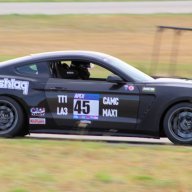
Yikes, 27 pounds... That's still pretty freagin heavy, even for an 18x10. The adage "you get what you pay for" applies, of course. The stock 19x9" wheel is about that heavy (OEM 19x9" wheel and OEM 255/40/19 tire = 57 pounds per corner, shown below right).

DSC3133-S.jpg
IMG_1863-S.jpg


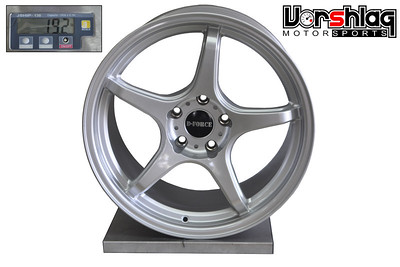
Our Vorshlag/D-Force 18x10" wheel costs nearly 2x as much ($309) as those import AMRs but weigh ~8 pounds less per corner (19.2 lbs), which is significant. That's mass you have to speed up, slow down, and is unsprung weight. Tough as nails, too - I've been beating on a set for 2 years street driving, track, and autocrossing. We still use this same set for streets/wets on our TT3 car.

_DSC3762-M.jpg


Wheels is one of if not THE best places to lose mass on your performance or competition car. Just sayin...
 

kcbrown

Member
Joined
Jul 24, 2013
Posts
656
Reaction score
5
Our Vorshlag/D-Force 18x10" wheel costs nearly 2x as much ($309) as those import AMRs but weigh ~8 pounds less per corner (19.2 lbs), which is significant. That's mass you have to speed up, slow down, and is unsprung weight. Tough as nails, too - I've been beating on a set for 2 years street driving, track, and autocrossing. We still use this same set for streets/wets on our TT3 car.

_DSC3762-M.jpg


Wheels is one of if not THE best places to lose mass on your performance or competition car. Just sayin...

Question about the various wheels and the weight in question....

Is the primary impact of a weight difference of a few pounds per wheel going to be on the acceleration and braking? If so, then isn't moment of inertia going to be a much larger factor than the weight itself?

Which is to say, if all the weight difference is concentrated at the hub, then the effect on acceleration should be quite a lot different (and much greater) than if it's concentrated at the rim, since acceleration and deceleration are occurring through the application of torque.


I would expect most of the mass difference to be concentrated at the rim, which is the worst possible place for it, but that almost certainly depends on the design of the wheel in question.


None of that, of course, affects unsprung weight, which I would expect to have a much larger impact on the front than the rear, since the rear has this big solid axle that weighs some 200 pounds, and it's hard to see how a few pounds would make a whole lot of difference there. The front is an entirely different matter, of course.


Terry, do you have moment of inertia data for your wheels? It would be useful to have that to use as a basis for wheel selection. The Forgestars have a number of patterns, and I doubt their moments of inertia are all the same...
 

csamsh

Senior Member
Joined
Apr 9, 2012
Posts
1,598
Reaction score
3
Location
OKC
DISCLAIMER: It's been a long time since I had calculus and physics in college- if I'm wrong, please correct me!

Question about the various wheels and the weight in question....

Is the primary impact of a weight difference of a few pounds per wheel going to be on the acceleration and braking? If so, then isn't moment of inertia going to be a much larger factor than the weight itself?

MOI varies directly as the mass of the object, and varies as the square of the radius. So, yes, getting a lighter 18" wheel will help considerably. Also- consider a rotating wheel. Treat it as a gyroscope. Do gyroscopes like to turn? No, they don't. There is some kinematics equation that I don't remember that deals with rate of precession and gyroscopic forces. Lighter wheels make everything better.

Which is to say, if all the weight difference is concentrated at the hub, then the effect on acceleration should be quite a lot different (and much greater) than if it's concentrated at the rim, since acceleration and deceleration are occurring through the application of torque.

The weight at the hoop & tire is what matters more (r^2). It matters more the larger "r" is, so spokes come into play as well.


I would expect most of the mass difference to be concentrated at the rim, which is the worst possible place for it, but that almost certainly depends on the design of the wheel in question.

less mass at hoop/rim=better


None of that, of course, affects unsprung weight, which I would expect to have a much larger impact on the front than the rear, since the rear has this big solid axle that weighs some 200 pounds, and it's hard to see how a few pounds would make a whole lot of difference there. The front is an entirely different matter, of course.

statically, you are correct. dynamically, it matters


Terry, do you have moment of inertia data for your wheels? It would be useful to have that to use as a basis for wheel selection. The Forgestars have a number of patterns, and I doubt their moments of inertia are all the same...

I would expect not! The formula for MOI of a continuous mass rotating around a fixed point (a wheel) is the integral of p(r)*r^2 dV integrated over the volume of the object. If you could come up with a function (maybe not actually a function), and us it to determine mass density at all points "r" (p(r)) over a radial cross section of the wheel, then, yes, you could probably approximate it.

 
Last edited:

kcbrown

Member
Joined
Jul 24, 2013
Posts
656
Reaction score
5

kcbrown said:
Terry, do you have moment of inertia data for your wheels? It would be useful to have that to use as a basis for wheel selection. The Forgestars have a number of patterns, and I doubt their moments of inertia are all the same...

I would expect not! The formula for MOI of a continuous mass rotating around a fixed point (a wheel) is the integral of p(r)*r^2 dV integrated over the volume of the object. If you could come up with a function (maybe not actually a function), and us it to determine mass density at all points "r" (p(r)) over a radial cross section of the wheel, then, yes, you could probably approximate it.



Actually, I would expect that the MOI is something that can be measured. After all, it's used in angular momentum calculations, so it should be possible to apply a known torque to the wheel's center, measure how much time it takes for it to spin up to a certain rotation rate, then take those numbers plus the mass and derive the MOI.

And, actually, you don't even need the MOI for that measure to be useful. If the torque in question is known, then the amount of time it takes for the wheel to spin up to a certain target RPM is sufficient for comparison purposes.

But in any case, I would think the manufacturer would have MOI data if it's not something that can be measured...


By the way, this raises a related question. From a MOI perspective, is it better to run an 18" wheel or a 19" one, presuming the same wheel design for both?

EDIT: actually, it occurs to me that the above question can be answered relatively easily as well, provided one has the proper equipment. Simply mount a tire onto, e.g., an 18x10 wheel, and another of the same make, model, width on a 19x10 wheel (but with ratios that results in the diameters with the tires mounted being as close to each other as possible so, e.g., 285/40/18 and 285/35/19), and see which one takes longer to spin up to a given rpm with a given torque on it.

 
Last edited:

csamsh

Senior Member
Joined
Apr 9, 2012
Posts
1,598
Reaction score
3
Location
OKC


By the way, this raises a related question. From a MOI perspective, is it better to run an 18" wheel or a 19" one, presuming the same wheel design for both?


18. More mass neat the center of rotation lowers MOI.

You could probably measure MOI. It's all based on torque, so there is probably some "wheel dyno" somewhere.
 

kcbrown

Member
Joined
Jul 24, 2013
Posts
656
Reaction score
5
18. More mass neat the center of rotation lowers MOI.

But that's for the wheel alone.

The problem is that the tire has to be included in this calculation. And for the 18" wheel, you've got more tire mass out near the edge.

So it becomes a question of whether the greater sidewall area of the 18" wheel and tire combination represents a larger angular mass than the increased radius and spoke mass of the 19" wheel.

My gut feeling is that you're right, that moving the rim out by another inch (which increases the rim's angular mass and inertial mass since the rim's circumference is now larger), plus the addition of spoke mass out there, makes for quite a lot more angular mass than the two strips of tire rubber between the 18" and 19" marks do, and that this result favors the smaller diameter wheel even more as the wheel width increases.


You could probably measure MOI. It's all based on torque, so there is probably some "wheel dyno" somewhere.
That's exactly what I was thinking. :thumb:
 
Last edited:

csamsh

Senior Member
Joined
Apr 9, 2012
Posts
1,598
Reaction score
3
Location
OKC
But that's for the wheel alone.

The problem is that the tire has to be included in this calculation. And for the 18" wheel, you've got more tire mass out near the edge.

So it becomes a question of whether the greater sidewall area of the 18" wheel and tire combination represents a larger angular mass than the increased radius and spoke mass of the 19" wheel.

My gut feeling is that you're right, that moving the rim out by another inch (which increases the rim's angular mass and inertial mass since the rim's circumference is now larger), plus the addition of spoke mass out there, makes for quite a lot more angular mass than the two strips of tire rubber between the 18" and 19" marks do, and that this result favors the smaller diameter wheel even more as the wheel width increases.


T :thumb:

Yeah if you use tires that are the same height, you move the hoop of the wheel a half inch closer to the hub with an 18 vs a 19. That would lower MOI.
 

Support us!

Support Us - Become A Supporting Member Today!

Click Here For Details

Back
Top