Pentalab, the more of your posts I read, the more I become convinced you have no bloody clue how physics, suspension design, thermodynamics, or just about anything actually works. What makes things even worse is that you seem to think you are correct even when other people clearly point out you are not.
Ask yourself: what is more likely? That you are indeed the smartest person on this forum and that everyone else doesn't know what they are talking about, or that maybe--just maybe--you have more to learn than you think you do.
Nasa has a sign up that sez.... "one test is worth a 1000 opinions". None of this cooling discussion is rocket science. If you are generating XXX btu's.... you require a cooling scheme that will dump XXX btu's.... and perhaps a bit more. It's a case of thermal management. You want to end up with a cooling system, such that cylinder head temps are kept in check, and don't exceed XXX deg F. To pull that off, you require a water pump/ eng rad setup, with enough airflow through the rad. IF you can keep the eng coolant temps in check, your oil temps will drop off too.... but in some cases, not enough. A HE, using water ( NOT hot eng coolant) to extract the heat of the hot oil..then the heated water fed to a 2nd HE..( with air through the 2nd HE) would work. IE: a closed loop setup, with 2 x HE's, one pump. A simpler approach would be a bar + plate type oil cooler..with of course air through the cooler...+ a T stat.
"For reference, we had NO oil cooler NOR an aftermarket radiator in our Mustang
GT for the first 3 years of track use. With 430+ whp and ambient temps often above 100°F - and usually 2 people double-driving this car at each event - for 30+ events per year, we had NO oil OR coolant overheating problems, while setting track records. No problemo. We use 15W50 Mobil1 oil and change it religiously. That was the extent of the changes to the cooling or oiling for the first 3 years. "
"The factory coolant/oil "cooler" is NOT a very good design that, we feel strongly, SHOULD BE REMOVED. It IS an oil HEATER. The GTs don't have this design and they DON'T overheat on track.
"But we HAVE REMOVED these silly trans scoops on some of our customers' Boss302s and SOME overheating complaints HAVE BEEN REDUCED. We've also replaced the Boss302 coolant-based oil cooler with the GT radiator hoses added an external fluid-to-air oil cooler with very positive results. We done both to a customer's heavily tracked boss302, which we also added external gauges to, and oil temps dropped markedly".
" See, the "scoop" is trying to divert under car air flow up towards to the Getrag MT-82 TRAIN WRECK wreck of a transmission (that can and does overheat badly - we turned 3rd gear blue before it FAILED)."
"When we wanted to MAKE A MORE FUNCTIONAL front splitter, we
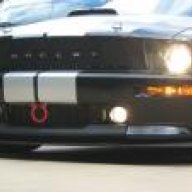
completely blocked off the upper grill (oh n0es!!11!!one!!) and all of the incoming airflow for the radiator now comes from
just the lower opening, sealed to the a/c condenser (gasp!) and radiator.
"What do you consider "overheating"? When I first started tracking my BASE GT, I saw coolant temperatures around 230 degF and oil temperatures reaching almost 310 degF. If the Boss 302's run a lot hotter than that, I'm really surprised that Ford continued to release them after the first year without beefing up the cooling system. It's certainly possible that it was a gross oversight, but given the intended use for them, I have to be skeptical. "
"As the front of the car slows down the air without a diffuser, this is the ideal place for an inlet. A
splitter is commonly used here, serving to increase the amount of downforce at the front of the car. The airstream is brought to stagnation above the splitter by an air dam, causing an area of high pressure. Below the splitter, the air is redirected away from the stagnation zone and is accelerated, causing the pressure to drop. This, combined with the high pressure over the splitter, creates downforce. The larger the area of the splitter, the more downforce is generated.
Ok, so we have low pressure below the splitter...and high pressure above the splitter. To get the splitter to work, the air above the splitter needs to be stagnated..hence the air dam. IF the upper grille is blocked off..AND hood vents are used.... the air is gonna scream through the lower grille. If the lower grille is located above the air dam, this higher velocity airflow through the lower grille may or may not affect splitter performance. It would depend if a dam was used, how big, and how high above any dam the lower grille is located.
It appears the MT-82 "train wreck" tranny still requires some cooling...like a real one this time....small rad. If base GT's have 230 F water temps and 310 F oil temps, the base GT has insufficient cooling. For you folks with sky high water + oil temps...did any of you measure the cylinder head temps ???
As for the discussion on water vs air cooling... in large metal tubes, used for broadcast use, air cooling will remove 50 watts per square cm. Vapor phase cooling will remove 135 watts per sq cm. Water will remove 1000 watts per sq cm. 1 watt = 3.41 btu's per hr. Of course you have to factor in the temp of the cooling water..+ air temps, etc. I design cooling systems for the above, so have some experience with it.... but its a different application from a mustang.
We used vapor phase cooling on one of the diesel standby generator's at work. The theory is when you turn 100 deg C water into 100deg C steam, you release a tremendous amount of energy. The steam is condensed back to water..and cooled just below 100 deg C. Turning 100 deg C water to 100 deg C steam is 20 x more eff vs raising 99 deg C water to 100 deg C water.
Some of the diesel standby generators I looked after were V16's..with pistons the size of paint cans. Eng rads were the size of a garage door, and a 98,000 cfm fan used to pull air past the rad. Turbo HE cooling was done via an air to air HE....stacked on top of the main eng rad. Any errors in these cooling systems can be very costly.
In my particular case, I have 6 x rads to cool via air through both the upper and lower grille. If an oil cooler is used, then it's up to 7. I require all the air I can get... hence the 7 bar upper grille....and lower chin spoiler. I'm currently looking at vented hoods.... to relieve pressure. I don't want water getting through them though. I designed a scheme where the louvers would only begin to open at 30 mph..and open more with increased speeds..( higher underhood pressures). HVAC systems use something similar to relieve pressure in commercial buildings. Some positive pressure is retained....to keep dust out.
At our local sc track, they will only allow 100% distilled water (+ water wetter) to be used in eng rads.....no glycol. Some of the cars will use a higher pressure in the coolant loop. The boiling point will be raised considerably (think pressure cooker theory). You can extract more heat with 100% distilled water vs a 50-50 water glycol mix..esp if water wetter is used.
Impact pressure from wind goes up to the square of the wind velocity. 70 mph is double the pressure of 50 mph. 70 mph is triple. 100 mph is quadruple. 111.8 mph is 5 x the pressure. These cars are as streamlined as a brick. The cd is nothing to write home about.
As a rough rule of thumb, to stuff double the air through a small orfice, you require 4 x the pressure.
For folks at higher elevations it all gets worse. The air density is thinner of course. The weight of the air is way less. ( mass airflow rate factors in the weight of the air). At 5000', you require 20% more cfm to get the same mass airflow. You also require 20% more pressure as well. The problem is at 100 mph, your cfm through your rads stays the same, but the weight of the air is less. You lose it right there. Your eng fan (or say HE fan if a blower is used) needs another 20% cfm. It also requires another 20% more pressure. Wait, it gets worse. Fans are rated for sea level..not elevation. A series of calculations is then done to determine what sea level rated fan can be used to work at 5000'. The results will make you gag. Works out to aprx another 57% cfm required..and a helluva lot more pressure. Worse case is higher ambient temps + higher elevations.
I'm no suspension expert....suffice to say the PHB setup is extremely limited. If you saw the go pro video's of the rear tires going from being tucked into the wheel wells to extending way out past the wheel well, during auto cross, you would need little convincing that a watts link is the real answer. I'm not impressed with the oem traction lock lsd either....I replaced it with a tru-trac. The oem GT suspension on my 2010 leaves a lot to be desired. (nose dive under braking, back ends lifts. Front end rises, back end squats with acceleration. Flops about during cornering.) I replaced all of it.
Back to cooling. What thresholds are you folks using for the high and low speed eng fan ?? oem is 204F coolant temps for the low speed fan...and 209F coolant temps for the high speed fan. Low speed fan is adjustable from 170-230 F. High speed is adjustable from 180-240 F.
If you drop them down a bit... you won't have to play.... "catchup".