
DILYSI Dave
Member
"We do FEA" means not much. It's a tool, but only that. It doesn't magically make parts not break.


I would only be guessing but I would think that if a part looks like it has a problem revealed with FEA then it definitely will have a problem in the finished product, but if a product looks good after the analysis it doesn't mean it's guaranteed good to go. Is that true or a bad guess?
Sent from my iPhone using Tapatalk
And Steve Poe also already pointed out that there was a KB A-arm failure that same week at the track.
Sent from my iPhone using Tapatalk



It's not nearly as simple as that, because "doing FEA" says nothing about how extensive the analysis was or how detailed the model itself was. There can be orders of magnitude differences between two analyses for the same part with both legitimately being Finite Element Analyses.I would only be guessing but I would think that if a part looks like it has a problem revealed with FEA then it definitely will have a problem in the finished product, but if a product looks good after the analysis it doesn't mean it's guaranteed good to go. Is that true or a bad guess?
It's not nearly as simple as that, because "doing FEA" says nothing about how extensive the analysis was or how detailed the model itself was. There can be orders of magnitude differences between two analyses for the same part with both legitimately being Finite Element Analyses.
I suspect that a FEA performed at this point to either validate or exclude the various root causes mentioned would be in somewhat greater depth than what might have been performed when the part was originally designed.
Like Dave said, FEA is only a tool. It can be a very good tool, but it's still only as good as the input data going in and the engineering evaluation of what comes out.
Norm
All models are wrong, some are useful.Like Dave said, FEA is only a tool. It can be a very good tool, but it's still only as good as the input data going in and the engineering evaluation of what comes out.
Norm
All models are wrong, some are useful.
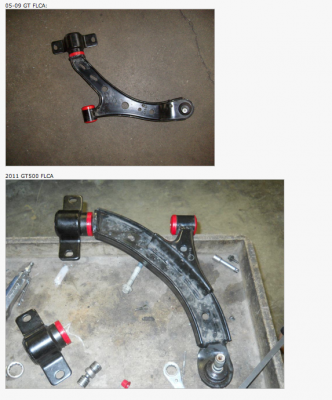
Even Ford OEM redesigned the A-ARMs. 2011 also comes with larger front brakes which increases the stress on the A-Arms.
It appears Ford increased the curved section to increase its strength.
I guess I will be adding some reinforcing to the BMR A-Arms I was fixing to install. Figures I just prime them and was ready for the Red Candy paint.


except for the balljoint flange which looks much thinner. i havent worked on a newer car in a while but im suspecting that its the entire model line change to ease production. also the larger balljoint is added due to the 05-09 balljoints ability to wear out after 15-20k miles.

My 2010 has control arms like the above 2011. It also has larger diameter ball joints.

Starting on 08/03/2009 (mid year '10 production run) the part number switched to one part number for all V6, GT, and GT500. So it appears to be a running change for all models. Probably a financial decision more than a strength thing.
I heard they did it to correct the ball joint problem V6/GT's were having.