

You are using an out of date browser. It may not display this or other websites correctly.
You should upgrade or use an alternative browser.
You should upgrade or use an alternative browser.
Looking for Opinions on a Simple V6 Drift Setup
- Thread starter Ike
- Start date


sheizasosay
Alive
- Joined
- Jun 28, 2011
- Posts
- 1,024
- Reaction score
- 4
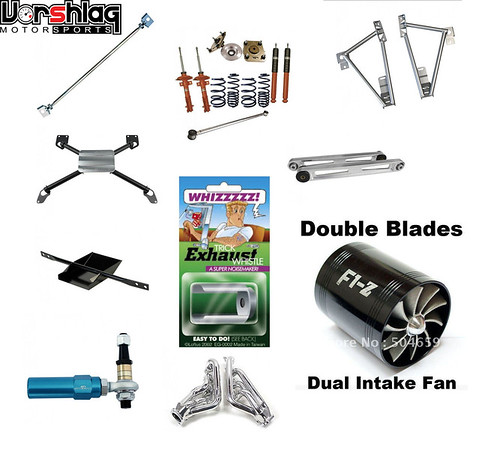
According to the internet, there's 1000 bolt on parts every S197 must buy. Most of the stuff offered for these cars are better at wallet lightening than anything else. I am honestly shocked at the number of nearly worthless bolt-on doo-dads there are for this car. Some of the stuff out there is just made to make somebody money. I lump about 75% of the S197 aftermarket parts offerings in with exhaust whistles and intake fans...
I did take Mr. Hidley at his word on his statement that Ford built roll steer into the car. I can't prove it or disprove it, which is why when I posted the comment I started it out with the part that you deleted.
Interesting info Dave posted though about putting it on the alignment machine and testing it. He came up with the same conclusion as you. Good to know.

I would also like to add, our car is currently on some test/prototype front springs....and it is sitting at 26.70" fender height (from the OEM 29"~)
We have our own rack / equipment here, and we set alignment and bumpsteer here in house on our rack.
Our 2011 Mustang, our 2005 Mustang, and 2007 Mustang have never "needed" a bumpsteer adjustment, in terms of actual driving / experience.
On paper, from our measurements, we have noticed that when lowering the car more than 2"~ up front, you will get a red-flag in terms of positive bump during suspension movement (full compression, to full droop)
When this "on paper" positive bump is in action, on pavement, it is honestly not very noticeable. I will attribute this simply to the OEM FLCA and Tie-Rod design.
Even testing various length ball joints, combined with various ride heights, we have not seen a major need in addressing the bump steer.
THAT said, when we DO actually notice bumpsteer - it is typically on combos that are lowered substantially, combined with some serious toe-in settings up front.
Technically, if you are lowering the car more than 1.5"...it is a good idea to lengthen the tie-rod to compensate for a conflict in arc changes between the FLCA and Tie-Rod.
At the end of the day, it really just depends on many variables. I've got customers who have some extreme combos, who don't need bumpsteer correction....and I've got some who do. As a matter of fact, I just helped a customer with his SCCA car, dial out his positive bump that he was experiencing.
We have our own rack / equipment here, and we set alignment and bumpsteer here in house on our rack.
Our 2011 Mustang, our 2005 Mustang, and 2007 Mustang have never "needed" a bumpsteer adjustment, in terms of actual driving / experience.
On paper, from our measurements, we have noticed that when lowering the car more than 2"~ up front, you will get a red-flag in terms of positive bump during suspension movement (full compression, to full droop)
When this "on paper" positive bump is in action, on pavement, it is honestly not very noticeable. I will attribute this simply to the OEM FLCA and Tie-Rod design.
Even testing various length ball joints, combined with various ride heights, we have not seen a major need in addressing the bump steer.
THAT said, when we DO actually notice bumpsteer - it is typically on combos that are lowered substantially, combined with some serious toe-in settings up front.
Technically, if you are lowering the car more than 1.5"...it is a good idea to lengthen the tie-rod to compensate for a conflict in arc changes between the FLCA and Tie-Rod.
At the end of the day, it really just depends on many variables. I've got customers who have some extreme combos, who don't need bumpsteer correction....and I've got some who do. As a matter of fact, I just helped a customer with his SCCA car, dial out his positive bump that he was experiencing.
Thanks for the great replies!
New list: (italic has been changed)
Suspension
Camber Caster Plates
Coilovers Of Some Kind TBD (MUST have helper springs)
Whiteline Watts Link
Whiteline LCAs
Whiteline LCA Relocation Brackets
BMR UCA w/ Relocation Bracket
BMR Control Arms AA025?
Steeda Bumpsteer Kit
Brakes/Wheels/Tires
14" Brembo BBK on front (stock rear)
18x9 PF01 Wheels (or similar)
Dunlop ZII 275mm tires
I'll research coilovers, (and probably never find THE answer) and BMR: anything I should know about these front control arms? Is the aa025 the right one for me?
This will be driven to the track, and around town somewhat. I have a truck, but prefer to just drive the track car around and have heard really bad things about using rod ends on the street from the BMW crowd.
Let me know, Thanks!
New list: (italic has been changed)
Suspension
Camber Caster Plates
Coilovers Of Some Kind TBD (MUST have helper springs)
Whiteline Watts Link
Whiteline LCAs
Whiteline LCA Relocation Brackets
BMR UCA w/ Relocation Bracket
BMR Control Arms AA025?
Steeda Bumpsteer Kit
Brakes/Wheels/Tires
14" Brembo BBK on front (stock rear)
18x9 PF01 Wheels (or similar)
Dunlop ZII 275mm tires
I'll research coilovers, (and probably never find THE answer) and BMR: anything I should know about these front control arms? Is the aa025 the right one for me?
This will be driven to the track, and around town somewhat. I have a truck, but prefer to just drive the track car around and have heard really bad things about using rod ends on the street from the BMW crowd.
Let me know, Thanks!
sheizasosay
Alive
- Joined
- Jun 28, 2011
- Posts
- 1,024
- Reaction score
- 4
I don't drift, but if I was gonna try, my formula would like this:
http://www.bmrsuspension.com/?page=products&productid=158
http://www.bmrsuspension.com/?page=products&productid=189
http://www.amazon.com/Detroit-Locke...id=1392477024&sr=1-3&keywords=ford+8.8+locker
on low profile tires 30-35 series.
Then again, I don't drift.
http://www.bmrsuspension.com/?page=products&productid=158
http://www.bmrsuspension.com/?page=products&productid=189
http://www.amazon.com/Detroit-Locke...id=1392477024&sr=1-3&keywords=ford+8.8+locker
on low profile tires 30-35 series.
Then again, I don't drift.
Ike;1969379 Coilovers Of Some Kind TBD[/I said:(MUST have helper springs)
ANy reason for the tender springs? I think lots of S197 setups don't use them...mine seem to do ok without
sheizasosay
Alive
- Joined
- Jun 28, 2011
- Posts
- 1,024
- Reaction score
- 4
ANy reason for the tender springs? I think lots of S197 setups don't use them...mine seem to do ok without
I'm wandering too. First thing that came to mind was that he was researching old treads and got to the Eibach Multipro 2 coilover thread that is in this sub-section and there was a big ole dialogue about helper vs tender and what was what. Other than that, I couldn't guess either.
I'm wandering too. First thing that came to mind was that he was researching old treads and got to the Eibach Multipro 2 coilover thread that is in this sub-section and there was a big ole dialogue about helper vs tender and what was what. Other than that, I couldn't guess either.
It would seem to me they serve no other purpose than to jack up your stack-up height, but I could be wrong.
FWIW, I have maybe a millimeter of "play" with my front suspension at full droop with an 8" spring

neema
Member
It would seem to me they serve no other purpose than to jack up your stack-up height, but I could be wrong.
FWIW, I have maybe a millimeter of "play" with my front suspension at full droop with an 8" spring
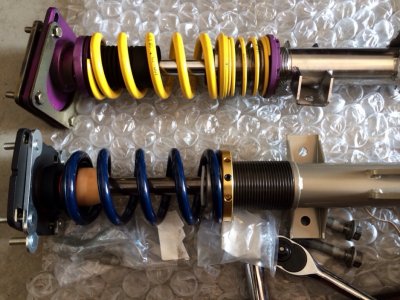
I think that's the idea. KW uses a tender/helper on both the front and rear and it takes any "slop" out from using a shorter spring. Cortex doesn't use a helper spring and it has about an inch of space between spring and top hat at full droop.
See below for the helper spring.

Thinkkker
Member
Now I don't say this about the bumpsteer kits lightly - as I've tracked dozens of lowered S197 Mustangs without bump steer kits and didn't notice the massive bumpsteer some make you think occurs.
I've never done anything on mine. I havent noticed the bump steer. Though, maybe I have just limited my suspension working enough that it doesn't matter

A helper spring, is a similar approach, to company's that design/offer a dual rate standard replacement spring (Like us/BMR)
A tender and helper spring often look very similar.
A helper spring, "helps" maintain spring tightness/pressure at full droop. This helps with ride quality, and ensures the spring stays placed firmly in the mount at all times. This "helping" spring also works VERY well for drag racers.
A tender spring, is simply a another spring, as pictured above (tender and helper springs often look the same) - that is used to produce a progressive overall spring rate. So, for example, the primary coil spring would be a 250lb/in rate....and the tender spring may be a 175lb/in rate.
The tender spring will also act as a helper.....but a much more "harsh" helper.
A tender and helper spring often look very similar.
A helper spring, "helps" maintain spring tightness/pressure at full droop. This helps with ride quality, and ensures the spring stays placed firmly in the mount at all times. This "helping" spring also works VERY well for drag racers.
A tender spring, is simply a another spring, as pictured above (tender and helper springs often look the same) - that is used to produce a progressive overall spring rate. So, for example, the primary coil spring would be a 250lb/in rate....and the tender spring may be a 175lb/in rate.
The tender spring will also act as a helper.....but a much more "harsh" helper.
A helper spring, is a similar approach, to company's that design/offer a dual rate standard replacement spring (Like us/BMR)
A tender and helper spring often look very similar.
A helper spring, "helps" maintain spring tightness/pressure at full droop. This helps with ride quality, and ensures the spring stays placed firmly in the mount at all times. This "helping" spring also works VERY well for drag racers.
A tender spring, is simply a another spring, as pictured above (tender and helper springs often look the same) - that is used to produce a progressive overall spring rate. So, for example, the primary coil spring would be a 250lb/in rate....and the tender spring may be a 175lb/in rate.
The tender spring will also act as a helper.....but a much more "harsh" helper.
Never knew there was a difference!

Sky Render
Stig's Retarded Cousin
At it's most basic, a "drift" setup is very similar to a corner-carving setup. However, if you really want to get serious into drifting, there begin to be some differences.
I suggest reading some of the articles here:
http://www.motoiq.com/Tech/TheUltimateGuidetoSuspensionHandeling.aspx
EDIT:
Also, Cortex uses Koni dampers for their lowest-price coil-overs. And so does Ground Control. And those Cortex coil-overs look an awful lot like GC coil-overs...
I suggest reading some of the articles here:
http://www.motoiq.com/Tech/TheUltimateGuidetoSuspensionHandeling.aspx
EDIT:
Also, Cortex uses Koni dampers for their lowest-price coil-overs. And so does Ground Control. And those Cortex coil-overs look an awful lot like GC coil-overs...
Never knew there was a difference!
Glad I could learn ya!
EDIT:
Also, Cortex uses Koni dampers for their lowest-price coil-overs. And so does Ground Control. And those Cortex coil-overs look an awful lot like GC coil-overs...
The rears on the Cortex are true coilovers... Any strut using Koni inserts is going to look pretty much the same.

Whiskey11
SCCA Autoscrosser #23 STU
- Joined
- Feb 24, 2012
- Posts
- 1,644
- Reaction score
- 4
At it's most basic, a "drift" setup is very similar to a corner-carving setup. However, if you really want to get serious into drifting, there begin to be some differences.
I suggest reading some of the articles here:
http://www.motoiq.com/Tech/TheUltimateGuidetoSuspensionHandeling.aspx
EDIT:
Also, Cortex uses Koni dampers for their lowest-price coil-overs. And so does Ground Control. And those Cortex coil-overs look an awful lot like GC coil-overs...
And they aren't the same. I made a similar comment when I was chatting with Filip about the Torque Arm setup and his coilovers. The inserts could be the same but he manufacturers his own strut body which has an optional higher offset for the holes in the spindle ears to allow for more inboard tire room up front. It allows him to run the 18x10.5 ET47 Enkei PF01's he has on his page front and rear without spacers. On the GC Coilovers, the swaybar mounting plate is only on one side of the strut body, making them specific to a side whereas Cortex uses a universal strut body (simplifying construction and installation).
The valving is entirely different too from what he has told me. Also the whole coilover thing in the rear. I also think his Koni's are monotubes whereas GC uses twintubes. Don't quote me on that though.
Cortex:

Ground Control:

I too thought they were the same.... Griggs Racing has something silly similar to the GC setup as well but probably isn't. I do think the camber plates are GC though for Cortex. Same Green poly donut under the spring plate.
Last edited:
Whiskey11
SCCA Autoscrosser #23 STU
- Joined
- Feb 24, 2012
- Posts
- 1,644
- Reaction score
- 4
According to neema, who recently posted his Cortex install (albeit with JRi shocks), the caster/camber plates were manufactured by Maximum Motorsports.
The ones pictured above are definitely NOT MM plates. MM wouldn't have the "free hanging" stud holders like GC uses because they are a huge PITA. Also, MM uses a spherical bearing at the center with an articulating spring perch (when used with coilovers) whereas the ones pictured above use a poly donut, green in color, that doesn't articulate easily by hand. Finally, those camber plates pictured above are camber only, MM is caster/camber. Whether or not the picture is up to date (it's straight from Cortex's page) is a different story.
The ones pictured above are definitely NOT MM plates. MM wouldn't have the "free hanging" stud holders like GC uses because they are a huge PITA. Also, MM uses a spherical bearing at the center with an articulating spring perch (when used with coilovers) whereas the ones pictured above use a poly donut, green in color, that doesn't articulate easily by hand. Finally, those camber plates pictured above are camber only, MM is caster/camber. Whether or not the picture is up to date (it's straight from Cortex's page) is a different story.
I'm not arguing what is in the picture. Here is the post by neema. I also don't know if he is correct that they are from MM.
Whiskey11
SCCA Autoscrosser #23 STU
- Joined
- Feb 24, 2012
- Posts
- 1,644
- Reaction score
- 4
I'm not arguing what is in the picture. Here is the post by neema. I also don't know if he is correct that they are from MM.
The ones he has are definitely MM! Go figure!

Similar threads
- Replies
- 18
- Views
- 601


- Replies
- 11
- Views
- 1K

- Replies
- 6
- Views
- 587


Latest posts
-

-
-
Should I stay away from 2005 to 2008 (spark plugs)?
- Latest: 2019Chieftain-no-more
-


Support us!
Support Us - Become A Supporting Member Today!
Click Here For Details