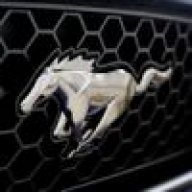
Your cooling mods and results?

Pentalab

Senior Member
Joined
Mar 5, 2013
Posts
5,500
Reaction score
1,312
I swear, you post up more unsubstantiated bullshit than anyone.

Sent from my toilet using Tapatalk

The oem upper grilles on these cars are a joke..esp the 10-12 cars. A bunch of us tried it..and it works. Everybody who tried it also saw a slight increase in boost. The increase in airflow through the HE /eng rad etc is substantial. Try it yourself. The 05-09 cars would get a 9 bar grille.
 

Sky Render

Stig's Retarded Cousin
Joined
Feb 24, 2011
Posts
9,463
Reaction score
358
Location
NW of Baltimore, MD
I'm not arguing that a different grille will not increase airflow. I am arguing your unsubstantiated, bullshit claim that the stock grille blocks 80% of the airflow to the stock grille.
 

Pentalab

Senior Member
Joined
Mar 5, 2013
Posts
5,500
Reaction score
1,312
I'm not arguing that a different grille will not increase airflow. I am arguing your unsubstantiated, bullshit claim that the stock grille blocks 80% of the airflow to the stock grille.

Measure the surface area of all the slots in the oem grille....then compare that to the entire surface area. My 2010 upper grille consist of 4 narrow slots on either side of the pony. Then 7 more on either side of those. So 11 slots in total on either side of the pony. Grand total of 22 x narrow slots. Do the maths yourself.

No point in bigger rads, bigger fans, etc....then block most of the upper grille off. Then folks wonder why they have cooling issues with the HE for their blower.


I find it amusing that the 13-14 GT-500 doesn't even have an upper grille. I was reading somewhere about the exploits of folks tracking their boss 302 cars last summer. The boss grille had the removable covers for the fog deletes. Even with the covers removed, they still couldn't get enough air through the grille..and >300 deg F oil temps resulted..+ sky high coolant temps. Their fix was to temporally remove the upper grille entirely.....problem solved.

The oem headlights are poor at night..so I also use the foglamps. I replaced the oem headlights with 8000K hids. They got installed at the same time as the 7 bar upper grille. The pair of 8k hids is far brighter than the oem headlights + oem foglamps combined.

I was leery about using a 7 bar grille...cuz I would lose my foglamps. The oem headlights by themselves are semi useless, and dangerous at best.

Whoever designed the oem upper grille on the 10-12 cars dropped the ball...fubar. It's not engineered, it's ill conceived.
 

Dubstep Shep

WUB WUB VROOM VROOM
Joined
Jun 22, 2013
Posts
3,382
Reaction score
0
Location
Houston, TX
I can tell you for a fucking fact 80% of the grill isn't blocked off from the factory. I can go count the number of honeycombs that are and aren't filled for proof if need be. There are not four blocked honeycombs for every open one.

This is besides the point that an 80% reduction in flow area DOES NOT correspond to an 80% reduction in flow. Doubling the cross sectional area of a flow path doesn't double the flow. There are diminishing returns there.
 

Wicked GT

OCD with ADD...
Joined
Apr 24, 2011
Posts
7,487
Reaction score
4
Location
Omaha, NE
I was so thrown off with the 80% closed comment I actually counted my honeycomb openings. I only counted the honeycomb section where at least 75% of it was open to view. There are 48 honeycombs between the foglights on the 2012 grille. 22 of those honeycombs are open and allow air in to the engine compartment. Based on that you are looking at closer to 45% open, not 20%... Now, I didn't actually take measurements of the entire grill surface and account for the exterior sections being closed, the fog lights, the pony emblem, etc.
 

Sky Render

Stig's Retarded Cousin
Joined
Feb 24, 2011
Posts
9,463
Reaction score
358
Location
NW of Baltimore, MD
I can tell you for a fucking fact 80% of the grill isn't blocked off from the factory. I can go count the number of honeycombs that are and aren't filled for proof if need be. There are not four blocked honeycombs for every open one.

This is besides the point that an 80% reduction in flow area DOES NOT correspond to an 80% reduction in flow. Doubling the cross sectional area of a flow path doesn't double the flow. There are diminishing returns there.

Holy crap, write this down. 15 May 2014: Vince agrees with Shep. :highfive:
 

Vorshlag-Fair

Official Site Vendor
Joined
Nov 12, 2010
Posts
1,592
Reaction score
116
Location
Dallas, TX
OK, so.... I feel like there is a lot of myth and speculation surrounding these S197 cars with respect to cooling - most notably around these parts: grills, brands of radiators, oil coolers, and hoods.

First of all, the GT500s are terrible track cars. The supercharged engine is a massive heat soaked mess. It is a great drag race car. The 5.0 Boss302 and GT are the only track worthy models of the Mustang in the past 4 years, so I'm just ignoring the GT500.

DSC_8930-M.jpg


Of these two models the GT's don't seem to have overheating problems but the Boss302s sure do. They overheat with mild track use as delivered from the factory and it only gets worse they harder they are driven on track, especially at high altitude and in high ambient temps. Ford has sent out a considerable number of free parts and upgrades to Boss302 owners that had overheating issues - kudos to them for some good customer service. And after enough parts get changed out they seem to overheat less. But they rarely achieve the rock solid cooling of the GTs.

For the Boss302s I've see all sorts of tricks and doo-dads, special hoods and grills, but the 2011-14 GTs just have virtually no overheating problems with the same motor and power levels. Why is that? What is different on the Boss302?

Two things pop out to us, and they are things we have removed from Boss302s that see track use - with positive results:

boss302-oil-cooler.jpg


1. The factory coolant/oil "cooler" is not a very good design that, we feel strongly, should be removed. It is an oil heater. The GTs don't have this design and they don't overheat on track. So....

Untitled-1%20copy-M.jpg


2. The transmission "scoop" cooler. The picture above is a Shelby piece, but the Boss302 unit is just as bad.

But wait, how could this shovel mounted under the car negatively affect the engine/oil cooling? Simply from the massive disruption of airflow under the car it creates. See, the "scoop" is trying to divert under car air flow up towards to the Getrag MT-82 train wreck of a transmission (that can and does overheat badly - we turned 3rd gear blue before it failed). Well what does that scoop really do? Its a huge addition to drag, and we think it creates a high pressure area under the car that then backs up airflow trying to exit the engine bay... all of that air coming into the upper and lower front grills needs somewhere to GO. In a stock Boss302 this airflow has to pass through the radiator then exit under the car.... and very possibly it gets bogged down in the turbulence caused by the "trans scoop".

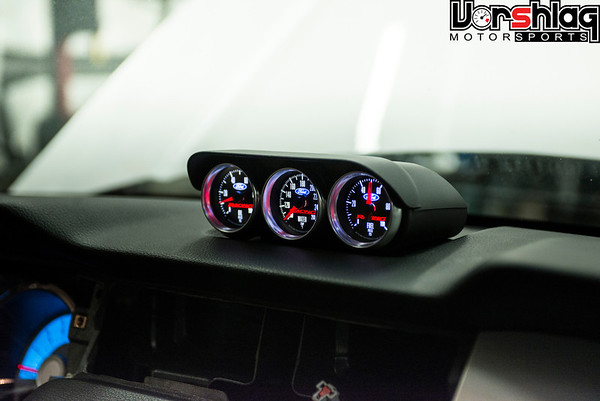
Now, we haven't done scientific pressure monitoring or wind tunnel testing on the trans scoop, of course. But we HAVE removed these silly trans scoops on some of our customers' Boss302s and some overheating complaints have been reduced. We've also replaced the Boss302 coolant-based oil cooler with the GT radiator hoses added an external fluid-to-air oil cooler with very positive results. We done both to a customer's heavily tracked boss302, which we also added external gauges to, and oil temps dropped markedly.

_DSC1655-M.jpg


Venting the hood (aka: Tiger Racing hood) helps the Boss302s so much - and again this is speculation - because we think it allows the backed-up airflow from from the engine bay to finally exhaust out, which the pooper scooper is blocking.

06-tiger-racing-boss-302s-M.jpg


The Boss302 guys flock to the Tiger Racing hoods because it makes such a huge difference for them. And it looks "cool". If you already have this hood - great. It works. But maybe first you guys with overheating Boss302s could go and unbolt that ding-dong trans scoop under the car and do another track event - and then watch the temps. This one simple "de-mod" alone could make as much or more of a difference as the TR hood, before you drop $2K on the hood + bodywork + fitting + painting. Removing the pooper scooper would obviously cost a lot less, but also crack a lot less, and fit better than these hoods do, in my opinion.

_DSC1082-M.jpg

This Pikes Peak ~630 whp Subaru we're working on now has a hood vent similar to the GT500 style

Another upgrade is to remove the factory oil cooler and possibly add an external oil cooler. There are several kits out there around $1000, complete. Maybe try the much larger all-aluminum Mishimoto (or Ford Racing or another) radiator. At least the Mishimoto unit is cheap (right now MAP is $247). And if you want to vent the hood you could just add the GT500's ~$75 plastic hood vent, up at the front of the engine bay in a low pressure zone (not so far back as the Tiger Racing hood's vents, which are a higher pressure area - that won't extract as well). That's my opinion...

DSC_5259-M.jpg


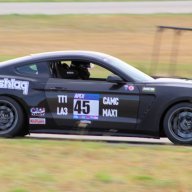
For reference, we had no oil cooler nor an aftermarket radiator in our Mustang GT for the first 3 years of track use. With 430+ whp and ambient temps often above 100°F - and usually 2 people double-driving this car at each event - for 30+ events per year, we had no oil or coolant overheating problems, while setting track records. No problemo. We use 15W50 Mobil1 oil and change it religiously. That was the extent of the changes to the cooling or oiling for the first 3 years.

10257914_687315381334942_2984025744976640444_o-M.jpg


When we wanted to make a more functional front splitter we completely blocked off the upper grill (oh n0es!!11!!one!!) and all of the incoming airflow for the radiator now comes from just the lower opening, sealed to the a/c condenser (gasp!) and radiator.

_DSC0783-M.jpg


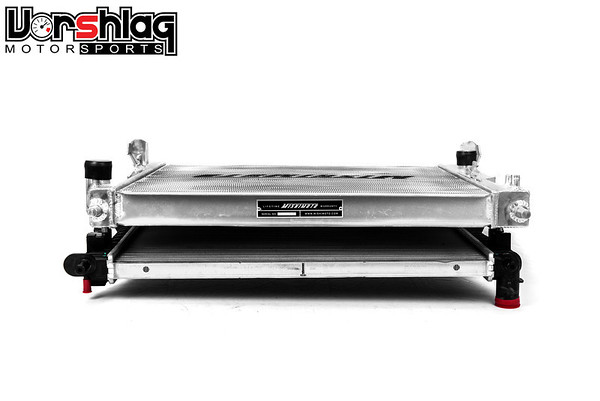
We upgraded to a Mishimoto aluminum unit at the same time as we updated the front aero. Why? Because it was so cheap and we wanted to test it out. Of course we have reverse ducted the hood, which also works wonders. But the engine cooling is now rock-freakin-solid. Still no oil cooler, either.

_DSC0746-M.jpg

The stock GT radiator with plastic end caps is on the bottom. The ~$250 Mishimoto radiator is on top

Ford Racing and others make beautiful radiators, but most of those cost double what the Mishimoto S197 unit does (or more - some are $700+). Sure, one or two of them have an internal coolant-to-oil cooler stuffed inside one of the end tanks, but again - not a big fan of that type of "oil cooler". Nothing beats a dedicated, external air-to-oil cooler for effectiveness on track.

i-6BRr4bH-M.jpg


Anyway, that's my two cents. Take that series of observations as you will... :hi:

Cheers,
 
Last edited:

Sky Render

Stig's Retarded Cousin
Joined
Feb 24, 2011
Posts
9,463
Reaction score
358
Location
NW of Baltimore, MD
When we wanted to make a more functional front splitter we completely blocked off the upper grill (oh n0es!!11!!one!!) and all of the incoming airflow for the radiator now comes from just the lower opening, sealed to the a/c condenser (gasp!) and radiator.

LOL
 

ddd4114

Member
Joined
May 22, 2011
Posts
353
Reaction score
29
Location
Columbus, OH
Of these two models the GT's don't seem to have overheating problems but the Boss302s sure do.

...

For reference, we had no oil cooler nor an aftermarket radiator in our Mustang GT for the first 3 years of track use. With 430+ whp and ambient temps often above 100°F - and usually 2 people double-driving this car at each event - for 30+ events per year, we had no oil or coolant overheating problems, while setting track records. No problemo. We use 15W50 Mobil1 oil and change it religiously. That was the extent of the changes to the cooling or oiling for the first 3 years.
What do you consider "overheating"? When I first started tracking my base GT, I saw coolant temperatures around 230 degF and oil temperatures reaching almost 310 degF. At that point, the only changes I made from the OEM setup were brake pads, brake ducts, and NT-05 tires. If the Boss 302's run a lot hotter than that, I'm really surprised that Ford continued to release them after the first year without beefing up the cooling system. It's certainly possible that it was a gross oversight, but given the intended use for them, I have to be skeptical.

What kind of coolant/oil temperatures did you see before you changed the cooling system?
 

frank s

at Play
Joined
Jul 25, 2010
Posts
537
Reaction score
16
Location
Paradise
In the early 1970s one of the popular automotive magazines used to try raising their image by indulging in occasional publication of a learnéd-engineer article on some aspect of performance cars and their modification.

Such a piece left me with one understanding: the any part of the grille opening in the front of a car that is not in a direct line of attack from incoming air at highway-and-up speeds is wasted and anti-aerodynamic. They showed flow rates and I was convinced enough to make and install grill covers for the non-direct-line portions on my Vega GT. There was no change in cooling performance (oil and water temps were the same, before and after) and the car gained a couple-three mph on the Riverside International Raceway 1.1-mile back straight.

Does anyone reckon that more modern cars are different enough that this direct-line stuff is no longer true?

VegCpRIRS.jpg
 

ddd4114

Member
Joined
May 22, 2011
Posts
353
Reaction score
29
Location
Columbus, OH
In the early 1970s one of the popular automotive magazines used to try raising their image by indulging in occasional publication of a learnéd-engineer article on some aspect of performance cars and their modification.

Such a piece left me with one understanding: the any part of the grille opening in the front of a car that is not in a direct line of attack from incoming air at highway-and-up speeds is wasted and anti-aerodynamic. They showed flow rates and I was convinced enough to make and install grill covers for the non-direct-line portions on my Vega GT. There was no change in cooling performance (oil and water temps were the same, before and after) and the car gained a couple-three mph on the Riverside International Raceway 1.1-mile back straight.

Does anyone reckon that more modern cars are different enough that this direct-line stuff is no longer true?

VegCpRIRS.jpg
I was wondering if somebody was going to post something like this... :thumb:

From the factory, the grille opening in anything short of a super car will be very small for aerodynamic purposes, not due to bad engineering. You'll even see shutter grilles used to improve fuel economy on modern cars. This is not a foreign concept to race cars either.

The key is that mass flow is always conserved. If you don't have much area for air to exit the engine bay, then opening the grille will not help much. If you add extracting vents in areas of low pressure, then you will see a cooling benefit at speed.

EDIT: On second thought, even super cars aren't an exception. It just depends on how well the ducting is designed and how much power needs to be rejected.
 
Last edited:

NoTicket

Member
Joined
Jun 2, 2013
Posts
303
Reaction score
0
Add a grill, a boss 302 oil cooler and a trans scoop -> problem solved.

Nailed it.
 

NoTicket

Member
Joined
Jun 2, 2013
Posts
303
Reaction score
0
Should I have put /sarcasm or something after? Dry humor doesn't fly in these forums.
 

Pentalab

Senior Member
Joined
Mar 5, 2013
Posts
5,500
Reaction score
1,312
I was so thrown off with the 80% closed comment I actually counted my honeycomb openings. I only counted the honeycomb section where at least 75% of it was open to view. There are 48 honeycombs between the foglights on the 2012 grille. 22 of those honeycombs are open and allow air in to the engine compartment. Based on that you are looking at closer to 45% open, not 20%... Now, I didn't actually take measurements of the entire grill surface and account for the exterior sections being closed, the fog lights, the pony emblem, etc.

Well...factor in the pony, fog lamps, and portions outboard of each foglamp. Then factor in the honeycomb structure itself. Your 45% drops way down..like less than half again.
 

claudermilk

Senior Member
Joined
Jul 12, 2012
Posts
1,840
Reaction score
1
Location
SoCal
Excellent post, Terry. That certainly helps focus future wishlist items. I know i had already wondered about the wisdom of the Boss oil cooler setup--it seems dumb just looking at it & I suspected the exact issues you have stated seeing. So that is now definitively on the "do not buy" list. For now it's do nothing & monitor. For the future, perhaps the Mishimoto radiator (already on my radar) as cheap insurance. Later if there is a need, a separate oil cooler setup with t-stat. You analysis & theory on the trans scoop is interesting as well and makes logical sense--so something else to not throw money at.


In the early 1970s one of the popular automotive magazines used to try raising their image by indulging in occasional publication of a learnéd-engineer article on some aspect of performance cars and their modification.

Such a piece left me with one understanding: the any part of the grille opening in the front of a car that is not in a direct line of attack from incoming air at highway-and-up speeds is wasted and anti-aerodynamic. They showed flow rates and I was convinced enough to make and install grill covers for the non-direct-line portions on my Vega GT. There was no change in cooling performance (oil and water temps were the same, before and after) and the car gained a couple-three mph on the Riverside International Raceway 1.1-mile back straight.

Does anyone reckon that more modern cars are different enough that this direct-line stuff is no longer true?
I was wondering if somebody was going to post something like this... :thumb:

From the factory, the grille opening in anything short of a super car will be very small for aerodynamic purposes, not due to bad engineering. You'll even see shutter grilles used to improve fuel economy on modern cars. This is not a foreign concept to race cars either.

The key is that mass flow is always conserved. If you don't have much area for air to exit the engine bay, then opening the grille will not help much. If you add extracting vents in areas of low pressure, then you will see a cooling benefit at speed.

EDIT: On second thought, even super cars aren't an exception. It just depends on how well the ducting is designed and how much power needs to be rejected.
Very good points. I've been thinking about fabbing up a custom grille and this is something I'll need to think about if/when I get around to it. The idea is as much for appearance as to open up the grille, but perhaps that isn't the best of ideas after all--maybe add in some ducting/baffles to direct all the air to the radiator if I do follow through.
 

Support us!

Support Us - Become A Supporting Member Today!

Click Here For Details

Back
Top