since i've been on brakes, i have a ??

2013kAB

Member
Joined
May 11, 2013
Posts
81
Reaction score
0
since i've been on the subject of brakes of late, i have a question. when doing a track day typically novices over work their brakes (at least i did, to the point of smelling them for the first 3-4 laps haha). that was probably due to putting on the brakes a lot sooner and not as hard than i should have right? in other words, when driving on the street you tend to put the brakes on lightly so as to decelerate comfortably to a stop sign or whatever. this is what novices typically do on track?

what a novice should learn is to brake as hard as the car will, which minimizes the amount of time the brakes are engaged and hope they've timed it correctly to make the turn? and they should learn to carry more speed into a corner.

so in a race situation, does a driver ever get to a point where he/she needs to "go easy" on the brakes for endurance purposes and if yes, how do they "go easy"? does that mean they have to slow their approach speed (lift off the throttle sooner or at all and coast a bit?) or brake early etc??

thanks,
 

SoundGuyDave

This Space For Rent
Joined
Apr 9, 2007
Posts
1,978
Reaction score
29
If you look one line up from your new posting, you'll find this:

http://s197forum.com/forum/showthread.php?t=93622

Read the whole thing, but pay particular attention to the braking section...

Recap:

Yes, what you propose as a braking technique is called "threshold braking" and has the effect of decelerating the car the most efficiently, thus generating the least heat. As for "hope they've timed it correctly..." that question is ALSO answered... Use braking point references, and adjust them as needed.

With respect to the "go easy" part, managing your junk on track is the heart of the art of endurance racing. First, start with the right pad compound, to get the maximum braking force with minimum heat/wear for your driving style, and then if you need to adjust your pace, try shifting at around 6200RPM (redline) rather than when you hit the limiter. This in essence puts you into a short-shifting strategy, which yields less fuel consumption, at the expense of longer lap times. It also lowers your terminal velocity into the braking zone, which will need to be adjusted to suit the newer, slower entry speed. After all, you still want to carry that same 95% through the corner...

Most important things about braking, though are smoothness and consistency. Make sure you take that quarter-second or so to go from initial contact with the pedal to full application pressure, don't just jump on (or off!) the pedal. Make sure you brake the same way, every time... Same pedal application rate, same pedal pressure, same reference point on the track.
 

2013kAB

Member
Joined
May 11, 2013
Posts
81
Reaction score
0
thanks. i forgot where i read about threshold braking! will continue to study that _whole_ sticky.

as for my "pro" questions... i think ultimately what i was getting at is that just because the hardware and setup is x% better on a race prepared car, you really still do have limits in all areas. eventually something is going to get stressed. i know that's kind of obvious, but i'm just thinking it through.
 

SoundGuyDave

This Space For Rent
Joined
Apr 9, 2007
Posts
1,978
Reaction score
29
thanks. i forgot where i read about threshold braking! will continue to study that _whole_ sticky.

as for my "pro" questions... i think ultimately what i was getting at is that just because the hardware and setup is x% better on a race prepared car, you really still do have limits in all areas. eventually something is going to get stressed. i know that's kind of obvious, but i'm just thinking it through.
I do endurance racing, and so far, with a basic, solid brake package, I've had NO issues with on-track fade or heat management. In fact, the two "weak points" on the car are the stock fuel tank and tire management, not the brakes. My kit right now is really pretty simple: GT500 Brembos up front with 3" passive ducts, stock 2006 rear calipers (no dust shields), Steeda lines, Motul RBF600 fluid (maintained religiously!) and Hawk DTC-60 pads on all four corners. Ford or Centric rotors. I will admit, however, that we do have a plan in place in the event we boil the fluid... I use speed-bleeders, and there's enough space around the spokes of the wheel to hang a tube on the outside bleeder and blow out the "bad stuff" on a pit stop without having to pull the wheel off. Roughly 45 seconds per corner, and another 45 to top off the master, adding "only" a tic over two minutes to the stop. The bottom line, though, is that a properly engineered brake package is just not likely to be the weak link. Bigger rotors means an increase in mass, which in turn means more heat capacity. Less car weight means less energy is needed to slow the mass, and there is a corresponding decrease in thermal energy applied to the rotor. Do both, and brakes become a fairly distant concern.

I did watch one of the DP teams at Daytona (24hrs) do brake service, and it was slick.... Car rolls in, air jacks pop it up, yank the wheels, while the driver holds pressure on the brake pedal. Disconnect a Staubli dry-break fitting in the front brake hose, pull the two bolts that mount the caliper to the radial mount, and toss the whole assembly aside. Replace with a new, pre-bedded, pre-bled, pre-pressurized rotor and caliper assembly, reconnect the dry-break fitting, toss on a new wheel and tire, drop the air jacks and away they went. Total time: 38 seconds!

Bottom line is that thermal management is the key to keeping brakes alive. Even the NASCRAP boys can manage a 4-hour race without having to do brake maintenance, and most of them are limited to 12.5-13" rotors on 3600lb cars. And yes, they do use brakes! Plenty of glowing rotors, even with dual or triple ducts with blowers inline.
 

2013kAB

Member
Joined
May 11, 2013
Posts
81
Reaction score
0
Wow ok. So the hardware can and does push the limits really far out. Hm.
 

jayel579

Member
Joined
Oct 15, 2010
Posts
401
Reaction score
0
Location
North Jersey
Great write up Dave, I never saw that.

For the OP, in regards to braking I think the biggest problem for novice drivers on the track in getting out of "street" braking method. Brake use on the track is completely different than on the street. If you are "street" braking than this is when you will run into over heating, pad wear, rotor wear, fluid issues. It is a technique that you'll have to work with your instructor on the track to understand this. Dave mentions this with his "touch-press" method, hard to really describe in a write up though he explained it better then I could but is more of a learn as you do it technique. This method will translate well once you start to trail brake in particular corners at the tracks you go to and then help extend the life of your tires as well.
 
Last edited:

SoundGuyDave

This Space For Rent
Joined
Apr 9, 2007
Posts
1,978
Reaction score
29
Wow ok. So the hardware can and does push the limits really far out. Hm.


Yes, it can, and does... I had a buddy loan me his 2012 Brembo car for a session at a track day (stock fluid, ducts, Hawk HP+ pads, street tires), and I managed to boil the piss out of the fluid in four laps. Call it six HARD braking zones and four "mild" zones per lap. I flushed his whole system with Motul RBF600, and the car was good for the rest of the day... It's the whole package you need to look at, not the individual components. I think that if he had good fluid, though, it would only have been another lap or two before the pads would have started to melt. The HP+ stuff just isn't up to the kinds of temps generated at race pace with a heavy car. There's also a BIG difference in the amount of heat generated in the braking system going into a braking zone at 120MPH rather than at 90-105... HP+ is good enough for screwing around, or for novice-level speeds, but when you start pushing the pace, you can overstress them fairly quickly if you're on a brake-intensive track.
 

2013kAB

Member
Joined
May 11, 2013
Posts
81
Reaction score
0
well i think i have enough to chew on for a while until the next day.
 

Vorshlag-Fair

Official Site Vendor
Joined
Nov 12, 2010
Posts
1,592
Reaction score
116
Location
Dallas, TX
Yes, it can, and does... I had a buddy loan me his 2012 Brembo car for a session at a track day (stock fluid, ducts, Hawk HP+ pads, street tires), and I managed to boil the piss out of the fluid in four laps. Call it six HARD braking zones and four "mild" zones per lap. I flushed his whole system with Motul RBF600, and the car was good for the rest of the day... It's the whole package you need to look at, not the individual components. I think that if he had good fluid, though, it would only have been another lap or two before the pads would have started to melt. The HP+ stuff just isn't up to the kinds of temps generated at race pace with a heavy car. There's also a BIG difference in the amount of heat generated in the braking system going into a braking zone at 120MPH rather than at 90-105... HP+ is good enough for screwing around, or for novice-level speeds, but when you start pushing the pace, you can overstress them fairly quickly if you're on a brake-intensive track.

Agreed - good story, and one I've run into as well.

To the OP: you have to make sure every part in the braking system is up to track abuse. I stopped driving customer/student cars (esp. Mustangs) a while ago, because I seem to quickly find the weak link in their braking systems.

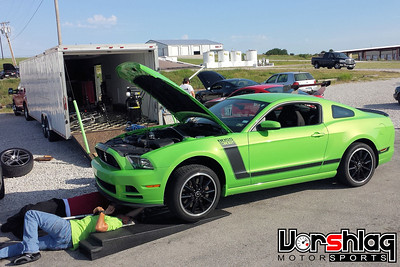
Me and one of my techs went to a track event last month here in Texas, at one of our "brake intensive" tracks (ECR). Hot day. We were testing the newly upgraded brakes on my 2013 GT (145" Brembos, Carbotechs, Motul, front brake ducting) and it was amazing. Was pounding out laps over 4 sessions that day without issue. Our 2011 GT was driven hard all day as well, by my wife, also without too much problem (she killed the front rotors by day's end, though - they were getting very thin and had a lot of weekends on them).

DSC_8949-S.jpg
DSC_9052-S.jpg


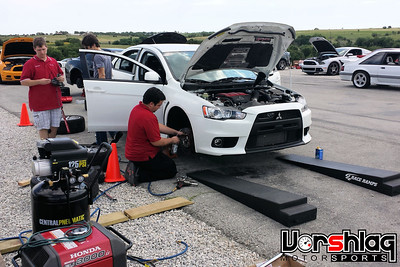
There were a lot of noobs at this event, drive new but mostly bone stock Mustangs. Even with instructors slowing them down, several of the new guys ran out of brakes in one or two sessions. We ended up doing full Motul RBF600 fluid flushes on several cars, one guy fried his pads, and we stayed busy all day long working on brakes...

20130629_085236-S.jpg
20130629_110137-S.jpg


In the first session of the day one of the students asked one of the experienced instructors to take a few laps in his 2012 Mustang GT (non-Brembo car). The instructor took a warm up lap (driving 5/10ths) then sped it up a little on the beginning of lap 2 (7/10ths) and drove right off the end of the hardest braking zone corner. He was shocked - "Man, I was barely pushing the car, didn't have two laps on it yet. It just lost the brakes completely!!! Pedal went to mush, I was pumping the brakes but nothing was happening."

Been there, done that. We looked at the car and both the fluid was boiled and the front pads were gone, turned to goo. Luckily no damage was done other than to ego. Student was really bummed, as he got ZERO laps himself (they gave him credit for a track day the next weekend). We brought spare track pads for S197s, but didn't have them for the non-Brembo front calipers in our trailer, so he went home early. He came by later the next week, picked up some Carbotechs and Motul from us, and I gave him some barely used 13.2" front rotors, and he was back at the track the next weekend - with no problems.

So the moral is - don't underestimate the basics. These cars come with crap consumables from the factory: the stock brake fluid and pads are for street use ONLY. Even noobs can ruin the old/stock fluid quickly, but often times they are rolling around so slow that it can then only take one lap by a more experienced driver to wreck the fluid/pads. And it doesn't take much to need front ducting, too.

Cheers,

 

2013kAB

Member
Joined
May 11, 2013
Posts
81
Reaction score
0
yeah, i've read about (mostly in this section) about pistons going away, rotors, pads, fluids... i think i'm heading in a good direction. the wilwoods, different pads, fluids. only thing is, i might not get new rotors for street use in time, so i think i might just head into my next event with the same rotors and upgraded pads/fluid. then i'll swap out back to street pads, order new "street" rotors for in between. i like to take things slow. and hey, as has been pointed out you pro guys and event organizers, a track day is about fun.

also, there is an opportunity to do a 1 day high performance driving school yet at road america, where i think it's mostly auto-x type stuff and car control. so i'm actually considering that in lieu of the next full track day in august. then i could do a track day again in october. when i'll be sure to have both street and track setup.

ha! i'm also still on factory all-seasons which won't change until late next year if at all. but next year could be a 4 event season for me so we'll see :)

i do regret that i never got involved 10 years ago with my wrx. i did a couple summers of auto-x which was cool no doubt, but for some reason it never occurred to me that ra was regularly rented out! i mean, i knew you could rent it. but it's not the type of thing they advertise and i never thought to look closer.

thanks all for feedback.
 

csamsh

Senior Member
Joined
Apr 9, 2012
Posts
1,598
Reaction score
3
Location
OKC
Just a note on rotors-

A few months back I started running Carbotech AX6 for street autocross pads, and XP16 (front) / XP12 (back) for track. So far I have switched to the track pads, back to the street pads, back to the track pads, and am back on the street pads again, all on the same set of rotors. I have had no ill effects. When I swap pads I go hammer the brakes for a couple minutes, and I'm good to go.

I don't know if this is unique to Carbotech as far as being able to swap compounds on the same rotors on a whim, but it sure is nice to not have to yank calipers and do rotors every time I swap pads.

If only the rears were Brembos too...
 

neema

Member
Joined
Aug 30, 2010
Posts
748
Reaction score
0
Location
Fresno, CA
Just a note on rotors-

A few months back I started running Carbotech AX6 for street autocross pads, and XP16 (front) / XP12 (back) for track. So far I have switched to the track pads, back to the street pads, back to the track pads, and am back on the street pads again, all on the same set of rotors. I have had no ill effects. When I swap pads I go hammer the brakes for a couple minutes, and I'm good to go.

I don't know if this is unique to Carbotech as far as being able to swap compounds on the same rotors on a whim, but it sure is nice to not have to yank calipers and do rotors every time I swap pads.

If only the rears were Brembos too...


I need to do this. I went from stoptech street pads (not even properly bedded and >100 miles!) to carbotech xp12s on the stoptech 380mm rotor and there are deposits or something causing a shimmy up front after one track event. i tried to drive around town to get the pads to abrasively clean the rotors, but I think the pads aren't aggressive enough. hopefully i can sand the rotors and pads to give them another shot. I was still able to make the pedal go soft with a 15" rotor, xp12/xp10s, ducting, and ate superblue. Guess I need to go for brembo/motul fluid.

I'd really like to switch pads without changing rotors. my rotors aren't exactly cheap.

Terry, it's awesome that you guys provide that track support. Anytime you want to move to California and service Laguna Seca/Thunderhill/Buttonwillow/etc..., you'll be more than welcome :)
 

sdunlap10

Junior Member
Joined
Aug 14, 2011
Posts
16
Reaction score
0
Location
Tampa
When you guys swap from street pads to track pads, where do you do it? Is it safe to be on track pads for the commute to/from the track (my 1 way trip is ~100 miles)?
 

SoundGuyDave

This Space For Rent
Joined
Apr 9, 2007
Posts
1,978
Reaction score
29
Csamsh and Neema: I know for a fact that Carbotech makes a street pad that is compatible with their XP series stuff, but a call to them would be in order to make sure you get the right stuff. And yes, the Carbotech stuff is super rotor-friendly, but that same lack of abrasiveness makes it quite tricky to wipe the old transfer layer off the rotor. Best bet may be to get a thousandth or two taken off on a brake lathe; kind of sounds like you got "something" on there that's not sympatico with your pad selection. At least one BMW dealership in the area that does motorsports prep keeps a set of Hawk Blue pads around just to wipe out transfer layers!! VERY abrasive when cold.

sdunlap10: Assuming that you have basic mechanical skills, it should take you far less than an hour to swap out the pads on all four corners in the paddock. I used to do that fairly regularly (it's a trailer queen now) and I had it down to about 25 minutes flat if I was hustling. I don't advocate driving on the street with race pads, since they have a certain MINIMUM temp to really work properly. I nearly ate the back-end of a minivan on the way to a track once, and it took more than a second or two for the panic-stop brake pedal input to translate to actually stopping the car... Can you get away with doing it at home? Sure. Should you? That's more up to you. I would just plan on starting your track day an extra half-hour early, and swap them as soon as you get to your paddock spot.
 

csamsh

Senior Member
Joined
Apr 9, 2012
Posts
1,598
Reaction score
3
Location
OKC
Csamsh and Neema: I know for a fact that Carbotech makes a street pad that is compatible with their XP series stuff, but a call to them would be in order to make sure you get the right stuff. And yes, the Carbotech stuff is super rotor-friendly, but that same lack of abrasiveness makes it quite tricky to wipe the old transfer layer off the rotor. Best bet may be to get a thousandth or two taken off on a brake lathe; kind of sounds like you got "something" on there that's not sympatico with your pad selection. At least one BMW dealership in the area that does motorsports prep keeps a set of Hawk Blue pads around just to wipe out transfer layers!! VERY abrasive when cold.

sdunlap10: Assuming that you have basic mechanical skills, it should take you far less than an hour to swap out the pads on all four corners in the paddock. I used to do that fairly regularly (it's a trailer queen now) and I had it down to about 25 minutes flat if I was hustling. I don't advocate driving on the street with race pads, since they have a certain MINIMUM temp to really work properly. I nearly ate the back-end of a minivan on the way to a track once, and it took more than a second or two for the panic-stop brake pedal input to translate to actually stopping the car... Can you get away with doing it at home? Sure. Should you? That's more up to you. I would just plan on starting your track day an extra half-hour early, and swap them as soon as you get to your paddock spot.

I notice more weirdness on the rears than the fronts. The front rotors get scrubbed off and look like normal pretty quickly, no matter which way the swap is going. The rears look a little funky (more so when going XP12->AX6) for a little while after I switch.
 

neema

Member
Joined
Aug 30, 2010
Posts
748
Reaction score
0
Location
Fresno, CA
Note taken Dave. I don't know if I can turn 2 piece rotors but I'll try to clean them up and sand the pads down to start over.

I guess Carbotech doesn't like to play with other brands after all. So much for race pads being abrasive enough to clean off transfer layers :(
 

jayel579

Member
Joined
Oct 15, 2010
Posts
401
Reaction score
0
Location
North Jersey
When you guys swap from street pads to track pads, where do you do it? Is it safe to be on track pads for the commute to/from the track (my 1 way trip is ~100 miles)?

sdunlap10: Assuming that you have basic mechanical skills, it should take you far less than an hour to swap out the pads on all four corners in the paddock. I used to do that fairly regularly (it's a trailer queen now) and I had it down to about 25 minutes flat if I was hustling. I don't advocate driving on the street with race pads, since they have a certain MINIMUM temp to really work properly. I nearly ate the back-end of a minivan on the way to a track once, and it took more than a second or two for the panic-stop brake pedal input to translate to actually stopping the car... Can you get away with doing it at home? Sure. Should you? That's more up to you. I would just plan on starting your track day an extra half-hour early, and swap them as soon as you get to your paddock spot.

Exactly what Dave said. I get to the events usually the night before, to tech, drop off the car, change brakes and tires. Brakes are way easy to change and you do not need to be a ASE Master Tech to do this, I never really understand why guys don't just change pads at the event. I generally am at events with my brother who trailers his car so I luck out in that I have a support vehicle with tools and a ride back to the hotel. I goal is to have a truck and trailer for next season.
 
Back
Top