
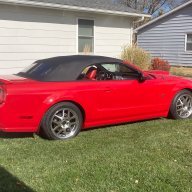
I just installed the steeda springs/struts and shocks with adj panard bar along with gt500 wheels and tires on my 17000 mile 2006 gt conv,really happy with the look,not happy with the ride,does not take much of a bump to cause a hard shock in the frt,also have gt500 strut mounts and strut brace,ready to put stock springs back? (Also put cut down fp bump stops) thanks

You are using an out of date browser. It may not display this or other websites correctly.
You should upgrade or use an alternative browser.
You should upgrade or use an alternative browser.
Steeda susp
- Thread starter C5illini
- Start date

Is there a question in that post?
RED09GT
Equal Opportunity Offender
Can you elaborate what you mean by a "hard shock"?
Are they the Pro-action steeda struts?
Are they the Pro-action steeda struts?
RED09GT
Equal Opportunity Offender
Subframes are a waste of money on these cars. Save your money.
What exactly were you expecting by lowering the car? What other cars are you used to that you find this setup harsh?
What exactly were you expecting by lowering the car? What other cars are you used to that you find this setup harsh?
/\ thisSubframes are a waste of money on these cars. Save your money.
moved to chat

Shredder
Member
- Joined
- Oct 15, 2020
- Posts
- 81
- Reaction score
- 15
Never mentioned What tire & size are you running? That’s going to play a factory into ride quality.
I wanted a better look,do not need better handling ,have 9.5 wheels with 255/45/18 and 285/40/18’s. Has anyone used the BMR sp009 springs,they are quite a bit softer by the rate .None of my many cars over the years have reacted this way,severe jarring when hitting any rough road! Thanks. Rod
RED09GT
Equal Opportunity Offender
Those BMR springs are softer and might give you closer to what you want, I guess.
Which Steeda springs did you buy? I can't say I remember anyone finding the ride quality of the steedas to be too harsh.
How long have they been on the car? Struts do take a few hundred miles until they are broken in.
Is one of the struts defective? I had a defective monroe strut on an explorer and it felt like a hammer hitting a brick every time I hit a bump. I would give everything a look-over to see if there is anything defective. Check the strut mounts as well.
Which Steeda springs did you buy? I can't say I remember anyone finding the ride quality of the steedas to be too harsh.
How long have they been on the car? Struts do take a few hundred miles until they are broken in.
Is one of the struts defective? I had a defective monroe strut on an explorer and it felt like a hammer hitting a brick every time I hit a bump. I would give everything a look-over to see if there is anything defective. Check the strut mounts as well.

DieHarder
Senior Member
- Joined
- Nov 9, 2019
- Posts
- 1,854
- Reaction score
- 1,078
If you want a decent ride with good handling recommend Roush Springs. Firmer, good travel without being jarring. I tried FRPP springs, great handling if you're on a track but the car rode like a truck on blocks. I now run Roush springs with Bilstein B6 shocks. Slightly firmer ride over stock, good handling, but still comfortable and expansion joints don't jar the car around like a one of those 25 cent kiddy rides to Mars....
Not a big AM fan but if you'd like to check them out:
https://www.americanmuscle.com/roush-lowering-springs-0514-gt-v6.html
Not a big AM fan but if you'd like to check them out:
https://www.americanmuscle.com/roush-lowering-springs-0514-gt-v6.html
golkhl
Senior Member
They are the sport springs,only ones they offer for a conv.,only driven 50 miles on tires,struts and springs,had front aligned ,new gt500 strut mounts.
You need to put 500 miles on it, let the suspension settle, and take it from there.
I think as it settles, you will notice a difference.

06 T-RED S/C GT
Senior Member
I just installed the steeda springs/struts and shocks with adj panard bar along with gt500 wheels and tires on my 17000 mile 2006 gt conv,really happy with the look,not happy with the ride,does not take much of a bump to cause a hard shock in the frt,also have gt500 strut mounts and strut brace,ready to put stock springs back? (Also put cut down fp bump stops) thanks
If your looking for a better ride quality? swap out your Steeda Pro Action struts/shocks towards Bilstein B6 struts/shocks. Your Steeda Sport Springs are a linear rated spring designed to improve your car's handling but without having to sacrifice ride comfort which most progressive rated aftermarket springs are well known for. IMHO, I really don't think your going to notice much difference in ride quality by replacing your current Steeda Sport Springs with BMR SP009 springs. Despite the SP009's having a lesser spring rate, they are still nevertheless a progressive rated spring. That being said, IMO you would notice more of a difference by making the switch from your Steeda Pro Action struts/shocks to Bilstein B6 HD struts/shocks and pair them together with your Steeda Sport Springs.
You have the Steeda Sport Springs.. IIRC the reason they provide a smoother ride quality, is they're considered a linear rate spring rather than a progressive rate which most lowering springs are designed more towards improving the overall handling vs ride comfort. Linear rated springs are also designed to improve handling, but are not quite as firm as a progressive rated spring. From my understanding, linear rated springs provide improved overall handling without having to sacrifice ride quality in the processBilstein solved the rough, jarring ride on my lowered 05 GT.
Bilsteins will go on everything from now on.
I also used Steeda springs.
Which ever ones lower 1 inch in front and 1.25 in the rear

Last edited:
RED09GT
Equal Opportunity Offender
You have the Steeda Sport Springs.. IIRC the reason they provide a smoother ride quality, is they're considered a linear rate spring rather than a progressive rate which most lowering springs are designed more towards improving the overall handling vs ride comfort. Linear rated springs are also designed to improve handling, but are not quite as firm as a progressive rated spring. From my understanding, linear rated springs provide improved overall handling without having to sacrifice ride quality in the process
Sort of.
With two springs with a similar rate (listed rate for the linear, average rate for the progressive), the progressive springs get stiffer as they compress, which makes it so the first bit of travel is a relatively soft rate to better absorb small imperfections. As they compress more, they get into a stiffer part of the spring to tighten things up in corners.
The linear rate springs will often feel more of the initial bump.
Bigger bumps, the linear rate spring will tend to feel less harsh compared to a progressive spring that will transition abruptly from the softer initial rate to the stiffer rate and that can cause a sudden jarring.
For most of the lowering springs for the street market, the difference isn't a big deal as the spring rates for this part of the market are pretty soft compared to the competition oriented stuff.
I prefer the feel of a linear rate spring but for the street lowering springs offerings, it is pretty much a coke vs. pepsi argument.
06 T-RED S/C GT
Senior Member
From my experience with Eibach Pro Kit Springs paired with Koni Sport adjustable struts/shocks, even when adjusted to full/soft settings, I practically feel every road imperfection and bump despite how big or small, like a sudden jarring as you just described. At this point, I honestly can't say for certain if it's Eibach Pro Springs that are responsible or if it's the valving of the Koni Sport adjustable struts/shocks? Perhaps it's a bit of both for all I knowSort of.
With two springs with a similar rate (listed rate for the linear, average rate for the progressive), the progressive springs get stiffer as they compress, which makes it so the first bit of travel is a relatively soft rate to better absorb small imperfections. As they compress more, they get into a stiffer part of the spring to tighten things up in corners.
The linear rate springs will often feel more of the initial bump.
Bigger bumps, the linear rate spring will tend to feel less harsh compared to a progressive spring that will transition abruptly from the softer initial rate to the stiffer rate and that can cause a sudden jarring.
For most of the lowering springs for the street market, the difference isn't a big deal as the spring rates for this part of the market are pretty soft compared to the competition oriented stuff.
I prefer the feel of a linear rate spring but for the street lowering springs offerings, it is pretty much a coke vs. pepsi argument.
RED09GT
Equal Opportunity Offender
It very well could be. I've never used the Koni's but have used the pro-kit eibachs on my fox body. Big bumps sucked with non-adjustable Tokicos.
06 T-RED S/C GT
Senior Member
So which suspension setup did you have with your 09 GT? I can't recall from memory lol.
Similar threads
- Replies
- 2
- Views
- 2K


- Replies
- 6
- Views
- 3K


Support us!
Support Us - Become A Supporting Member Today!
Click Here For Details