My camber is -1.7/-1.8 (Left/right), caster is 7/6.9 and toe is .11/.11.
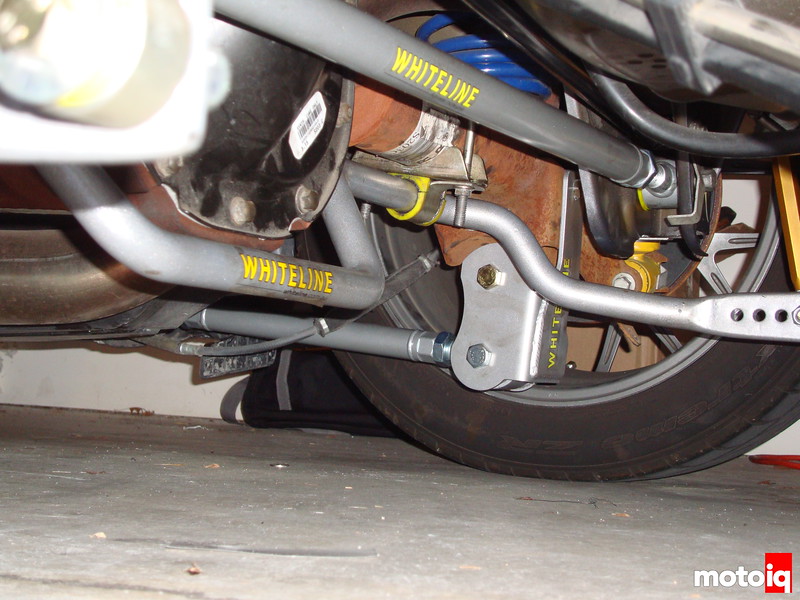
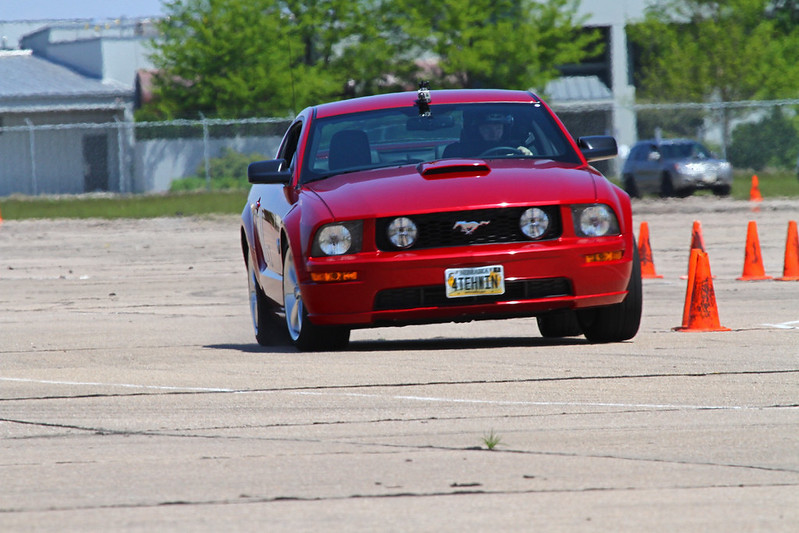
I think we just had an object lesson in the camber gain curve fall into our laps. These two cars are set with virtually identical static camber, but the car in the top picture is lowered while the one in the lower picture is not. When you're lowered, you're operating in a region of the curve that doesn't give back negative camber quite as fast when the suspension is moved still further into 'bump' - as happens to the outer front during roll. So when you don't have as much camber gain working for you, you need to set more static in order to end up at the same place when you're driving it.
I'm using Max Motorsports plates and lowered on Steeda Sport springs. Are you saying I should go down to -3 for camber?
Once you work out a method for swapping between street camber and track/autocross camber without having to keep measuring, you'll definitely want to set more negative than -1.8° for the track. How much further probably depends on how grippy your tires are, as that affects how much roll you have to work with/compensate for. But I'd say at least -2.5°, and set your toe at that camber setting to ~zero for the big track (more than a tiny bit of toe-out might be a little too twitchy). As long as there isn't a huge difference between your street and track camber settings, you can probably just let the toe for your street driving specs fall wherever it lands.
Significant toe out is more appropriate to lower speed/tighter turn autocrossing where a little twitchiness is easier to deal with (and may even be preferable).
With a little practice, swapping between camber settings should take only a couple of minutes per side, including jack time to unload the suspension to make actually moving the C-C plate adjustment easier (why I said that you don't want to have to measure anything gets a lot clearer here). Since the rate of toe change per degree of camber change is pretty slow, not having to touch it avoids setting up for and measuring at least something.
Depending on what your street driving is like, dropping back to -1.5°-ish may or may not make much difference. If you're currently getting pretty even wear at about -1.75° without counting on track time to beat up the outer shoulders to even it out, it's probably close enough to what's best for your daily driving.
I didn't feel like body roll was that bad from inside the car, just expected to see a flatter car when I was seeing pictures from mid corners.
I think when your attention is on staying on line and hitting your marks and when you've got enough shock/strut damping, the amount of roll you sense from the driver seat will always feel less than what you'd observe from the outside. Even in cars that roll a lot more than either of the cars in the above pics do (see
thumbnail pic ↓↓↓) , it still doesn't feel anywhere near as bad as it looks.
Norm