Got this question from an SCCAforums member...
Hello, I was curious to here your opinion on something considering the headache these upper mounts have caused most people. If you were to ignore, just for a moment, any rules in terms of the racing you do with this car would you ever consider running a Torque Arm setup on the S197 since it eliminates the upper mount? What's your opinion on a Torque Arm setup in general on the S197 for a car that would see some small time events, back road shenanigans on the street and normal day to day driving? This is something I have considered pretty hard lately since I have yet to see a good option to get rid of all the problems with the upper link. I hear NVH can be a bit of a challenge with the Torque Arms transmitting rear pumpkin noise into the cabin but some folks haven't thought it was too bad and others thought it sounded kinda Cool
That's actually a very good question, and one I've had with several SCCA autocross racers, various S197 track enthusiasts, and GM guys. I'm going to post this in my S197 Mustang build thread across
all forums, since the
"Torque Arm in an S197?" question comes up a lot. And there's a lot of bad information out there, I feel.
Sometimes The Aftermarket Sucks
First, let's look at the aftermarket as a whole, and the actual worth of many of the suspension product offerings. Remember what I have said for years about a lot of the bolt-on doo-dads in the aftermarket:
some of the stuff out there is made simply because people will buy it. If it is steel, shiny, fabricated, and looks "neat" it often sells. There are so many bolt-on braces and reinforcements, replacement K-members and feeble control arms out there it is hard to wade through the junk and see the small number of helpful, properly designed, quality made parts that improve something. Some of the "I just replaced X" part" stories are soon followed by "This stupid thing broke!" complaints, but most of it gets enough steel thrown at it that they don't break, just don't do anything to improve the car. I had someone ask yesterday at the shop, "Should I get a better strut tower brace for my 2012 Mustang GT?" And I said "If you want a prettier one, sure, why not... but it won't make your car handle better or go any faster. Having
any strut brace is usually just about good insurance for long term chassis rigidity... but the stock one works great". I would wager a guess that 75% of the bolt-on crap made for the S197 is mostly blingy steel, only made to lighten your wallet...
 "Well, It Worked in The 1970s"... But So Did Bias Ply Tires
A Torque Arm + Panhard Rod rear suspension was first used by GM on the
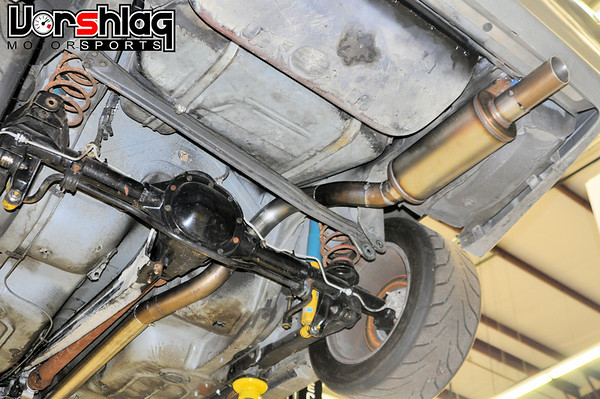
Chevy "Monza" chassis in 1975-80, adopted it to the Cosworth Vega chassis in 1975 (thanks wikipedia!), then was the basis for the all new 3rd gen Camaro/Firebird (F-body) chassis in 1982, and continued through the 4th gen F-body run all the way until 2002. The picture above is a mid 1980's V8 Camaro built for NASA's CMC class, and was in our shop for custom 3" stainless exhaust fabrication. This car has the stock stamped steel torque arm in place, and it bolts to the rear axle assembly - which was made to hold this. The transmissions in these cars had integral front mounts as well.
What's Good For The F-Body...
There are dozens of tubular or square steel fabricated aftermarket torque arms made for the 3rd/4th gen F-body chassis, some are adjustable (pinion angle), some have a front sliding spherical mount, others are "de-coupled" or even have a spring front mount. Most are made for drag racers but there are a few tailored for track racers, which can work for autocrossing. These are not a bad upgrade on these cars, as the stock stamped steel piece if a bit flimsy when loaded up with lots of braking torque and/or tire grip and/or power.
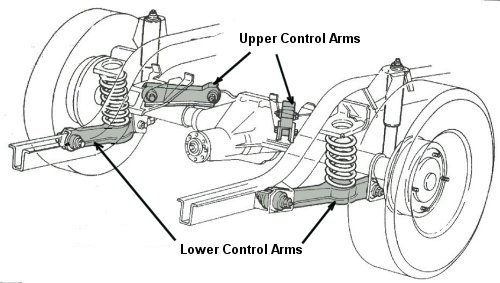
The TA rear suspension was a novel way to package the "upper" rear control arm of a solid axle car while still leaving good back seat room. The long torque arm, stuffed in the driveshaft tunnel, replaced the traditionally
short upper control arm(s) in a 3- or 4-link rear suspension. There are some geometry advantages and some disadvantages to the TA, but for the most part it worked in these factory designed cars because it
gave better packaging and good enough handling & acceleration. It hurt braking performance, however, and the F-body's dreaded "axle hop" is traced to the geometry and bushing failures of the factory Torque Arm. Still, it was better than most of the crap used in pony cars in the 1980s-1990s, and I've personally installed aftermarket torque arms (plus panhard rods or watts links) onto many Fox and SN95 chassis Mustangs, with good results.
Torque Arms Fit For Foxes
These Fox/SN95 solid axle Mustangs, based on a 1977 Fairmont rear suspension, are a horribly handling messes with the stock "quadralink" rear suspension. These cars had no secondary lateral axle location, and instead the upper control arms are canted inboard at the top to give
some lateral control of the axle. When these 4 upper and lower arms swing through their arcs, though, they bind HORRIBLY. To combat this, Ford kept the rear control arm bushings SUPER soft, which covered up this inherent suspension bind. Then, after they put a decent V8 in these cars (1985), Ford engineers slapped
4 shocks on the rear axle - two vertically mounted, two horizontally mounted - to keep it from axle hopping and flopping around under acceleration, because the control arm bushings were all so soft. Truly a terrible OEM solution in every way. Still, they sold a crapload of these cars, and drag racers and other racers changed the rear LCAs quickly. I've owned and raced and worked on many of these Fox Mustangs, too. If you added stiffer polyurethane bushings to the UCAs on a Fox/SN95, you would eventually rip the control arms and upper mounts arms right out of the chassis. Been there, seen that. These added MASSIVE bind as well. We took the rear springs out of a Fox with poly rear bushings and it not only supported the weight of the car, but you could drive it like that!
So much bind.
This meant that getting those upper control arms out of the rear suspension was IMPERATIVE, and naturally Mustang guys looked at the F-body TA solution. For the most part (with some notable exceptions), these 3rd/4th gen F-bodies dominated the Fox/SN95 in autocrossing and road racing for nearly 2 decades, and the factory TA + Panhard rod rear suspension was a large part of that handling advantage. So yes, an aftermarket Torque Arm + lateral link is a great solution for 1982-2004 Mustangs. It can work in drag racing or autocrossing, and SCCA rules makers finally relented and allowed the upper arms to be removed when a Torque Arm was installed. Many, many years after allowing TAs.
Why would you keep the UCAs in place with a newly added TA? Bad class rules. If anyone kept the OEM arms in place AND added a Torque Arm to a Fox/SN95, there was so much rear suspension bind that it made things much worse. Tossing the UCAs away when you installed a TA was normal, but not in SCCA circles. You see, the rules makers often don't understand suspension design or the aftermarket solutions, at all, and after writing rules
allowing Torque Arms in SP, they "forgot" to also allow removal of the UCAs. Then when this glaring omission was pointed out, they fought the UCA removal
for years.
SCCA knows best! So autocrossers with these Fox/SN95 cars that wanted the benefits of a torque arm would have to "keep" the stock upper arms in place, so many replaced the UCA bushings with Nerf football foam. This let the UCArms flop around harmlessly, didn't affect the handling and did not add bind. So the upper arms were just there for show, like on a T-rex.
RARR!!! This met the letter of the rules, and the SCCA rules makers finally realized their mistake and updated the rules to allow UCA removal. Many. Years. Later.
A Lot Can Change In 30 Years
Some things never go out of style, but some technologies do become outdated. Brake drums are never used on performance cars anymore, but they were the standard for braking for almost 100 years. Just so, the almighty Torque Arm rear suspension has probably seen its day in the sun. Sure, this
was a great aftermarket solution for 23 years of Mustang production, and it also worked well enough for 21 years on the factory F-body chassis. But what about the S197 chassis? The 5th gen Camaro? No, not so much use anymore. Ford found a way on the S197 to package a 3-link and finally added a separate Panhard Bar, and still managed to add high revving 420 hp V8 and kept the price under $29K. They could have used a torque arm, but there are just so many compromises, so they didn't.
But the aftermarket sometimes just keeps doing what it makes money at. Since a lot of what is made and offered for the S197 Mustang is coming from some of the same shops that have been developing parts for the old Fox/SN95 for almost 3 decades,
some of them just take the
same old solutions and apply them to the newer chassis. This is where I think the mistake lies - in what I call
"aftermarket inertia". Dated engineering that doesn't necessarily work well on the latest Mustang chassis is being pushed onto people by some parts makers... that either don't know any better, or just want to make some sales. I say all this with the "In my opinion, your results may vary, blah blah blah" statement at the end.

The new for 2005
Mustang S197 chassis has a pretty decent 3-link/panhard rod rear suspension, that is light years ahead of the Fox/SN95 mess it replaced. This was and is the best handling Pony Car Ford has ever built, and part of why the 2011+ GT and Boss302 is compared in the same breath, and favorably, to $70K BMW M3s by all of the major car magazines. It was the first Mustangs in 2+ decades to
not be based on the old 1977 Fairmont suspension technology. Sure, the S197's LCAs and UCA are still chock full of soft rubber bushings to allow for a smooth ride, but the fixes for these are MUCH easier than the Fox/SN95 cars. Just get some good, adjustable length LCAs with better bushings,
ignore the UCA, bolt on some LCA relocation brackets, then get proper dampers and springs. Once the car is lowered you need either an adjustable Panhard rod or a Watts Link kit, to control the lateral location and re-center the axle. For 90% of the track/auto-x S197 guys out there, that's a good fit. For the last 10% at the pointy end of the racing grid, add a properly made UCA that has sphericals at both ends. Done.

I think an aftermarket Torque Arm is the
wrong suspension solution for the S197 chassis. It could even make the car handle worse than stock, in some instances, possibly... no,
very likely adding axle hop under braking. I haven't driven an S197 with a TA yet, so I could be wrong... but I don't think so. I've raced in too many Fox, SN95, 3rd gen and 4th gen F-bodies to believe otherwise. As a suspension designer, I understand the geometry minutiae, the Pros and Cons of a torque arm set-up. I've owned 8 different 3rd or 4th gen F-bodies, 6 Foxes, and worked on many dozens more of them over the past 20 years. So I've witnessed axle hop in these cars first hand, the clanking and banging of the aftermarket TAs, and seen the extremes needed to tame these newly added problems. I've even seen a T56 transmission housings literally EXPLODE at an autocross, after
violent axle hop under braking, with the torque arm pounding into the transmission in a 4th gen F-body.
BOOM! Gears and fluid and case going everywhere. I have fought with bushings and shocks and tubular Torque Arms on these cars, both my own and customer cars, and know that they make for less than ideal street cars when you "fix" most of the problems. Aftermarket TAs get very noisy, very fast.
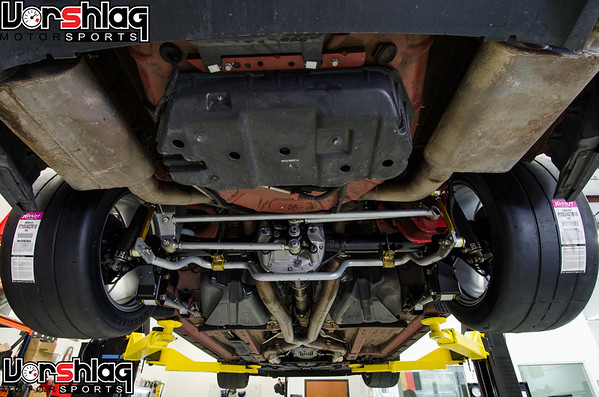
So all that being said, I won't recommend a Torque Arm as a good solution for anyone with an S197 Mustang.
Except for ONE situation: Serious, ultra-competitive SCCA autocrossers who cannot replace the LCA or use LCA relocation brackets (in ESP and STU class) but otherwise CAN run a torque arm.
Which leads us to where we are now on solid axle rear suspension rules in SCCA Solo.
The rules are broken. The solid axle rear suspension rules, as currently written for SP and ST, seem to be penned by people that do not understand suspension design, or the common aftermarket solutions. So we end up where the only way to get the geometry corrected on a lowered S197 is by spending $1000++ adding a janky, last century Torque Arm rear suspension solution to a 21st century car. Again, only on a
serious SCCA autocross car built for ESP or STU, that's the only time a Torque Arm on an S197 makes sense. We had even planned on making one for my 2013 GT we were gong to build for ESP, until the SCCA "re-clarified" a rule that made the class less than ideal for us to build around (and kept the rule broken for 2+ years).
For everyone else that autocrosses or tracks their car, not in SCCA's ESP or STU class,
don't use this Horse and Buggy solution. That may seem negative towards the SCCA, and harsh to some aftermarket companies, and frankly
it is. Because I've had to build cars around SCCA's broken and tortuous rules for 25 years. And I have seen too many useless suspension parts and poor solutions being sold by manufacturers. We go to trade shows and see that roughly 75% of the stuff there is useless CRAP. It frustrates me when I see people waste their time and money on useless crap.
We still design many of our suspension products to meet some SCCA rules, begrudgingly, but it is because some of our customers want that. It drives me nuts when a rule is written so poorly that we have to make something less than ideal to meet it, but they write the rules used by 80% of the autocross clubs in the nation. What do ya do? Until the day that another group supplants the SCCA in autocross attendance and rules making, we're all stuck with their mess of a rulebook.
I write letters to the SEB asking for rules updates and fixes. All. The. Time. It doesn't do much good, but if enough people write in and ask for these common sense updates, over enough years, they.... will.... slow...ly...fix... them. Also, given enough time, many of these old farts die off or leave the sport, and eventually some new blood with a little sense will make it onto these rules boards. I've seen a
few bright, upcoming autocrossers make it onto a few committees and rules boards lately, and that is encouraging.
Here's what to ask for, if you are stuck in ESP or STU in an S197 Mustang, and want to see changes:
1. Allow alternate LCAs. Adjustable in length, tubular steel in construction, why not? You're talking under $300 in parts to fix stamped steel, floppy stock arms, all while giving you pinion adjustment.
2. Allow bolt-on, axle-side LCA relocation brackets. This $100 fix is so common and works so well that it hurts me to see them not legal in Solo (we install 2-3 sets of these on S197s
per week). These make for significant fixes to rear geometry on virtually ALL solid axle RWD cars that are lowered (other than 1960s-based leaf sprung cars). Allowing these low cost, commonly available-for-every-car-in-ESP brackets that move the pick up points negate the need for $1000+ torque arm "fixes".
Those two allowances are sorely needed, as the current SCCA Solo rules for this area are at least twenty years out of date with the aftermarket and racers.
Before you ask, yes, I know some people will want to know more of the nitty-gritty details. Someone will ask for the geometry breakdown, every pro and cons, somebody else will throw three pages of calculations, another will add some vector graphics, and before you know it this will turn into an internet suspension nerdfest, heh. I think this summarizes the argument quickly: basically everything you do to help forward acceleration by adding a Torque Arm, hurts braking. Just adjusting the squat geometry ($100 LCA brackets) in a lowered S197 helps as much or more as a TA, has no down-sides, doesn't add the clanking and banging that normally comes with an aftermarket TA, and is 1/10th the cost or less. Well, other than the fact that they are not yet legal in some SCCA Solo classes. Also know that a TA is an old 1970s solution that just doesn't necessarily help the 2005-era S197 chassis 3-link rear suspension as much as it did the 1970s opposed 4-links in the Fairmont/Fox/SN95.
Cheers,