

You are using an out of date browser. It may not display this or other websites correctly.
You should upgrade or use an alternative browser.
You should upgrade or use an alternative browser.
what is your Max engine RPM set to, and at what RPM do you shift?
- Thread starter MadBee93
- Start date
ArizonaGT
Road Course Member
What year/engine? Sounds way too low to be a Coyote.
For any engine, it would be helpful to have a dyno plot to know when you are out of power and compare that with where (in the RPM range) you will land (or want to land) when you upshift to the next gear.
For any engine, it would be helpful to have a dyno plot to know when you are out of power and compare that with where (in the RPM range) you will land (or want to land) when you upshift to the next gear.

Boaisy
Dark Knight
I think my tuner has mine set around 7,500 (Coyote), but I still shift no later than 7,000 because I don't have a Boss 302 or CJ intake.
Jucostud
booooost'd
When i had my 4.6 the limiter was set at 7K and I usually shifted at 6700-6800. On my 2014 I had a Boss manifold, boss valve springs, boss tensioners, and ford racing coyote exhaust cams and the car made power to redline. I had the rev limiter set at 7825(highest allowed on the stock coyote ecu) and would shift at 7600rpm.
2013MustangGT
Budget Boss
I have a stock Coyote and I shift at 6500 because there are no gains after that and the engine heats up to much.

tigerhonaker
Senior Member
4.6L 3v engine.
I plan to get some dyno runs in soon so I can calculate the optimal shift points for each gear, but I'm wondering how far you can go and still be safe.
Below is a picture of my Bullitt Mustang which shows the Red-Line.
I do know as others have said it's not really how far can you push the RPM before it blows.
It's seeing where the max torque/HP is and shifting within that range.
You actually want to shift before it goes beyond those ranges.
It takes time to shift and get into the next gear and that allows you to be in some cases way past the optimum shift RPM.
That even includes like mine with the TCI SSF tranny.
It's programmed shifts are while it's still in the correct Torque/HP range.
And honestly there are not all that many people that can out-shift an Auto set-up for Fast-Shifts.
You might want to reconsider your thinking on maximum RPM and how that relates to shifting.
(Just a suggestion)
If you look close you can see the Max RPM on the tach is, 6,500 RPM from the factory with stock engine.

Terry
Last edited:
SlowJim
Member

It's seeing where the max torque/HP is and shifting within that range.
You actually want to shift before it goes beyond those ranges.
Why would you ever want to shift before max HP?? You want to maximize the average power to the wheels in each gear. That will always be after the peak in the curve. Unless the HP drop off a cliff right after peak, but I have never seen an engine drop THAT fast.
you guys on stock engines with minor changes (Intake, catback, tune) were do you find the optimal shift point? for the 2005-2009 4.6L motor.

Boaisy
Dark Knight

tigerhonaker
Senior Member
Why would you ever want to shift before max HP?? You want to maximize the average power to the wheels in each gear. That will always be after the peak in the curve. Unless the HP drop off a cliff right after peak, but I have never seen an engine drop THAT fast.
you guys on stock engines with minor changes (Intake, catback, tune) were do you find the optimal shift point? for the 2005-2009 4.6L motor.
OP,
I don't have a stock engine right now but I can recall what I was told when I did have the stock engine.you guys on stock engines with minor changes (Intake, catback, tune) were do you find the optimal shift point? for the 2005-2009 4.6L motor.
The Stock 3-Valve 4.6 engine ...
5,800-6,000 RPM ............
Terry
Last edited:
Mark Aubele
Member
- Joined
- Feb 11, 2015
- Posts
- 247
- Reaction score
- 0
Limiter at 7600 shift at 6800 usually.
Norm Peterson
corner barstool sitter
I've got my Aeroforce gauge's upshift indicator set to go off at 5900, which on the road courses I've run so far only matters for 3rd and 4th gears. I'm probably a hundred rpm or so above that before I actually execute the 3-4 shift. In 4th at 5900 rpm there isn't hardly enough acceleration happening to call it acceleration, the Aeroforce's mph display just kind of morphs into being the next number.
Norm
Norm
Whiskey11
SCCA Autoscrosser #23 STU
- Joined
- Feb 24, 2012
- Posts
- 1,644
- Reaction score
- 4
2009 4.6L 3V here, 7000 RPM red line and I usually shift at wherever the autocross course allows me to shift to second in the straightest line possible. Car has a JLT Gen 3 CAI and a Hypermotive Tune and I'm sure it stops making power well before the 7000 RPM red line but I didn't have it tuned to 7,000 to make power. I have it tuned to 7000 RPM because the speed in gear is needed and the car still pulls reasonably well at those RPMs in second gear.
SoundGuyDave
This Space For Rent
- Joined
- Apr 9, 2007
- Posts
- 1,978
- Reaction score
- 29
Okay, here we go:

The engine here is internally stock, just has all the bolt-on goodies, headers, CAI, deletes, etc. For road-course work, the 3-4 shift is the only one that really counts 99% of the time, so let's look at the RPM drop going from gear to gear.
3rd is a 1.32:1 ratio gear, and 4th is a 1:1 gear, assuming stock 3650 trans. So, if you shift 3-4 at 6500RPM, which is the redline shown above, your NEW RPM in gear is 4848, which translates to around 290HP, and around 320lb-ft going to the ground. IF you shift at 6000, your new RPM in gear is 4545, you get around 280HP, and 325lb-ft.
So, what's the upshot? There is a marginal increase in torque shifting at 6K rather than 6k5, but in terms of horsepower, there's a bit of a loss at that point. With 3.73 rear gears, and 25.5" tires (275/35-18) that shift point is right around 100mph (6K=93mph, 6k5=100), so aero resistance is becoming a factor, as we have a slightly higher Cd than a minivan. At that point I'd rather have the HP to pull with, rather than the torque.
Now, all that said, shifting at 6500 puts a lot more stress on things, and I only usually do that at sprint pace, rather than endurance pace. During enduro racing (3hrs+), we shift the car at 6K to both keep engine temps down and conserve fuel. We'll still go to 6500 if it avoids making a shift, or when attacking or defending a position.
The engine here is internally stock, just has all the bolt-on goodies, headers, CAI, deletes, etc. For road-course work, the 3-4 shift is the only one that really counts 99% of the time, so let's look at the RPM drop going from gear to gear.
3rd is a 1.32:1 ratio gear, and 4th is a 1:1 gear, assuming stock 3650 trans. So, if you shift 3-4 at 6500RPM, which is the redline shown above, your NEW RPM in gear is 4848, which translates to around 290HP, and around 320lb-ft going to the ground. IF you shift at 6000, your new RPM in gear is 4545, you get around 280HP, and 325lb-ft.
So, what's the upshot? There is a marginal increase in torque shifting at 6K rather than 6k5, but in terms of horsepower, there's a bit of a loss at that point. With 3.73 rear gears, and 25.5" tires (275/35-18) that shift point is right around 100mph (6K=93mph, 6k5=100), so aero resistance is becoming a factor, as we have a slightly higher Cd than a minivan. At that point I'd rather have the HP to pull with, rather than the torque.
Now, all that said, shifting at 6500 puts a lot more stress on things, and I only usually do that at sprint pace, rather than endurance pace. During enduro racing (3hrs+), we shift the car at 6K to both keep engine temps down and conserve fuel. We'll still go to 6500 if it avoids making a shift, or when attacking or defending a position.
barbaro
Member
- Joined
- Jan 23, 2011
- Posts
- 281
- Reaction score
- 0
My torque peak is between 6200-6750. But I make maximum horsepower at redline at 7750. My habit when I am going for it is to shift as close to redline as possible usually between 7200-7500. That of course is always a 50/50 proposition which is why I have ordered the MGW racespec, Steeda engine mounts and the Max Motorsports K-member to stabilize my driveline. I have noticed on several occasions my engine and tranny slop coupled with the chassis mounted shifter was locking me out of gear at the track and occasionally on the street. The way my engine is built I think it is better to shift close to the horsepower peak which drops me down to my torque peak. But I could be wrong. As an aside you will notice that max speed at 7750 is approximately 163-164mph in 5th gear. That is as fast as a 2011 with 3.73 gears can go. I did the Mojave Magnum and shifted into sixth at 7500-7600 and 5 fat girls jumped into my trunk. The torque/hp even at that rpm cannot handle the jump to sixth gear. Aerodynamics takes over
[URL="https://www.youtube.com/watch?v=LOlP7NNdiQ8
[/URL]https://www.youtube.com/watch?v=LOlP7NNdiQ8
[URL="https://www.youtube.com/watch?v=LOlP7NNdiQ8
[/URL]https://www.youtube.com/watch?v=LOlP7NNdiQ8
Attachments

Last edited:

My '05 GT has most of the usual bolt ons along(except for throttle body) with cams. I have the rev limiter set to 7,000 and shift at about 6800 RPM on the track. After 3,000+ track miles its still going strong.
Below the dyno shots the power before and after I added the Kooks headers and high flow cats.
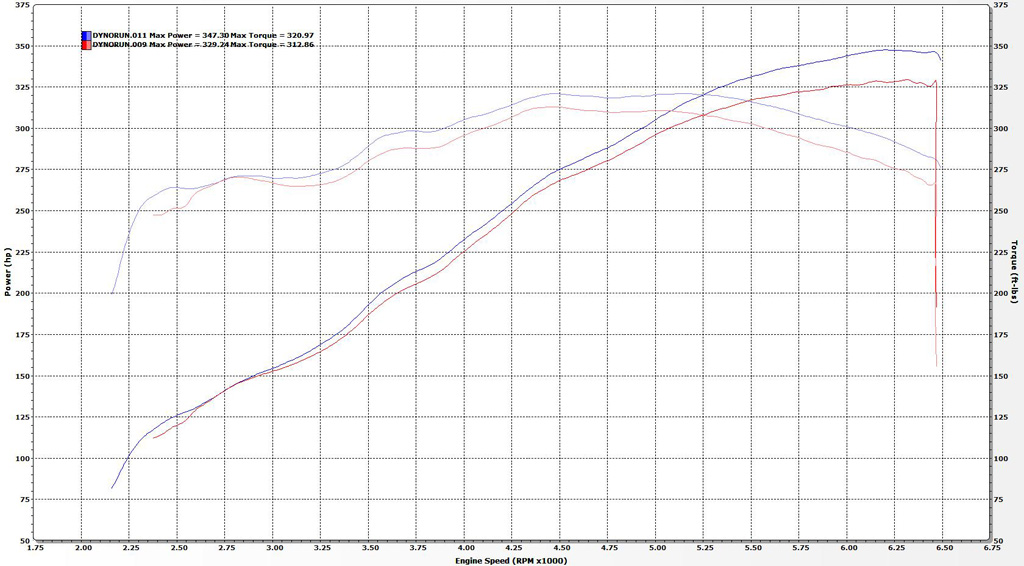
Below the dyno shots the power before and after I added the Kooks headers and high flow cats.

Similar threads


- Replies
- 50
- Views
- 2K


- Replies
- 10
- Views
- 877
- Replies
- 2
- Views
- 966

- Replies
- 3
- Views
- 480

Latest posts
-
-

-
-
Should I stay away from 2005 to 2008 (spark plugs)?
- Latest: 2019Chieftain-no-more
Support us!
Support Us - Become A Supporting Member Today!
Click Here For Details