
Mustang headers

ghunt81

New parts on old junk!
Joined
Jan 20, 2016
Posts
1,193
Reaction score
276
Location
Clarksburg, WV
I did JBA long tubes years ago, first the ceramic coated then found a great deal on 304SS versions so I pulled out the ceramics and put those in.

Install is time consuming but not difficult. You do have to raise and support the engine while doing the job since the engine mounts have to come out. By far the biggest pain is removing the stock manifolds because everything is rusty. After that it's a breeze. Be aware it will be much louder even with the high flow cats.

BTW if you do it get stage 8 locking fasteners, they aren't that expensive and you won't have to worry about the header bolts. Also make sure you get a multi-layer steel or aluminum gasket, I have run both and both are good (some headers still come with crappy paper gaskets).

 

Pentalab

Senior Member
Joined
Mar 5, 2013
Posts
5,506
Reaction score
1,323
I noticed that the Kooks LT's are a lot shorter than the JBA LT's.
Apparently, by changing the length of the LT's, you can move the TQ curve higher / lower in the RPM range. The longer the LT's, the TQ is optimized more for the lower end. The shorter LT's are optimized for more TQ towards the upper rpm range.
 

Flusher

Member
Joined
Apr 26, 2016
Posts
527
Reaction score
252
There is really a lot more to headers than what I typically see generalized as long tube and short tube variants.

Tube inside diameter, relative to displacement and RPM, can bias output about torque peak. Just because 2" primaries fit on a 1.6L Honda doesn't mean it's going make big power because of big flow. Gaseous expansion slows velocity, increases reversion, decreases scavaging, and hurts power. Everyone seems to have a good handle on, pipes that are too small, hurt power.

The number of bends and the bend radius greatly affect flow. In a V8 application, occasionally, the front two cylinders end up with a long (mostly) straight primary. If the designer is entertaining the idea of equal-length primaries, the rear two cylinders are going to have to snake around to end up at the same location.

Equal flow is more important to circle track cylinder head and header guys than equal length. Primary tubes with more bends should be shorter than those with more bends. Bends are restrictions, the tighter the BR, the greater the restriction.

How do the primaries match the ports? Is there any overlap? Does the angularity of the tube relative to the flange match the angularity of the port relative to the flange? The ports should blend seamlessly into the primaries, with minimal areas for gaseous expansion.

Collector type, design, length, cross-section of the venturi pinch don't seem to take priority in the manufacturing of production headers. I'm really curious to know the interaction of exhaust gases as it crashes into the catalytic monolith. It can't be good for laminar flow.

All I'm saying is that there is more to this than simply long or short.
 

Dino Dino Bambino

I have a red car
Super Moderator
Joined
Aug 11, 2014
Posts
4,535
Reaction score
2,652
Location
Cyprus
I noticed that the Kooks LT's are a lot shorter than the JBA LT's.
Apparently, by changing the length of the LT's, you can move the TQ curve higher / lower in the RPM range. The longer the LT's, the TQ is optimized more for the lower end. The shorter LT's are optimized for more TQ towards the upper rpm range.

What he said.
The primary header tube diameter determines the rpm at which the torque peak is tuned. On a 4.6 3V, that's 4400rpm with 1-5/8" primaries and 5200rpm with 1-3/4" primaries.
The primary tube length determines where in the rpm range you'll see reflective wave scavenging. A longer primary length will fatten the torque curve to a greater degree below the torque peak, whereas shorter primaries will fatten the torque curve to a greater degree above the torque peak.
Full length 1-5/8" headers e.g. BBK, JBA produce their biggest torque gains from 2700-5300rpm and really fatten up the midrange. The Kooks/Pypes are considered 3/4 length and the reflective wave scavenging from these headers not only isn't as strong, but also occurs slightly higher up the rpm range (3000-5500rpm).
Shorty headers come in many flavours but the only ones I'd even consider are the JBA. The average primary pipe length of 15.5" is too short to provide any reflective wave scavenging, but they do provide a decent 5-6lbft torque gain in the lower half of the rpm range where you need it in a daily driver, and a 5-6hp gain above 5500rpm.
 

AHaze

Member
Joined
Dec 31, 2019
Posts
432
Reaction score
280
Location
Edmonton, AB
Shorty headers come in many flavours but the only ones I'd even consider are the JBA. The average primary pipe length of 15.5" is too short to provide any reflective wave scavenging, but they do provide a decent 5-6lbft torque gain in the lower half of the rpm range where you need it in a daily driver, and a 5-6hp gain above 5500rpm.
Can you explain what the shorties are doing that the stock manifolds aren't to make this low end torque gain possible if it's not from scavenging. Not trying to be an ass here, I'd genuinely like to know in case I'm ever forced to remove my LTs due to new emissions legislation.
Are these numbers repeatable over multiple dyno runs? 5 lb.ft. at 3000 rpm is less than 3 HP which falls into pull to pull variance territory.
 

Dino Dino Bambino

I have a red car
Super Moderator
Joined
Aug 11, 2014
Posts
4,535
Reaction score
2,652
Location
Cyprus
Can you explain what the shorties are doing that the stock manifolds aren't to make this low end torque gain possible if it's not from scavenging. Not trying to be an ass here, I'd genuinely like to know in case I'm ever forced to remove my LTs due to new emissions legislation.
Are these numbers repeatable over multiple dyno runs? 5 lb.ft. at 3000 rpm is less than 3 HP which falls into pull to pull variance territory.

You might be interested to read this article:

https://www.andersonfordmotorsport.com/content/exhshoot3.htm

I agree that the TQ gains are small enough to fall within the range of dyno variance but they seem to have been repeatable in that article.
An improvement in airflow would only explain the higher rpm HP/TQ gains, and the primary tube length is too short to produce reflective wave scavenging in itself. Perhaps the addition of an X-pipe behind the JBA shorty headers helps to a degree.
 

Midlife Crises

Senior Member
Joined
Jul 20, 2019
Posts
2,356
Reaction score
1,889
Location
Fairbanks, Alaska
Some basic facts to think about when selecting off the shelf headers.
For a given cylinder size, the tube diameter determines the speed of the airflow. The length of the tube determines when the reflected wave will reach the exhaust valve. The collector diameter has an effect on how strong the reflected wave is and the length of the collector affects how long or broad the wave can be. The tube length should be matched to the valve timing and rpm range the engine will operate in.
 
Joined
May 1, 2009
Posts
86
Reaction score
29
How does a supercharger affect the header pipe size? Would the supercharger work with 1 5/8" primaries versus the 1 3/4? Would really like to keep the low RPM torque/power.

That's the question a lot of us having. Thinking about installing long tube headers, but what happens if we decide to go with a supercharger a couple of years later.
 

Pentalab

Senior Member
Joined
Mar 5, 2013
Posts
5,506
Reaction score
1,323
How does a supercharger affect the header pipe size? Would the supercharger work with 1 5/8" primaries versus the 1 3/4? Would really like to keep the low RPM torque/power.

That's the question a lot of us having. Thinking about installing long tube headers, but what happens if we decide to go with a supercharger a couple of years later.

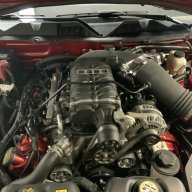
I installed the small roush M90 blower 1st...then the LT's a few years later. JBA titanium ceramic coated LT's, 1 5/8" primary's, and 2.5" collector. Where the 4 x primary's merge, to plug off the exact center, they use a tapered portion, sometime called 'spikes' or 'firecones' etc. Also the mating JBA hi-flow catted H.....pypes M80's resonators, and FRPP FRS-500 SS mufflers. Before the LT's installed, I replaced the oem twin 55mm TB with the bigger FRPP twin 62mm TB. Added a K+N panel air filter..and had the entire mess re-tuned several times by VMP, for 94 octane. Our 94 octane does not have any ethanol in it.

The LT's made a huge difference, it was the final piece of the puzzle. But my boost is only 5.7 psi. The LT's work superb, in or out of boost.

Also installed a DSS-DS. They dyno tested, and their graphs show another 30 ft lbs of tq @ 2.5 krpm (14.5 hp @ 2.5 krpm)..... which drops like a rock above and below 2500 rpm. 2-3 hp increase at 6 krpm. The folks with the same M90 blower, but using the smaller blower pulley, more boost, and oem exhaust (no lt's) make 10-12 more rwhp than I do. They also make less TQ at the lower end of the scale. Peak tq in both cases was aprx the same.

But LT's are a helluva lot more $$ vs a simple pulley swap...( + bigger idler).
 
Last edited:

07 Boss

Senior Member
Joined
Jan 25, 2009
Posts
4,298
Reaction score
1,413
Location
Sin City
How does a supercharger affect the header pipe size? Would the supercharger work with 1 5/8" primaries versus the 1 3/4? Would really like to keep the low RPM torque/power.

That's the question a lot of us having. Thinking about installing long tube headers, but what happens if we decide to go with a supercharger a couple of years later.


If you are burning more air and fuel you are producing more exhaust. Basically the more power you make the larger your exhaust needs to be. Whether you do that with nitrous, a supercharger or just a bad ass NA build. The more fuel you burn the more exhaust you need. There are numerous online calculators to figure out what size exhaust and header sizes need to be as well as header tube length can be used to dial in your torque curve. Here is a general chart to get you in the ball park.

Horsepower Output Primary Diameter
200-325 hp. 1 1/2 in.
275-425 hp. 1 5/8 in.
400-500 hp. 1 3/4 in. or 1 7/8 in.
500 hp. or more 2 in. or larger


Below is a more specific formula for calculating header primary size base on an NA motor.

Area of the Primary Tube (PPA) = (peak torque rpm ÷ 88,200) x (c.i.d. ÷ number of cylinders)

For example, let's look at a 350 c.i.d. small block with a peak torque goal of 5,000 rpm.

PPA = (5,000 rpm ÷ 88,200) x (350 c.i. ÷ 8)

PPA = 0.057 x 43.75 c.i.

PPA = 2.49 square in.


When it comes to exhaust pipe size you have to figure a decent straight exhaust pipe will flow about 115 CFM per square inch. So you can either take your engine displacement and multiply it by rpms divided by 2. This will give you intake volume and then based on exhaust temps you can calculate for thermal expansion. Then you can take that number and and calculate the square inches necessary and convert that to diameter. Or you can just take 2.2 CFM/HP and then find the necessary area and diameter of the exhaust for a ballpark figure.

I have been using these to figure out my exhaust needs for my current build and I came up with 2.5" primaries with a 3.5" dual exhaust.
 

Midlife Crises

Senior Member
Joined
Jul 20, 2019
Posts
2,356
Reaction score
1,889
Location
Fairbanks, Alaska
How does a supercharger affect the header pipe size?
In very simple terms, the pressure ratio the engine is operating at determines the the change in airflow. With a PD blower operating at a pressure ratio of 2 the engine thinks its twice as big. A whole bunch of inefficiencies get in the way of this being true but that’s kinda how it works. Flowing twice as much air through an engine as normal, you might want to go from 1 5/8 tubes to 2” tubes.
 
Joined
May 1, 2009
Posts
86
Reaction score
29
Looks like Pentalab is having good success with the 1 5/8" primary pipe size with his supercharger, but some of the other calculations are recommending 1 3/4". When it's time for a supercharger I'll probably go with the one from Department of Boost and will keep it at a max of 450 HP.

I have already upgraded the radiator, fan, driveshaft, and brakes to handle the extra horsepower. I also had the clutch replaced a couple of weeks ago that's capable of handling the extra torque. I went with an aluminum flywheel and pressure plate that saved about 18 pounds. The clutch is still in the break-in phase, but the engine seems to rev a little easier with the weight reduction.
 

Flusher

Member
Joined
Apr 26, 2016
Posts
527
Reaction score
252
...I also had the clutch replaced a couple of weeks ago that's capable of handling the extra torque. I went with an aluminum flywheel and pressure plate that saved about 18 pounds. The clutch is still in the break-in phase, but the engine seems to rev a little easier with the weight reduction.

Which clutch did you choose?
 

Pentalab

Senior Member
Joined
Mar 5, 2013
Posts
5,506
Reaction score
1,323
If you are burning more air and fuel you are producing more exhaust. Basically the more power you make the larger your exhaust needs to be. Whether you do that with nitrous, a supercharger or just a bad ass NA build. The more fuel you burn the more exhaust you need. There are numerous online calculators to figure out what size exhaust and header sizes need to be as well as header tube length can be used to dial in your torque curve. Here is a general chart to get you in the ball park.

Horsepower Output Primary Diameter
200-325 hp. 1 1/2 in.
275-425 hp. 1 5/8 in.
400-500 hp. 1 3/4 in. or 1 7/8 in.
500 hp. or more 2 in. or larger


Below is a more specific formula for calculating header primary size base on an NA motor.

Area of the Primary Tube (PPA) = (peak torque rpm ÷ 88,200) x (c.i.d. ÷ number of cylinders)

For example, let's look at a 350 c.i.d. small block with a peak torque goal of 5,000 rpm.

PPA = (5,000 rpm ÷ 88,200) x (350 c.i. ÷ 8)

PPA = 0.057 x 43.75 c.i.

PPA = 2.49 square in.


When it comes to exhaust pipe size you have to figure a decent straight exhaust pipe will flow about 115 CFM per square inch. So you can either take your engine displacement and multiply it by rpms divided by 2. This will give you intake volume and then based on exhaust temps you can calculate for thermal expansion. Then you can take that number and and calculate the square inches necessary and convert that to diameter. Or you can just take 2.2 CFM/HP and then find the necessary area and diameter of the exhaust for a ballpark figure.

I have been using these to figure out my exhaust needs for my current build and I came up with 2.5" primaries with a 3.5" dual exhaust.

Ok, using your method above, and a peak tq goal of 4400 rpm, and a 281 cu inch eng.
(4400 rpm / 88,200) x (281/8) = 1.75 square inch's of surface area. ( cross sectional surface area of each primary tube).

1.75 square inches = 1.49" diameter.

My JBA LT's use 1 5/8" primary's. 1 5/8" = 1.625" diameter. 1.625">1.49"

Per your formulae, I would say my 1 5/8" primary's are ample for the task.

A few more items to note. When the primary diameter is increased, the velocity of the exhaust gasses will decrease....and pressure will also decrease. When the LT's are ceramic coated, both inside and outside, the internal exhaust gas temp will increase substantially..and internal pressure also increases. The hotter the exhaust gas temp, the faster it will flow, (increased velocity). I'm 90% convinced that the faster velocity of the ceramic coated LT's attributes to the end results.

I believe my combo of 1 5/8" primary's..and also ceramic coated, and the 2.5" collector, and also the LT's being full length, achieves my goal. TQ curve is very broad, from 1500-6000 rpm..and peaks at 4400 rpm. It's exactly where I wanted it.
 
Last edited:

Dino Dino Bambino

I have a red car
Super Moderator
Joined
Aug 11, 2014
Posts
4,535
Reaction score
2,652
Location
Cyprus
Ok, using your method above, and a peak tq goal of 4400 rpm, and a 281 cu inch eng.
(4400 rpm / 88,200) x (281/8) = 1.75 square inch's of surface area. ( cross sectional surface area of each primary tube).

1.75 square inches = 1.49" diameter.

My JBA LT's use 1 5/8" primary's. 1 5/8" = 1.625" diameter. 1.625">1.49"

Per your formulae, I would say my 1 5/8" primary's are ample for the task.

A few more items to note. When the primary diameter is increased, the velocity of the exhaust gasses will decrease....and pressure will also decrease. When the LT's are ceramic coated, both inside and outside, the internal exhaust gas temp will increase substantially..and internal pressure also increases. The hotter the exhaust gas temp, the faster it will flow, (increased velocity).

The cross sectional area of the primary pipes refers to the inside. Since the wall thickness of the headers is 0.0625" and you have to subtract that twice from the external diameter of 1-5/8", the internal diameter becomes 1.50" and the c/s area is 1.77 sq. In. This is how I arrived at 4400rpm.

Interestingly the stock intake manifold/stock camshaft combination is also set up to produce the 4th harmonic of the reflective wave at 4400rpm (maximum torque), with the 3rd harmonic arriving at 5900rpm (maximum horsepower). Using formula no.11 from one of my webpages:

https://www.angelfire.com/my/fan/formulae.html

Enter an EVCD of 472 for the stock camshaft (advertised intake opening duration is 248 degrees), 14" for the runner length, 1.8" for the runner diameter, and the value 3 or 4 for the RV.

Have fun playing around with that and the other formulae. :D
 

Pentalab

Senior Member
Joined
Mar 5, 2013
Posts
5,506
Reaction score
1,323
The cross sectional area of the primary pipes refers to the inside. Since the wall thickness of the headers is 0.0625" and you have to subtract that twice from the external diameter of 1-5/8", the internal diameter becomes 1.50" and the c/s area is 1.77 sq. In. This is how I arrived at 4400rpm.

Interestingly the stock intake manifold/stock camshaft combination is also set up to produce the 4th harmonic of the reflective wave at 4400rpm (maximum torque), with the 3rd harmonic arriving at 5900rpm (maximum horsepower). Using formula no.11 from one of my webpages:

https://www.angelfire.com/my/fan/formulae.html

Enter an EVCD of 472 for the stock camshaft (advertised intake opening duration is 248 degrees), 14" for the runner length, 1.8" for the runner diameter, and the value 3 or 4 for the RV.

Have fun playing around with that and the other formulae. :D
Good points. I never knew if they are quoting ID or OD...and assumed the wall thickness is so thin, that it amounts to a moot point in most cases. I will measure the circumference of a primary, then divide by 3.14 to see what the actual OD is. I have stock cams, and no lockouts on the cmv. However, the oem plastic intake manifold has been replaced with the Roush aluminum intake manifold. I forget what the total runner length is on the aluminum intake manifold.
 

Support us!

Support Us - Become A Supporting Member Today!

Click Here For Details

Back
Top