Lito tune

AdamBorz

Member
Joined
Oct 31, 2025
Posts
55
Reaction score
39
Location
Bernville, PA
So bought this car used and it had a stumble upon acceleration, found couple bad spark plugs, changed out 02 sensors etc. slightly better, but the stumble remained.

I bought HP tuning software and the credits for my car, pretty neat and I was able to view the tune in the car.

Contacted Lito (who’s been great) and he told me he doesn’t use HP tuner on these older Fords, he uses SCT. Well my car came with a SCTX3 so no issues; but still disappointing.

He gave me a base tune which has the throttle way better than it was but now car is going way rich after WOT runs and staying there until I either restart car or rev the engine repeatedly for a bit then the wideband starts reading again.

Lito says the narrowbands are showing lean, and he thinks the wideband I have might be reading wrong.

I can still log use HP scanner and it shows my FPDC jump to 75% when this happens. I can smell gas too.

I get that it would take a second or 2 to purge off fuel in a returnless system but I can continually drive around without Rev’ing engine and the wideband will stay pegged max rich and the car stumbles all over itself and smells of fuel.

After I installed Litos tune I found my BAP wasn’t working so fixed that, so maybe now that the BAP is working is the reason I never saw car do this before.

Car would run lean when accelerating (according to WB) hence I contacted Lito cause even setting my OL fuel to command .78 lambda I was going lean with 60 psi injectors etc.

Anyhow, am wondering if anybody else ever experienced this? I’m thinking of putting the original tune back in the car and running it to see if it happens with that tune.

Car has gt500 twin fuel pumps, 2 FPDMs etc so appears to be hooked up correctly.

I made Lito a video he wanted to see what wideband was reading. Gauge LED is not working right so have purchased new AEM wideband kit just haven’t gotten it installed yet.

If you zoom in on the wideband (pillar location) you can see it flick briefly lean when I floor it, then return to center then slowly creep rich. Lito said to accelerate then let off gas don’t shift to see what it does (I let motor wind down first pull) and it goes to 10:1.

Cool note, if you zoom in on boost gauge you can see how fast the KB brings on the boost. It actually pegs the gauge off the limiter stop before settling at 18 psi.

Haven’t had a chance to install the new wideband and gauge, and sorry about my head getting in the shot, I keep leaning forward to look in the side view mirror.

 

StockishS197

Member
Joined
Dec 24, 2024
Posts
434
Reaction score
378
Location
Houston
Hi and welcome!

Generally, I would trust Lito's advice.

What brand NB O2's did you use? Also, is your WB set to Lambda or AFR? Asking because the AFR setting in WBs generally set Stoich to 14.7, whereas Lambda readouts account for different ethanol content and will be easier to see if you are actually hitting the .78 Lambda you are commanding in the tune. On mine, I only use Lambda readings on my WB FWIW. And what brand WB?

I would say try and log injector PW to see if the injectors are commanding fuel during decel. Not sure if Lito's boosted tunes are different, but his DFCO tuning is pretty aggressive to shut off injectors to have the RPMs come down faster.
 
Last edited:

AdamBorz

Member
Joined
Oct 31, 2025
Posts
55
Reaction score
39
Location
Bernville, PA
Just for understanding: You get a mail-in tune, flash it with SCT and read out again with HP?


I got the 02 sensors Lito recommended (NTK). He sent me what he wants me to log on the SCT so I can send it to him. I don't understand the results of the SCT log and when I play it back it doesn't play right. My SCT x3 is older and I don't have a hookup to wideband like I do on the HP tuner scanner. I understand the HP Tuner scanner bettter, so for instance when it says my FPDC goes to 75% it says exactly that. On the SCT live view it just gives a decimal #. Lito says it shows my fuel injectors shut off, but I can still drive around (for miles) with the wideband pegged at 10:1 and the car is rev'ing and driving normal (besides sputtering). It stays pegged, I smell gas fumes until I rev the engine hard in neutral about 5 times, then the wideband starts working again, the fuel smell goes away etc.

The wideband is auto meter sport comp, the new one I ordered is the 30-4110 AEM. I have tried it reading both AFR and lambda... doesn't matter does same thing. The car is tunes for the 10% high octane ethanol gas...

Yes Lito's DFCO is extreme and I don't like the popping sound... which is why he suggested letting the car rev down instead of pushing in clutch or shifting to see if the DFCO would engage.... like I said unless the wideband really is reading backwards for some reason and the car is missing or stumbling due to being lean, I have no idea what is going on.

I am having an issue re-flashing the tune back with the HP tuner I get a message controller unlocker x11 service not supported. I am working alot at the moment and haven't had a lot of time to play with it plus it snowed recently in PA so... I downloaded the original tune from the car with the HP tuner (which was from the SCT in the PCM) and can read that tune. It is set for ethanol 10%. I can't not download Lito's tune, I get the weird message. Lito said he didn't lock the tune so I must be doing something weird or the car is having a ground issue or something else. Like I said I bought car used...

I'm not questioning what Lito said, I'm just saying I've never had the wideband do that before. However when I got the car it wasn't running right, and I found the BAP wires to the pressure sensor were not connected right. Now I took the boost switch out of the equation and just run it all the time (as suggested by Lito) and am getting the proper volts at the FPDMs now which might be accounting for the higher fuel pressure which jumps to 75 psi when I get off the gas... I can see it spiking for a sec or two since it can't return the fuel to the tank, but mine is staying at the 75% DC..... which is why I'm wondering if something is glitching or what?

I might just re-flash the car with Lito's tune, or the original tune from SCT if it'll let me. Maybe it glitched when uploading or something weird. I do know the car rev's like a beast now, until the wideband pegs.. then it starts bogging or missing or stuttering or whatever until I get the wideband acting normal again. So it's either rich or lean.. and I'm wondering why?

-=Adam
 

AdamBorz

Member
Joined
Oct 31, 2025
Posts
55
Reaction score
39
Location
Bernville, PA
you can actually hear the car stumble (on the video I posted), after the first rev and rev down, I go to hit the gas and it cuts out....
 
Last edited:

StockishS197

Member
Joined
Dec 24, 2024
Posts
434
Reaction score
378
Location
Houston
Worth checking, see if Lito changed your cars strategy with his tune. He did on mine, and if your HPT log file is set up with the factory strategy, it could make the log look different than it actually is. There are benefits to the Bullitt strategy, but swapping strategies can sometimes cause odd issues.

Lito swapped my tune strategy to a Bullitt strategy when I ran his tune and the log file I built for my factory strategy looked very off from what it actually was. I also had a weird P0300/P0316 code we couldn't solve with his tune file that hasn't happened since I started tuning my own car using the factory strategy. his tune ran and drove fantastic, it just had a couple odd minor things that came with it.

The decel popping is mostly due to the retarded decel timing from the Bullitt strategy, less so from the DFCO. Factory Bullitts run 25 degrees on decel whereas the factory GT calibrations run 45/60 degrees on decel.
 
Last edited:

AdamBorz

Member
Joined
Oct 31, 2025
Posts
55
Reaction score
39
Location
Bernville, PA
Worth checking, see if Lito changed your cars strategy with his tune. He did on mine, and if your HPT log file is set up with the factory strategy, it could make the log look different than it actually is. There are benefits to the Bullitt strategy, but swapping strategies can sometimes cause odd issues.

Lito swapped my tune strategy to a Bullitt strategy when I ran his tune and the log file I built for my factory strategy looked very off from what it actually was. I also had a weird P0300/P0316 code we couldn't solve with his tune file that hasn't happened since I started tuning my own car using the factory strategy. his tune ran and drove fantastic, it just had a couple odd minor things that came with it.

The decel popping is mostly due to the advanced decel timing from the Bullitt strategy, less so from the DFCO. Factory Bullitts run 25 degrees on decel whereas the factory GT calibrations run 45/60 degrees on decel.
Interesting. When I get a chance and can actually download his tune I’ll check it out; or I can just ask lol. He has been great with communicating, he just wants me to switch my wideband and then we’ll start testing again.
 

StockishS197

Member
Joined
Dec 24, 2024
Posts
434
Reaction score
378
Location
Houston
You can also check the strategy under the SCT device and compare what your factory strategy is based on the PCM code you have.
 

GlassTop09

Senior Member
Joined
May 24, 2019
Posts
1,361
Reaction score
834
Location
Farmington, NM
I am having an issue re-flashing the tune back with the HP tuner I get a message controller unlocker x11 service not supported. I am working alot at the moment and haven't had a lot of time to play with it plus it snowed recently in PA so... I downloaded the original tune from the car with the HP tuner (which was from the SCT in the PCM) and can read that tune. It is set for ethanol 10%. I can't not download Lito's tune, I get the weird message. Lito said he didn't lock the tune so I must be doing something weird or the car is having a ground issue or something else. Like I said I bought car used...
Hi AdamBorz,

If you don't mind, could you explain again the process you're referring to here from the beginning.............

1. Are you saying that you tried to reflash the initial tune cal file (SCT modded tune cal--not the original tune cal that was readout as stock file using SCT X3--that was flashed in the ECU by the SCT X3 tuner......) the 2 credited-licensed HPTuners MPVI3 interface initially read out of the ECU\translated\sent into the computer & VCM Editor software (that HPTuners VCM Editor software initially, automatically asked you to save a copy of........) back into the MPVI3 interface to write back into the ECU & you're getting an error message "controller unlocker x11 service not supported" thru VCM Editor software, yes?

1a. Or did you try to use the MPVI3 interface before loading the 2 credits to license the computer\interface\ECU?

2. I'm also reading that you downloaded the original tune (once again the same SCT-modded tune cal file currently loaded in ECU....not the original stock tune initially read out of ECU by the SCT X3--the return to stock function--before SCT X3 wrote in the SCT-modded tune cal file....) from the ECU w\ the 2 credited-licensed HPTuners MPVI3 interface & HPTuners VCM Editor software can read this same SCT-modded tune cal w\o issue........

FYI........the HPTuners MPVI3 interface locks itself to the computer that the HPTuners VCM Suite software (both the Editor & Scanner) is loaded on (where the 2 credited license info\data is stored activates both the VCM Editor & VCM Scanner software to the interface.........) AND to the ECU's VIN, controller calibration strategy ID--both OS & Controller Type ID--& ECU ID (3 digit code.......not the 4-digit ECU tear tag code located in AS_BUILT data & also on a tag on the physical ECU case that SCT is using to marry to.......) thus the ECU's internal firmware ID data (for both the Editor & Scanner software) thus also locks the MPVI3 interface to this specific ECU's controller strategy\VID block, so technically, if you could do the 2nd, you should've been able to do the 1st........

If you need help, please clarify so that I can fully understand................

Either post here or PM me.
 

whitmanink

Member
Joined
Dec 28, 2020
Posts
592
Reaction score
258
Location
denver pa
de-railing topic here ,
i live in adamstown and grew up in Mohnton.. and use to live right up the street from marios pizza in bernville lol.
what hp you putting down? i feel a roll race comming on this spring before i go boosted ,, and then of course after..
but yea definitely neeed to cruise fo sure
 

AdamBorz

Member
Joined
Oct 31, 2025
Posts
55
Reaction score
39
Location
Bernville, PA
de-railing topic here ,
i live in adamstown and grew up in Mohnton.. and use to live right up the street from marios pizza in bernville lol.
what hp you putting down? i feel a roll race comming on this spring before i go boosted ,, and then of course after..
but yea definitely neeed to cruise fo sure
I grew up in Pottstown and used to cruise High Street all the time. Now that I’m older (ahem, cough) I have nostalgia for those old days and times! Yes I get through Adamstown once in awhile now.

Previous owner told me around 650 hp… I’m gonna take to the dyno once I get her back to running correctly. The PO wasn’t the one that worked on her and didn’t take care of her… so I was looking for an older project (think 1967 era) to restore and came upon this car. Originally I was gonna pass when I saw the condition of the body and paint (dents and neglected) and engine not running correctly. I took for ride, most of the after market gauges not working car was missing etc. only have 40k miles so I took a chance. PO told me the builder pulled engine at about 20K miles and forged and added KB supercharger etc.

Running on all 8 cylinders and screams like you can hear in the video… this winter when I put her away for couple months might tear into it check for all the stuff PO told me it has…
 
Last edited:

AdamBorz

Member
Joined
Oct 31, 2025
Posts
55
Reaction score
39
Location
Bernville, PA
So I messed with car quickly last night (only had to work 11 hours yesterday LOL), I was able to download the tune Lito put in the car will go through it. For now, I'll try and post the screen shots I tool of the VCM log...1 is showing the FPDC at WOT around ~6000 rpms, 45%..... then I let off gas, FPDC goes to 75% and stays there and wideband goes pegged rich, car runs like ass....

edited to say the wideband info on the VCM is incorrect, I used a AEM voltage range not realizing it is different than the one have currently so car is more like 13:1 AFR and I want it to go richer at WOT hence contacting Lito...
 

Attachments

  • FPDC lito.pdf
    556.4 KB · Views: 12
  • wideband for lito.pdf
    687.4 KB · Views: 8

AdamBorz

Member
Joined
Oct 31, 2025
Posts
55
Reaction score
39
Location
Bernville, PA
Hi AdamBorz,

If you don't mind, could you explain again the process you're referring to here from the beginning.............

1. Are you saying that you tried to reflash the initial tune cal file (SCT modded tune cal--not the original tune cal that was readout as stock file using SCT X3--that was flashed in the ECU by the SCT X3 tuner......) the 2 credited-licensed HPTuners MPVI3 interface initially read out of the ECU\translated\sent into the computer & VCM Editor software (that HPTuners VCM Editor software initially, automatically asked you to save a copy of........) back into the MPVI3 interface to write back into the ECU & you're getting an error message "controller unlocker x11 service not supported" thru VCM Editor software, yes?

1a. Or did you try to use the MPVI3 interface before loading the 2 credits to license the computer\interface\ECU?

2. I'm also reading that you downloaded the original tune (once again the same SCT-modded tune cal file currently loaded in ECU....not the original stock tune initially read out of ECU by the SCT X3--the return to stock function--before SCT X3 wrote in the SCT-modded tune cal file....) from the ECU w\ the 2 credited-licensed HPTuners MPVI3 interface & HPTuners VCM Editor software can read this same SCT-modded tune cal w\o issue........

FYI........the HPTuners MPVI3 interface locks itself to the computer that the HPTuners VCM Suite software (both the Editor & Scanner) is loaded on (where the 2 credited license info\data is stored activates both the VCM Editor & VCM Scanner software to the interface.........) AND to the ECU's VIN, controller calibration strategy ID--both OS & Controller Type ID--& ECU ID (3 digit code.......not the 4-digit ECU tear tag code located in AS_BUILT data & also on a tag on the physical ECU case that SCT is using to marry to.......) thus the ECU's internal firmware ID data (for both the Editor & Scanner software) thus also locks the MPVI3 interface to this specific ECU's controller strategy\VID block, so technically, if you could do the 2nd, you should've been able to do the 1st........

If you need help, please clarify so that I can fully understand................

Either post here or PM me.
So, the SCT that came with car supposedly had the stock tune on it. I returned car to stock, downloaded it with VCM software (I bought the credits), then downloaded all the tunes on the SCT preloaded from competition Auto. None were stock (not even the one it said was stock), the 2 main tunes only difference I can see was the stoich value so 1 was set for 10% ethanol and 1 pure gas. The stock tune that was "saved" in SCT had the car with 50lb injectors so not stock; stock tune lost apparently before I purchased car. I have downloaded a 09 Mustang GT stock file from HP Tuner site though to peruse through to see the differences.

After Lito's tune was uploaded from SCT, I tried to download it with VCM (to see what he had done) and got that error I posted. Last night I was able to download it so I must have done something wrong originally when trying to download Lito's tune. Lito had sent me a tune, I uploaded it to my SCT and downloaded it to my car.

I read the LaSota racing ford tuning book you referenced in one of your posts (I picked up most of that info from reading forums but some of it was new to me). Contacted Lito really to pick his brain and learn from him too, just like I learned alot reading your post about the hot rod cam.

My SCT tune (in car when I bought it) didn't change the IVO specified in the PCM (for the comp cam), and when I changed it to reflect the comp cam it actually ran better.

Lito got rid of the stumble at idle, now we just got to work on the rest... I'm not gonna give away Lito tuning secrets, but he had the IVO changed for the compcams so he obviously understands the 3V's better than the previous tuner did that tuned the car.

BTW, I'm still working off of Lito's base tune, which was better than the tune the car came with for sure, and he told me about the BAP issue which I corrected. he could tell the duty cycle of the FP wasn't where it was supposed to be.

I'll probably switch cams (this winter) to see how much a hot rods will affect chop and HP on the dyno... after I get this compcam 127205 dyno'ed; I'd want to see where the HP starts to fall off up high to set the rev limiter... she pulls up to redline now for sure. I have stock diff gears, will probably go with 3.73 this winter too.

Anyhow, back to the question, why is the FP and FPDC skyrocketing and staying there after the WOT run???? I can't see anything commanding it to do that.
'
So I might reflash PCM with the Lito tune.... maybe something just get glitched or wacked during the upload ?????????

Final edit to say, I'd go with one of compcams stage 3 blower cams but I don't want to have to limit or lock out the VCT which would affect the cruising around type driving.
 
Last edited:

StockishS197

Member
Joined
Dec 24, 2024
Posts
434
Reaction score
378
Location
Houston
So, the SCT that came with car supposedly had the stock tune on it. I returned car to stock, downloaded it with VCM software (I bought the credits), then downloaded all the tunes on the SCT preloaded from competition Auto. None were stock (not even the one it said was stock), the 2 main tunes only difference I can see was the stoich value so 1 was set for 10% ethanol and 1 pure gas. The stock tune that was "saved" in SCT had the car with 50lb injectors so not stock; stock tune lost apparently before I purchased car. I have downloaded a 09 Mustang GT stock file from HP Tuner site though to peruse through to see the differences.

After Lito's tune was uploaded from SCT, I tried to download it with VCM (to see what he had done) and got that error I posted. Last night I was able to download it so I must have done something wrong originally when trying to download Lito's tune. Lito had sent me a tune, I uploaded it to my SCT and downloaded it to my car.

I read the LaSota racing ford tuning book you referenced in one of your posts (I picked up most of that info from reading forums but some of it was new to me). Contacted Lito really to pick his brain and learn from him too, just like I learned alot reading your post about the hot rod cam.

My SCT tune (in car when I bought it) didn't change the IVO specified in the PCM (for the comp cam), and when I changed it to reflect the comp cam it actually ran better.

Lito got rid of the stumble at idle, now we just got to work on the rest... I'm not gonna give away Lito tuning secrets, but he had the IVO changed for the compcams so he obviously understands the 3V's better than the previous tuner did that tuned the car.

BTW, I'm still working off of Lito's base tune, which was better than the tune the car came with for sure, and he told me about the BAP issue which I corrected. he could tell the duty cycle of the FP wasn't where it was supposed to be.

I'll probably switch cams (this winter) to see how much a hot rods will affect chop and HP on the dyno... after I get this compcam 127205 dyno'ed; I'd want to see where the HP starts to fall off up high to set the rev limiter... she pulls up to redline now for sure. I have stock diff gears, will probably go with 3.73 this winter too.

Anyhow, back to the question, why is the FP and FPDC skyrocketing and staying there after the WOT run???? I can't see anything commanding it to do that.
'
So I might reflash PCM with the Lito tune.... maybe something just get glitched or wacked during the upload ?????????

Final edit to say, I'd go with one of compcams stage 3 blower cams but I don't want to have to limit or lock out the VCT which would affect the cruising around type driving.
Perhaps someone more knowledgeable here can chime in on cam choices, but Hot Rods with their wide LSA will bleed boost more so not ideal for boosted applications, though they do sound nice :)

Also, I would think at the boost levels you are running, the VCT might be less stable due to the higher cylinder pressures so might be worth locking out regardless.
 

GlassTop09

Senior Member
Joined
May 24, 2019
Posts
1,361
Reaction score
834
Location
Farmington, NM
So, the SCT that came with car supposedly had the stock tune on it. I returned car to stock, downloaded it with VCM software (I bought the credits), then downloaded all the tunes on the SCT preloaded from competition Auto. None were stock (not even the one it said was stock), the 2 main tunes only difference I can see was the stoich value so 1 was set for 10% ethanol and 1 pure gas. The stock tune that was "saved" in SCT had the car with 50lb injectors so not stock; stock tune lost apparently before I purchased car. I have downloaded a 09 Mustang GT stock file from HP Tuner site though to peruse through to see the differences.

After Lito's tune was uploaded from SCT, I tried to download it with VCM (to see what he had done) and got that error I posted. Last night I was able to download it so I must have done something wrong originally when trying to download Lito's tune. Lito had sent me a tune, I uploaded it to my SCT and downloaded it to my car.

I read the LaSota racing ford tuning book you referenced in one of your posts (I picked up most of that info from reading forums but some of it was new to me). Contacted Lito really to pick his brain and learn from him too, just like I learned alot reading your post about the hot rod cam.


BTW, I'm still working off of Lito's base tune, which was better than the tune the car came with for sure, and he told me about the BAP issue which I corrected. he could tell the duty cycle of the FP wasn't where it was supposed to be.

I'll probably switch cams (this winter) to see how much a hot rods will affect chop and HP on the dyno... after I get this compcam 127205 dyno'ed; I'd want to see where the HP starts to fall off up high to set the rev limiter... she pulls up to redline now for sure. I have stock diff gears, will probably go with 3.73 this winter too.

Anyhow, back to the question, why is the FP and FPDC skyrocketing and staying there after the WOT run???? I can't see anything commanding it to do that.
'
So I might reflash PCM with the Lito tune.... maybe something just get glitched or wacked during the upload ?????????

Final edit to say, I'd go with one of compcams stage 3 blower cams but I don't want to have to limit or lock out the VCT which would affect the cruising around type driving.
Ah ok............so all ended up working as it should.
My SCT tune (in car when I bought it) didn't change the IVO specified in the PCM (for the comp cam), and when I changed it to reflect the comp cam it actually ran better.

Lito got rid of the stumble at idle, now we just got to work on the rest... I'm not gonna give away Lito tuning secrets, but he had the IVO changed for the compcams so he obviously understands the 3V's better than the previous tuner did that tuned the car.
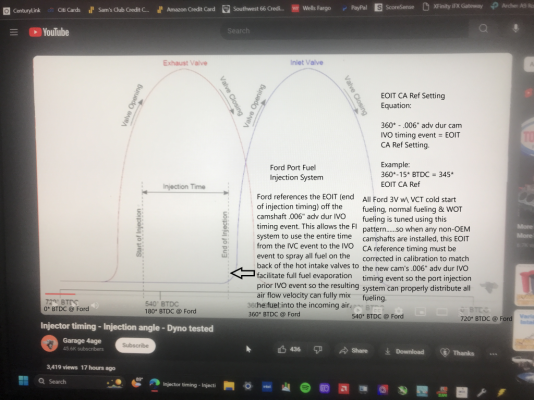
So now you see when you properly set the FI EOIT CA ref setting to match the .006" adv dur cam IVO event of any 3V camshaft--the way the creators of this platform, FoMoCo, designed this to be done--basic design & operation of a typical sequential port EFI fuel injection system so that all of the fuel is sprayed on the back of closed intake valves before the valves open so that all of the necessary transient fueling puddle fuel is also applied\maintained (facilitates cold start & accel\decel or "transient throttle response application"....) along w\ the calc'd fuel based off measured air mass flow then allowed the needed time for as much of this fuel to evaporate (only evaporated fuel will ignite & burn......ECU SOIT is automatically adjusted between the cam's IVC thru cam's IVO timing events duration so that the EOIT will always occur before the intake valves start opening thus all of the needed fuel is sprayed into the cyl head's intake port......), stuff just works right......exactly as FoMoCo set\programmed it all to do.

Setting this 1 setting properly will solve a MYRIAD of fueling issues w\ this platform...regardless of the camshaft profile being used & very, very few of the OEM Ford settings concerning fueling will need to be touched at all.......the engine WILL also make more overall HP & TQ as well due to the cyl head intake ports are also DESIGNED to accommodate sequential port fuel injection......is why the fuel injectors are placed where they are to begin with......by design, no mistake by Ford.

The mistake is from other folks--not Ford folks--who misunderstand\unaware of the basic engineering concept\design.....regardless of how long tenured in the tuning business & the proof is in the strategies where stock cams have been changed out & the OEM 345* CA ref setting that matches the .006" adv dur 15* IVO cam timing event (360-15=345) of the stock Ford cams is STILL set in the strategy & the new cam's .006" adv dur cam IVO event timing is opening the intake valves earlier than 345* CA, thus initially throwing this entire fueling system out of whack as the injectors will still be spraying fuel while the intake valves will be lifting off their seats initiating airflow thus the fuel has lost some evap time & can't properly maintain necessary fuel puddling to maintain clean transient throttle operations\response thus will be sweeping more raw fuel into cyls than necessary causing more issues as well......including decreased MPG, increased emissions & excessive engine oil fuel dilution......none of them are good. The larger the spread, the worst this gets.

Engine will still run up to a point........but not at its most efficient state. Just because it runs doesn't mean it's right.

No black magic & no secrets here...............basic engineering principle\design & function..........apply it correctly, you get correct results across the board. You have the cam card info.......this is easy to set. Just convert the .050" duration data (lobe lift) to .006" adv dur data (seat lift) then apply the math.........then input it into the strategy........done. Best done correctly up front so that you don't have to go behind & correct a lot of other stuff that was changed to "fix the issues" created by incorrectly setting this 1 setting up front......ie, chasing rabbits in the tune cal.

Front end tuning (initial setup & calibrations mostly.......) is what overall usually makes or breaks a tune cal when all external maintenance is properly accounted for.

My 2 cents.........................

Typical EOIT Port Fuel Injection Timing Pattern that Ford Uses (PAINT).JPG.png
 

AdamBorz

Member
Joined
Oct 31, 2025
Posts
55
Reaction score
39
Location
Bernville, PA
Ah ok............so all ended up working as it should.

So now you see when you properly set the FI EOIT CA ref setting to match the .006" adv dur cam IVO event of any 3V camshaft--the way the creators of this platform, FoMoCo, designed this to be done--basic design & operation of a typical sequential port EFI fuel injection system so that all of the fuel is sprayed on the back of closed intake valves before the valves open so that all of the necessary transient fueling puddle fuel is also applied\maintained (facilitates cold start & accel\decel or "transient throttle response application"....) along w\ the calc'd fuel based off measured air mass flow then allowed the needed time for as much of this fuel to evaporate (only evaporated fuel will ignite & burn......ECU SOIT is automatically adjusted between the cam's IVC thru cam's IVO timing events duration so that the EOIT will always occur before the intake valves start opening thus all of the needed fuel is sprayed into the cyl head's intake port......), stuff just works right......exactly as FoMoCo set\programmed it all to do.

Setting this 1 setting properly will solve a MYRIAD of fueling issues w\ this platform...regardless of the camshaft profile being used & very, very few of the OEM Ford settings concerning fueling will need to be touched at all.......the engine WILL also make more overall HP & TQ as well due to the cyl head intake ports are also DESIGNED to accommodate sequential port fuel injection......is why the fuel injectors are placed where they are to begin with......by design, no mistake by Ford.

The mistake is from other folks--not Ford folks--who misunderstand\unaware of the basic engineering concept\design.....regardless of how long tenured in the tuning business & the proof is in the strategies where stock cams have been changed out & the OEM 345* CA ref setting that matches the .006" adv dur 15* IVO cam timing event (360-15=345) of the stock Ford cams is STILL set in the strategy & the new cam's .006" adv dur cam IVO event timing is opening the intake valves earlier than 345* CA, thus initially throwing this entire fueling system out of whack as the injectors will still be spraying fuel while the intake valves will be lifting off their seats initiating airflow thus the fuel has lost some evap time & can't properly maintain necessary fuel puddling to maintain clean transient throttle operations\response thus will be sweeping more raw fuel into cyls than necessary causing more issues as well......including decreased MPG, increased emissions & excessive engine oil fuel dilution......none of them are good. The larger the spread, the worst this gets.

Engine will still run up to a point........but not at its most efficient state. Just because it runs doesn't mean it's right.

No black magic & no secrets here...............basic engineering principle\design & function..........apply it correctly, you get correct results across the board. You have the cam card info.......this is easy to set. Just convert the .050" duration data (lobe lift) to .006" adv dur data (seat lift) then apply the math.........then input it into the strategy........done. Best done correctly up front so that you don't have to go behind & correct a lot of other stuff that was changed to "fix the issues" created by incorrectly setting this 1 setting up front......ie, chasing rabbits in the tune cal.

Front end tuning (initial setup & calibrations mostly.......) is what overall usually makes or breaks a tune cal when all external maintenance is properly accounted for.

My 2 cents.........................

View attachment 112864

I love reading your posts... well actually reading them a couple times to fully (and I use that term loosely) digest LOL. You are a wealth of knowledge. All I know is from reading posts like yours and talking with guys like Lito.

From you I learned that tab in the HP tuning software can be changed. Lito dialed it back from 345, not the full 29.5 degrees, but further than the other tuners that tuned my car before had (which they just left at the 345).


1766092170656.jpeg
 

GlassTop09

Senior Member
Joined
May 24, 2019
Posts
1,361
Reaction score
834
Location
Farmington, NM
Perhaps someone more knowledgeable here can chime in on cam choices, but Hot Rods with their wide LSA will bleed boost more so not ideal for boosted applications, though they do sound nice :)
Hey StockishS197,

Here is a MT article from Aug 2011 where some folks were testing ported 3V cyl heads on a boosted 3V & then tested NA Ford Hot Rod cams w\ these heads vs an experimental Ford cam grind that Ford developed to be strictly for FI applications..........dyno tests results showed that the experimental Ford FI cam didn't outperform the NA Ford Hot Rod cams on the same car\setup, so Ford ditched this project since the NA Hot Rod cams performed better....they just labeled the Hot Rod cams to be NA & FI compliable going forward.


Enjoy!
 

GlassTop09

Senior Member
Joined
May 24, 2019
Posts
1,361
Reaction score
834
Location
Farmington, NM
Lito dialed it back from 345, not the full 29.5 degrees, but further than the other tuners that tuned my car before had (which they just left at the 345).
Now what Lito is doing here you might call "black magic", but it's really based on some fundamental engine operational dynamics & physics.

Lab testing has determined that there are only 2 methods using port EFI fuel injection timing that will make the most TQ, 1 will be more efficient than the other while the other will make more TQ but won't be as efficient doing so.

The 1st method is the 1 I posted the picture of......this is the most efficient method for MPG, emissions & will make very high TQ output (the 1 Ford chose to use with 3V's........) due to the highly efficient use of burning as much of the fuel & air as possible inside of the cylinders.......high TQ output is created here from the ability to actually speed up the fuel burn rate (the main purpose of the CMCV's--charge motion control) from improved air\fuel charge motion created in the cyl\combustion chambers to maintain homogenous mix (air, fuel & some amount of EGR......depending on cam profile & amount of VCT cam retard being used......why these 3V's don't use an EGR valve......) thus also use\need less ignition timing to achieve the same amount of TQ output which will reduce the advent of mechanical pumping losses from igniting the air\fuel mix too early while the piston is still coming up to TDC during the compression stroke (from my testing & doing a lot of math, the critical ignition timing is around 24*-26* max, sweet spot is between 19*-22* for max TQ output w\ my engine using the NM version of E10 91 oct fuel @ 5486' elevation @ 65*F-100*F IAT--bad air, from 36*F-47*F IAT--good air--this drops to around 14*-15.5* max w\o knock due to the heavily increased air density thus engine loads.....).......after this you're starting to incur excessive force on piston coming up during the last part of compression stroke after ignition, countering the force on the leading piston being pushed down the bore during its power stroke to push vehicle forward as well as eating up some of the stored inertial momentum of the spinning flywheel\TQ converter to continue the crankshaft rotating instead of assisting the piston already in the power stroke to push the vehicle forward.....thus is netting some amount of final net TQ loss while incurring increased loading on rod bearings, crank main bearings, side loading piston skirts, wrist pins, etc. The further you go out, the worse this is getting.......this is why the term "MBT" in engine physics terms is really the engine coming into some level of force equalization across the crankshaft (why the engine stops making "extra" TQ & can start dropping TQ output.......), as long as the fuel's oct rating will allow these high cyl pressures to occur w\o knock. The big loser is the rotating component system........especially the bearings due to the extremely high cyl pressures being exerted on both sides.......wonder why cyl heads will eventually lift if the rods don't go 1st or bearings start spinning.........

This is what makes the GM LS\LT engines so potent........improved port then later DI\cyl air & fuel charge motion thru heads w\ improved chambers & quench\squish to make very high cyl pressures at much lower peak ignition timing w\o knock. Ford used CMCV's to achieve the same purposes along w\ the cyl head chamber design w\ the 3V--lacks effective chamber quench\squish--across the full RPM range.......whether the CMCV's are closed (simulating a longer runner at lower RPM's) or open in the process at higher RPM's.........

Food for thought if 1 is chasing peak HP\TQ numbers on dynos..............especially if you intend to drive\race your Stang year-round..........on a limited budget..........

The 2nd method is by injecting fuel thru open intake valves during the intake stroke---SOIT after the exhaust valve has closed---but EOIT just before the intake valve closes........simulating the process of DI except from the port. This method will make the most TQ output mainly due to the charge cooling effect from fuel spray evaporating directly inside of the cylinders\combustion chambers at the expense of some of the fuel not fully evaporating (due to the short time window for full evaporation thus some of this fuel doesn't get fully burned thus is expelled as soot......some of this fuel also can end up going thru the piston rings as blow by during compression thus can impact engine oil fuel dilution.....) thus not as efficient but will generate the most TQ due to being able to use more ignition timing to reach higher cyl pressure w\o knock.

Since Ford learned this, starting w\ the 2011 MY (the advent of the Coyote engine......) Ford incorporated this 2nd method to work in tandem w\ the 1st method by a process called OVI (open valve injection) to achieve the best of both methods of EFI port fuel injection where they make the most sense........uses the EOIT referenced off the cam IVO timing event as normal process until the engine loads exceeds a certain level (think high loads like WOT for instance.....) at which time the ECU will spray a determined amount of extra fuel thru the open intake valves to achieve the CC cooling to enable this engine to maintain higher spark timing thus enhanced high load TQ\HP outputs running 87 or higher oct fuel @ 11:1 CR........this is 1 of the ways that Ford can squeeze the amount of HP out of this engine while flattening out the TQ curve across the entire RPM curve.

Now, if 1 is fully understanding all of this from a dynamic POV, 1 could intentionally & strategically slip a little misted fuel thru slightly open intake valves during the intake stroke w\ this 3V to kinda achieve the very same result (charge cooling in CC's) as Ford already knew to do if they chose to by setting the FI EOIT CA ref setting in tune cal slightly later than the actual .006" adv dur cam IVO event timing of the camshafts being used.......that is, if you can accept the cons from doing this to gain a potential small peak HP\TQ gain vs setting this correctly.

I've tested this myself about 2 yrs back............determined it wasn't worth losing the far larger gain I got in MPG from correct EOIT ref CA setting while allowing the potential increase in engine wear thru increased fuel dilution, especially when my car is mostly a daily driver\cruiser duty & engine is high mileaged (184+K & counting).........have a 2nd vehicle (my Dodge RAM 1500 truck) to drive but it can't even come anywhere close to the MPG this Mustang can achieve & damn sure ain't as much fun to drive..........

IMHO, dedicated race car, game on........take full advantage of everything. A street car--especially 1 where you're using as a daily driver & is your only means of transportation........not worth this........set the FI EOIT ref CA setting properly & enjoy.

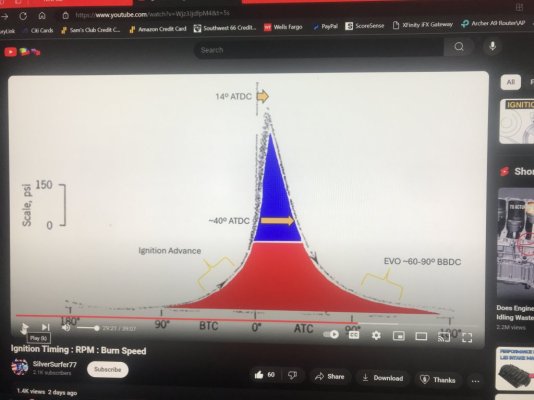
Provided below is picture of a US NACA 189 recording generated in 1922 of a gas-powered ICE engine cyl pressure plot vs crank angle where the cyl will make the most TQ against the crank throw at the highest effective fuel burn speed at that time.........that still stands to this day & every serious racing entity\OEM's on earth knows & tries to maintain to make max efficient HP\TQ.......... I find my engine using these Hot Rod cams hit this @ WOT at VCT 17* retard.......not the Ford recommended WOT 20* retard.......which corresponds to 10* ATDC, not 13* ATDC........today's fuels actually do burn at higher speed rates vs 1922...........

Again, if understood, no black magic & no secret.

Gasoline Burn Speed Max Cyl Press Graph.JPG
 

AdamBorz

Member
Joined
Oct 31, 2025
Posts
55
Reaction score
39
Location
Bernville, PA
Hey StockishS197,

Here is a MT article from Aug 2011 where some folks were testing ported 3V cyl heads on a boosted 3V & then tested NA Ford Hot Rod cams w\ these heads vs an experimental Ford cam grind that Ford developed to be strictly for FI applications..........dyno tests results showed that the experimental Ford FI cam didn't outperform the NA Ford Hot Rod cams on the same car\setup, so Ford ditched this project since the NA Hot Rod cams performed better....they just labeled the Hot Rod cams to be NA & FI compliable going forward.


Enjoy!

Now what Lito is doing here you might call "black magic", but it's really based on some fundamental engine operational dynamics & physics.

Lab testing has determined that there are only 2 methods using port EFI fuel injection timing that will make the most TQ, 1 will be more efficient than the other while the other will make more TQ but won't be as efficient doing so.

The 1st method is the 1 I posted the picture of......this is the most efficient method for MPG, emissions & will make very high TQ output (the 1 Ford chose to use with 3V's........) due to the highly efficient use of burning as much of the fuel & air as possible inside of the cylinders.......high TQ output is created here from the ability to actually speed up the fuel burn rate (the main purpose of the CMCV's--charge motion control) from improved air\fuel charge motion created in the cyl\combustion chambers to maintain homogenous mix (air, fuel & some amount of EGR......depending on cam profile & amount of VCT cam retard being used......why these 3V's don't use an EGR valve......) thus also use\need less ignition timing to achieve the same amount of TQ output which will reduce the advent of mechanical pumping losses from igniting the air\fuel mix too early while the piston is still coming up to TDC during the compression stroke (from my testing & doing a lot of math, the critical ignition timing is around 24*-26* max, sweet spot is between 19*-22* for max TQ output w\ my engine using the NM version of E10 91 oct fuel @ 5486' elevation @ 65*F-100*F IAT--bad air, from 36*F-47*F IAT--good air--this drops to around 14*-15.5* max w\o knock due to the heavily increased air density thus engine loads.....).......after this you're starting to incur excessive force on piston coming up during the last part of compression stroke after ignition, countering the force on the leading piston being pushed down the bore during its power stroke to push vehicle forward as well as eating up some of the stored inertial momentum of the spinning flywheel\TQ converter to continue the crankshaft rotating instead of assisting the piston already in the power stroke to push the vehicle forward.....thus is netting some amount of final net TQ loss while incurring increased loading on rod bearings, crank main bearings, side loading piston skirts, wrist pins, etc. The further you go out, the worse this is getting.......this is why the term "MBT" in engine physics terms is really the engine coming into some level of force equalization across the crankshaft (why the engine stops making "extra" TQ & can start dropping TQ output.......), as long as the fuel's oct rating will allow these high cyl pressures to occur w\o knock. The big loser is the rotating component system........especially the bearings due to the extremely high cyl pressures being exerted on both sides.......wonder why cyl heads will eventually lift if the rods don't go 1st or bearings start spinning.........

This is what makes the GM LS\LT engines so potent........improved port then later DI\cyl air & fuel charge motion thru heads w\ improved chambers & quench\squish to make very high cyl pressures at much lower peak ignition timing w\o knock. Ford used CMCV's to achieve the same purposes along w\ the cyl head chamber design w\ the 3V--lacks effective chamber quench\squish--across the full RPM range.......whether the CMCV's are closed (simulating a longer runner at lower RPM's) or open in the process at higher RPM's.........

Food for thought if 1 is chasing peak HP\TQ numbers on dynos..............especially if you intend to drive\race your Stang year-round..........on a limited budget..........

The 2nd method is by injecting fuel thru open intake valves during the intake stroke---SOIT after the exhaust valve has closed---but EOIT just before the intake valve closes........simulating the process of DI except from the port. This method will make the most TQ output mainly due to the charge cooling effect from fuel spray evaporating directly inside of the cylinders\combustion chambers at the expense of some of the fuel not fully evaporating (due to the short time window for full evaporation thus some of this fuel doesn't get fully burned thus is expelled as soot......some of this fuel also can end up going thru the piston rings as blow by during compression thus can impact engine oil fuel dilution.....) thus not as efficient but will generate the most TQ due to being able to use more ignition timing to reach higher cyl pressure w\o knock.

Since Ford learned this, starting w\ the 2011 MY (the advent of the Coyote engine......) Ford incorporated this 2nd method to work in tandem w\ the 1st method by a process called OVI (open valve injection) to achieve the best of both methods of EFI port fuel injection where they make the most sense........uses the EOIT referenced off the cam IVO timing event as normal process until the engine loads exceeds a certain level (think high loads like WOT for instance.....) at which time the ECU will spray a determined amount of extra fuel thru the open intake valves to achieve the CC cooling to enable this engine to maintain higher spark timing thus enhanced high load TQ\HP outputs running 87 or higher oct fuel @ 11:1 CR........this is 1 of the ways that Ford can squeeze the amount of HP out of this engine while flattening out the TQ curve across the entire RPM curve.

Now, if 1 is fully understanding all of this from a dynamic POV, 1 could intentionally & strategically slip a little misted fuel thru slightly open intake valves during the intake stroke w\ this 3V to kinda achieve the very same result (charge cooling in CC's) as Ford already knew to do if they chose to by setting the FI EOIT CA ref setting in tune cal slightly later than the actual .006" adv dur cam IVO event timing of the camshafts being used.......that is, if you can accept the cons from doing this to gain a potential small peak HP\TQ gain vs setting this correctly.

I've tested this myself about 2 yrs back............determined it wasn't worth losing the far larger gain I got in MPG from correct EOIT ref CA setting while allowing the potential increase in engine wear thru increased fuel dilution, especially when my car is mostly a daily driver\cruiser duty & engine is high mileaged (184+K & counting).........have a 2nd vehicle (my Dodge RAM 1500 truck) to drive but it can't even come anywhere close to the MPG this Mustang can achieve & damn sure ain't as much fun to drive..........

IMHO, dedicated race car, game on........take full advantage of everything. A street car--especially 1 where you're using as a daily driver & is your only means of transportation........not worth this........set the FI EOIT ref CA setting properly & enjoy.

Provided below is picture of a US NACA 189 recording generated in 1922 of a gas-powered ICE engine cyl pressure plot vs crank angle where the cyl will make the most TQ against the crank throw at the highest effective fuel burn speed at that time.........that still stands to this day & every serious racing entity\OEM's on earth knows & tries to maintain to make max efficient HP\TQ.......... I find my engine using these Hot Rod cams hit this @ WOT at VCT 17* retard.......not the Ford recommended WOT 20* retard.......which corresponds to 10* ATDC, not 13* ATDC........today's fuels actually do burn at higher speed rates vs 1922...........

Again, if understood, no black magic & no secret.

View attachment 112896


So I mentioned to Lito that I was thinking of changing to the Hot Rod came, he recommended I stay with the comp cam I have now as I would lose hp/tq or whatever. I don’t think he gets the idea I would sacrifice some of that for that chop lol.

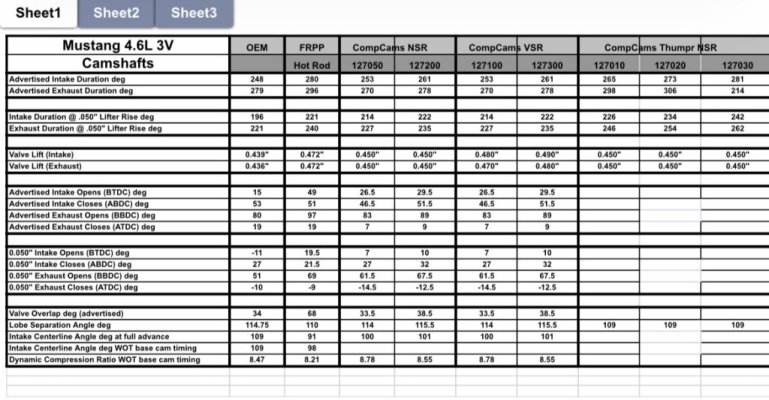
The chart I posted above say Hot Rod IVO is 49* vs OEM OF 15*. In a nut shell, you basically said through extensive testing you have come up with a calculated IVO (that I’m assuming you inserted into the programming) of something different than 315*? Maybe I’m taking that scalar too literally; OEM IVO of 15 hence its factory set at 345*.

Did I mention I like being able to pick the brains of people that have a greater understanding of all this than I?

Thank you!!
 

StockishS197

Member
Joined
Dec 24, 2024
Posts
434
Reaction score
378
Location
Houston
So I mentioned to Lito that I was thinking of changing to the Hot Rod came, he recommended I stay with the comp cam I have now as I would lose hp/tq or whatever. I don’t think he gets the idea I would sacrifice some of that for that chop lol.

The chart I posted above say Hot Rod IVO is 49* vs OEM OF 15*. In a nut shell, you basically said through extensive testing you have come up with a calculated IVO (that I’m assuming you inserted into the programming) of something different than 315*? Maybe I’m taking that scalar too literally; OEM IVO of 15 hence its factory set at 345*.

Did I mention I like being able to pick the brains of people that have a greater understanding of all this than I?

Thank you!!
Hot Rods IVO is 34 degrees sooner than the factory cam, so in crankshaft degrees that is 311.

GlassTop did some extensive testing and shared his results in the separate thread, but fuel injector timing is primarily for part throttle efficiency and emissions. At WOT, the change is negligible.

I tested both 345 and 311 and didn’t really notice a huge change - exhaust smelt cleaner especially at idle, and fuel efficiency may have increased slightly, but WOT AFR didn’t change.

If you change that scalar though, you will probably want to retune your MAF transfer as it could change slightly.

I don’t think that is the cause of the issue you are seeing though. My car ran more or less the same with both IVO settings.
 

Support us!

Support Us - Become A Supporting Member Today!

Click Here For Details

Back
Top