I apologize in advance for this very long post. There's probably too much detail
here for most people, but I didn't want to leave anything out that might be
helpful. Pictures of the installation are towards the end of the post.
I thought I would give an update on this project to share what I have learned about
the Coyote-S197 swap, in hopes that it may help someone else considering the swap.
My son's 2006 Roush Mustang is now back on the road with a ton of new parts,
including the Coyote engine, the VMP supercharger, the T56 magnum XL transmission,
and a few other related parts. He is just getting his feet wet with it, but you
can tell it is stupid fast already. We are looking forward to another track day,
but the car is now his daily driver on the street and is behaving itself for the
most part.
After wringing out the Roush supercharged 4.6, my son decided a supercharged Coyote
would be the way to go. We have a local friend who was upgrading from a VMP to a
Whipple supercharger on his 2017 Mustang, so we bought the VMP supercharger setup
from him. We also got the T56 Magnum XL package, which included the SFI bellhousing,
the transmission mount, and the shifter; it was a nice package. Also went with a
McLeod RXT clutch and a new Ford throwout bearing, plus a Mishimoto radiator.
After looking for a month or so we found a Coyote engine from a 2015 Mustang down
in a repairable place in Iowa. It came with all the parts we needed, including the
wiring harness, PCM, fuse box, and gas pedal. It was complete with all brackets and
engine accessories for about $5500, with 80K miles. We picked it up in March and
brought it home to start the swap.
Our original plan was to keep the engine all together. My son has very limited
mechanical experience with engines, and although I am very experienced with older
engines I've never been inside a modern one. So rather than commit to changing the
cams and cam phasers to work with the make it modular setup, we went with a guy on
Facebook called Lethal Nate, who would take the 4.6 engine harness and the Coyote
wiring harness, and merge them together. This way the the Gen2 PCM would work with
the engine, and the car's existing PCM would work with the instrument panel and
HVAC system.
After we had the engine for a few weeks,I decided to do a leakdown
check on the cylinders. Everything was going along fine until I hit cylinder 6 in
the firing order. All other cylinders up to that point had shown leakdown in the
0%-2% range, which was excellent. Unfortunately cylinder #6 showed 70% leakdown.
With a supercharger install on deck, this was unacceptable.
With the leakdown checker connected and the air pressure on, I listened
at the valve cover breather and the exhaust manifold, and heard nothing, but
leaking could be heard at the intake manifold inlet. So an intake valve was the
leaker. We pulled the intake manifold and determined that the leak was coming from
one of the two intake valves on #6. So we had to pull the left head.
As we started learning more about the Coyote engine and it's weaknesses,
we decided that swapping to new billet oil pump gears and crank gear would be a good
idea. Also, the PBH bracket setup that we purchased required modifications to the
timing cover, so we pulled that to make the modifications easier and also to swap
the oil pump gears and crank gear. So much for keeping the engine together, we may
have been better off with the make it modular setup, given the condition we found
the engine in. Hindsight...
Because we were going to have to re-time the engine along with installing the new
oil pump and crank gear, we pulled both valve covers, the cams,
rocker arms and adjusters, and finally the left head. Having not been inside one
of these engines before, I came away pretty impressed. The valvetrain was really
cool, and I was surprised by the tiny size of the valve springs and retainers, and
how the hydraulic lifters/adjusters/whatever they are called worked. Obviously
these engines rev due to light weight components, combined with a very large base
circle for the cam lobes. Made me want one for myself LOL!
With the head on the bench we started to go after the offending valve.
The valve springs were so small that my normal valve spring compressor wouldn't work,
so I took a deep socket that fit the retainer and machined an opening in it, then
used it with my valve spring compressor to compress the spring and remove the locks
so we could pull the offending valve. I stuck the valve in my lathe and found about
.006" of runout at the edge. So a bent valve, probably from some overrevving, was
the source of the leak.
We ordered a new valve from Ford, which was cheap at only about $20, and installed it
in the head. After re-installing the head I did another leakdown check and it was
only 6%, down from 70%. I suspect it will reduce further once the valve wears into
the seat, but in any case the problem was solved to our satisfaction.
We modified the timing cover and my son bead blasted it in my bead blast cabinet.
Came out looking real nice. We pulled the oil pump and did the youtube thing where
we dropped the original gears on the floor. Sure enough, they cracked. It's
amazing they last in the stock engines. My son got MMR oil pump gears and the crank
gear and we found an online video on how to get the engine timed correctly. Notably
the book we have on the Coyote engine, which was supposed to cover Gens 1, 2, and 3,
showed a Gen1 cam timing procedure, without specifying that it would not work for
later engines. Glad we didn't follow the book's advice.
After bolting everything back together and torquing all the fasteners, including new
fasteners of course for the head bolts and cam phasor bolts, we went ahead and
installed the PBH brackets. We had to get a new alternator pulley since with the
PBH setup the alternator runs backwards, and the original pulley is fitted with a
one way clutch. But we finally had the engine all dressed up and ready to go in
the car.
The 4.6 had been a pain to remove, because the BBM shorty headers made the engine
much wider than the frame. We had to pull it from the top, and separate the
transmission before hand. We figured it would be a lot easier to slip the new
engine/trans combo in from underneath. My son had purchased BBM shorty headers
for the Coyote, and they were way narrower than the ones on the 4.6. We measured
them, and they were right on the edge of 30" wide, which was the width of the
frame rails on the car. We elected to go forward with the install from underneath.
When we got the car dropped down over the engine/trans, we found that the headers
were just a bit too wide. Rather than going back to a top install, or removing
one of the headers and installing it after the engine was in position, we simply
dimpled a couple of the header tubes for clearance. That put us where we needed
to be, and the car dropped down nicely over the powertrain.
From there it was hookup, but we took a weekend break on that in order to put a
roll bar in the car. I didn't want my son to make some mistake driving it and flip it
over without protection. We removed the interior and I found a strong chassis
panel right behind the front seats that was suitable for a mount. I welded some 1/8"
steel plate to that panel to spread the load, then borrowed a friend of mine's tubing bender and
bent up the main hoop out of 1-5/8" chrome moly. The car also has a Steeda X-brace connecting
the rear suspension towers, so I bent up the back supports to connect to that. I
tack welded the back supports to the main hoop to keep them in place, and then we were
able to pull the whole roll bar out of the car to finish the welding those joints. We painted it,
then reinstalled it and TIG welded it to the Steeda X brace and the 1/8" steel plates.
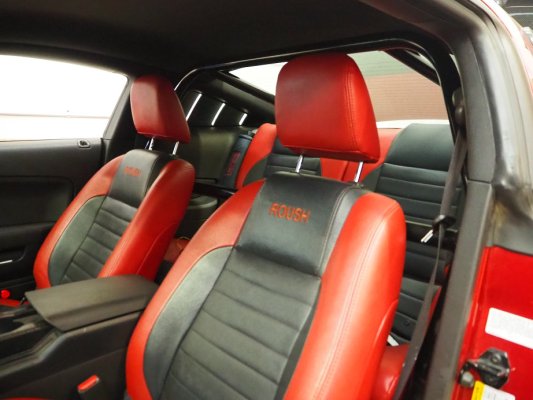
We had to cut a slot in each interior side panel to fit them around the roll bar, but the
cuts are barely visible. Picture below is how the interior looks after everything was
re-installed.
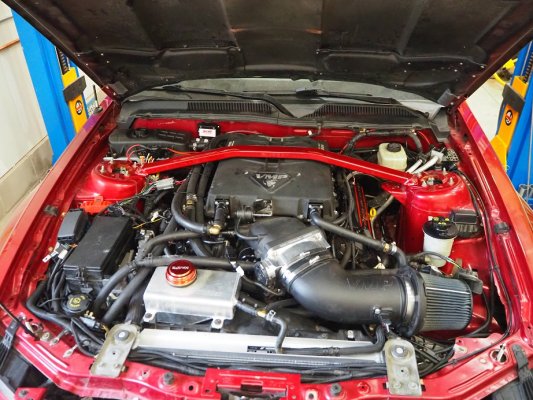
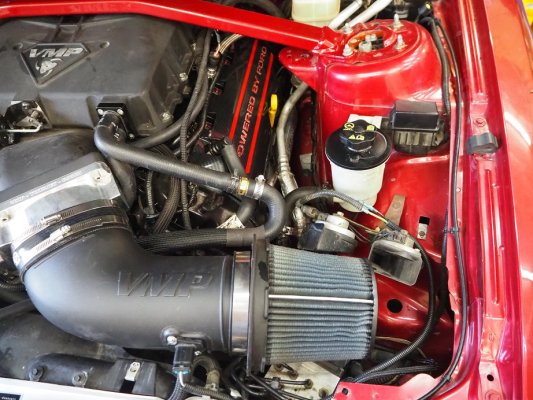
Back to the hookup. There was a lot of plumbing to consider, especially given
the supercharger's intercooler setup. Hooking up the oil cooler on the Coyote
required some right angle fittings to get the hoses where they needed to be, and we
had to modify the lower radiator hose from the Coyote engine to fit properly. The
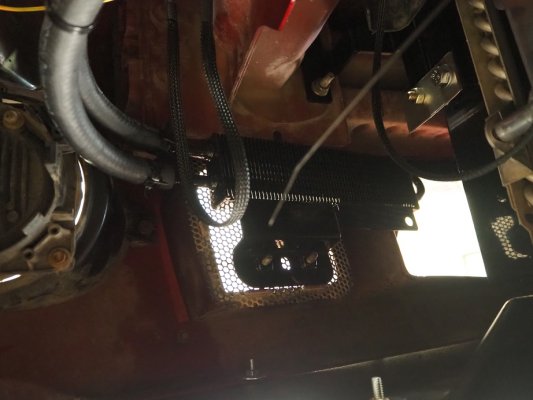
original power steering lines had these long aluminum tubes that went all the way
across the engine compartment and back; we assumed for cooling. We replaced them with
a conventional power steering fluid cooler (picture below), and mounted the reservoir
on the left fenderwell with a simple steel bracket. The horns also had to be relocated
to that area.
After about 8 weeks we got Lethal Nate's wiring harness. Nate turned out to be a great
guy to work with, always available to answer questions and give advice. The wiring harness
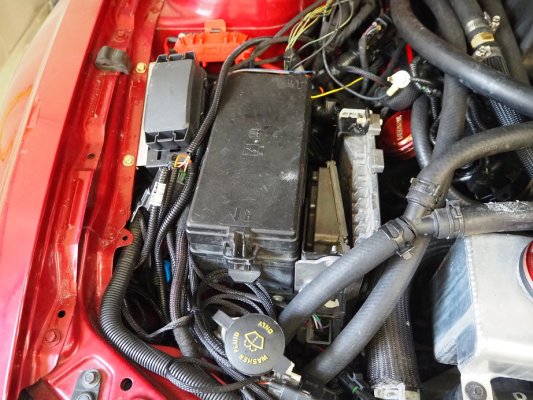
he sent included a large fuse and a smaller fuse box that worked with the existing fuse box.
In the picture below, the small black fuse box is mounted to the left of the factory box,
and the large fuse is in the red enclosure just behind it, mounted to the shock tower. I
also made up a bracket to mount the Gen2 PCM next to the factory PCM. There is a ton
of wiring in this area, which could be cleaned up with a little patience and shortening of some
of the stock wires, but we haven't got there yet. Lots of wiring cleanup yet to do on this car...
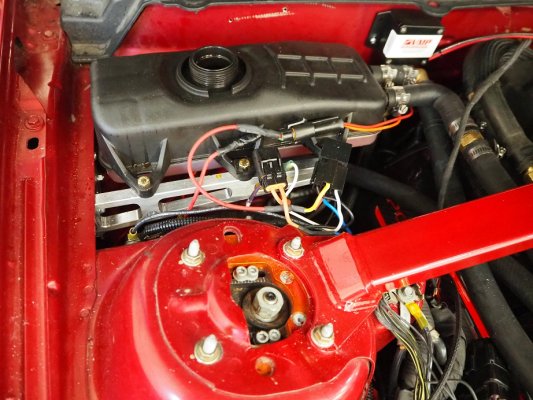
The intercooler reservoir was designed to mount on the left side of the supercharger,
but there it would have interfered with the brace going across the engine compartment.
We wanted to retain that brace, so instead I machined a little bracket to put the reservoir
at the back right of the engine compartment, where the battery had been. We hadn't
been planning to relocate the battery initially, but given the space constraints with the
supercharger setup it turned out to be necessary. A picture of the intercooler reservoir
is below. Also, to keep the engine supplied with fuel, we used a VMP fuel pump booster
to boost voltage to the pump, and a Redhorse return style fuel pressure regulator placed
under the car, back near the tank. It is set for a constant 60 psi of fuel pressure.
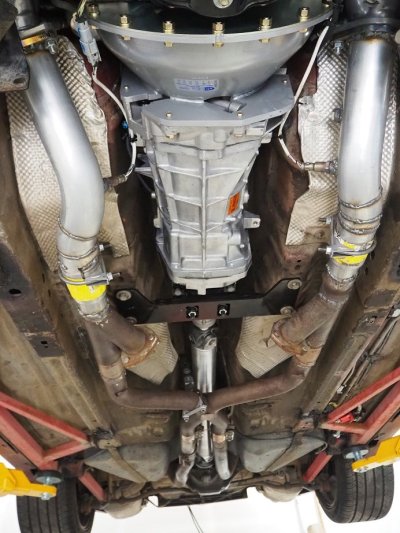
The last hookup item was the exhaust. The BBM header outlet was 3", so I wanted to keep the
3" diameter from the header outlet down to the connection with the remains of the existing
exhaust. We bought a 3" 16 gauge mandrel bent exhaust U-bend to make the connection.
The exhaust welding is ugly (see the picture), but the exhaust works, is tucked way up under
the car, and doesn't appear to leak. Also in the picture you can see the aluminum driveshaft
that works with the Coyote/T56 swap. Fit of the driveshaft was perfect.
After we finally had the hookup complete, we were down to the tune. We had decided not to
use a regular tuner, because apparently those guys lock the tune so it can't be modified. I
guess that's understandable, but I have done a bunch of EFI tunes using aftermarket ECUs,
and didn't like the idea of not being able to make modifications. Fortunately our friend who
sold us the supercharger was able to give us a tune that worked with his 2017 Mustang
when the supercharger had been on that car. My son got a copy of the HP tuners software,
along with the credits and OBD2 adapter, and he installed our friend's tune in the Gen2 PCM.
Of course, the car wouldn't start. Next we tried the stock tune from the naturally aspirated
Coyote, and the car started but seemed to run really rich. This made sense, because the injectors
for the supercharger setup are a lot bigger than the stock injectors.
After fighting with this for a week or so we eventually started modifying the stock tune with
elements of the supercharger tune, changing one thing at a time to see what wasn't working.
Eventually we found that the reason for the no-start was in the ignition portion of the tune, and
once we got around that then everything started working. After buttoning up some last issues,
my son put the finishing touch on the car:
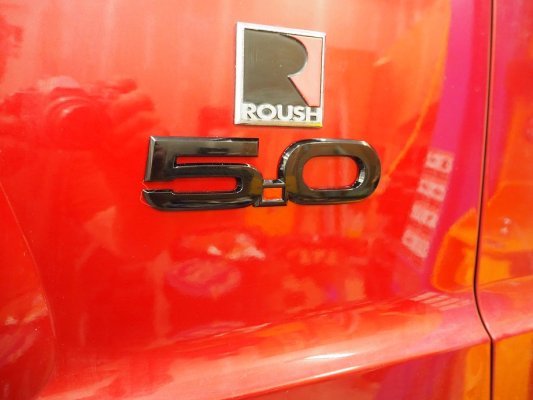
So, about a three month project with a successful ending. The first week driving the car
has led to a couple minor issues, including a noisy accessory drive belt and a clutch fluid
leak, but those have been solved already. We plan to do more tuning once we get
a chance to wring out the car a little. Tuning this thing is different for me, because
I'm used to speed-density stuff where the VE table is MAP based, not MAF or torque
based. We may take it to a dyno and tune it ourselves there, but right now its just
good to have the car back on the road and running well. And I hope this detailed post
helps some folks out when undertaking a project like this.