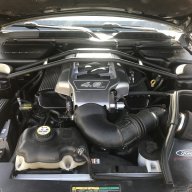
i have a jlt intake ,
lito said my maf was kinda skewed , and im wondering if this is a reason why?
because ever sinvce i put on the cai , my idle was never %100 stable
Also posted for those so interested............
If you're asking me..................the answer is yes, for more than just the air filter itself.......also due to the MAF section size. This 105-110 mm MAF section\tube is just too large w\ the OEM MAF sensor slot being located too far away from center of MAF section piping & too close to the MAF section sidewall to be accurate at low RPM air mass flow rates (air boundary layer is turbulent air due to flowing friction off walls & can influence air contact to MAF hot wire thru MAF slot.....), thus will excessively slow the airspeed velocity thru the MAF sensor slot at low RPMs thus the air will not make as smooth, clean &
consistent contact to the MAF hot wire thus can skew the 5v MAF reference output signal voltage from the MAF sensor to the ECU & cause similar resolution issues as these reusable cone air filters (due to the MAF sensor being located so close to these filters, it is imperative that the
filter media provide some type of air flow lamination\straightening to clean up air turbulence prior air entry into the MAF section & especially thru the MAF sensor slot to access the hot wire.........this is why the OEM's use smaller MAF section sizing that locates this MAF sensor slot opening as close to the center of the MAF section tube as possible to keep it away from any air boundry layer turbulence occurring off the MAF section walls but also to maintain the airflow velocity thru the MAF section above a minimum required speed that will ensure good, clean &
consistent air contact w\ the MAF hot wire element to eliminate voltage fluctuations that can cause the 5v reference signal voltage output from the MAF sensor to become erratic\unstable (thus the term resolution......)......throws off any calibrated MAF transfer function during calibration & afterwards which can\will throw off fueling......this can\will get worse if any tuners also intentionally disable MAF Adaption (race car thinking here....) in the tune calibration as well while using 1 of these CAIs.........they don't look good if your car is always randomly going into Limp Mode due to erratic MAF\SD airmass calcs that trigger excessive TQ errors thru IPC..........
But yours could also be due to a small vacuum leak around the MAF mounting flange (common w\ these ABS plastic tubes.......) or around the coupler at the TB that won't show up w\o the use of a smoke leak detector...........if you haven't already done this to eliminate this as a possibility.
But this statement of mine is a controversial topic for those who swear by these CAI's, much like the air surrounding CMCV's or 62 mm TB's.............regardless of any actual airmass flow data in existence that can potentially disprove the often-given reasonings for what has been established as "truths" concerning these components using WOT peak HP\TQ outputs off dyno sheet data alone........... This is 1 of these topics where that, just because someone made it "work" doesn't mean it is working correctly........just good enough to get by.
Individual choice is a good thing............as long as it is kept in that realm. When these choices are being touted as universal truths w\o any creditable evidence (actual air mass flow\resolution data to correlate any shown WOT peak dyno HP\TQ numbers.......not just peak WOT dyno numbers alone....), I've found that it all needs to be taken w\ a grain of salt. There is plenty of provided evidence out there across YouTube & other venues that can be used to both prove AND disprove the validity of the JLT 3 CAI claims. The only creditable evidence I've seen & noted around all this concerning this 3V is coming from Ford.........none of it provides any creditability towards JLT itself, outside of the general use of a cone filter. Ford has provided evidence to support using a cone filter vs a panel filter w\ this engine to optimize airflow thruput (aka the Ford-built 08-09 Bullitt CAI due to increased total filter surface area w\ the cone filter over the OEM stock panel filter......) ........just not a reusable 1 (too hard to maintain smooth airflow resolution thru MAF at lower RPM's thru a reuseable filter media.........dedicated race car OTOH, not an issue......) & definitely not 1 the size of the JLT 3 (just pure overkill & seems to be somewhat problematic at low engine RPM's concerning MAF resolution stability........).
This is why I initially chose to go w\ the Ford OEM 08-09 Bullitt CAI (actual 83 mm ID MAF section.......I physically measured mine at the time I installed it as it was reported to be 85 mm MAF......found this to be wrong.....the 2010 Ford OEM 4.6L Mustang CAI MAF section IS 85 mm ID......also physically measured it as I have 1.....intend to upgrade to it at some point in future.....) to upgrade over the stock OEM GT 80mm CAI but I was using the FP FA1891 air filters (grey media) w\ a dust sock until they were discontinued, then I went to the K&N E-1997 air filters until recently as I posted prior.........now I know for certain that this K&N E-1997 Bullitt replacement filter is not necessary or needed.....proven by actual MAF air flow data that immediately showed itself as soon as I had changed the filters out & installed the Ford OEM Bullitt FA 1895 replacement filter w\ a dust sock over it (the dust sock use was proven at the dyno to not be a restriction some 4+ yrs ago.......they make excellent "pre-filters" that can prolong a paper cone air filter's usable life........) thru a datalog & O2 sensor feedback correction, then made a WOT run to check the top end flow which showed itself to not be restricted in any way vs the K&N, then rechecked after making the noted corrections to my calibrated FR Hot Rod Cam MAF transfer function in my car's tune calibration thru another datalog that repeated all recorded prior thus proved the K&N air filter claims of improved airflow thus engine performance vs an OEM air filter to be false.........thru my 184K+mi engine at the least, but the much improved low RPM performance (hot idle quality, off idle & low RPM acceleration response, overall smoothness, cold start performance, etc from more accurate air mass calcs--both MAF & SD--thus more accurate fueling calcs thus more accurate O2 sensor feedback corrections......thru an 83mm MAF section......all items that cannot be shown thru a WOT-recorded dyno peak HP\TQ sheet.......doesn't make it not to be true as this can be demo'ed thru before\after tuning software datalog acquisition data........) was too obvious to ignore.
This aspect of doing your own tuning is where it can pay out dividends.............provided you put in the necessary time & effort to learn then properly vet established teachings\truths to either prove them valid or prove them false so in the end you aren't beholden to them or misled by any person touting them.
Just to put this out here, during my prior employment pre-retirement, I also--at 1 time--was a fully trained\certified F3 Measurement Tech (electronic gas measurement) for Phillips Petroleum Co before the merger w\ Conoco back in 2003.......so I do know a thing or 2 concerning air\gas measurement & the sciences surrounding it. The main reasoning why gas meter tubes are internally honed & polished while equipped w\ inlet straightening vanes is to reduce the boundry layer buildup from gasses flowing in contact w\ the inner pipe walls at high velocities as well as maintain a true inner ID size across the meter pipe length thus increases gas measurement calculation accuracy thru the orifice plate ID size in the center of the meter pipe & are sized according to the amount of expected volume flow output then resized as volume outputs change......meaning larger OR smaller as required........to retain measurement accuracy.
A slot type MAF sensor follows\emulates these gas measurement flowing principles within a CAI..........so larger just to be larger w\o actual creditable air mass flow numbers\MAF resolution stability to prove it is not better. Marketing 101.............we've all been pulled in by it at some point...........along w\ some level of peer pressure\influence.
With some items\components, your eyes can indeed lie to you if not bolstered by some understanding\knowledge of the sciences that are used to quantify the designs\sizing's that you see\are looking at......................
Any MAF section size >85mm is pure overkill (small enough to maintain good resolution thru the MAF section at low RPMs but large enough to not be a restriction at WOT...........when calculating ideal air mass flow thru a stock NA 4.6L V8 at 6,500 RPM's, a 83mm MAF section size is more than enough at these ideal WOT flows while providing very good MAF resolution stability at low RPM's w\ the proper air filter media being used.....) & isn't really providing any real benefit w\ a NA 4.6L 3V vs an Air Raid, C&L Street\Race or Roush CAI with or without the no tune required MAF insert installed or Ford OEM 08-09 Bullitt 83mm CAI--all within the margin of error thus is a wash........even w\ a cammed NA stroker, strokers make the usage odds seem better due to higher airmass flow thruput potential vs a stock block but not necessarily true just because.......mostly visual aesthetics & perceived performance improvements. Where these JLT 3 CAIs will truly shine (same also goes for all the CAI's I've mentioned prior......) is during consistent full WOT service, much in the same vein as a typical 62mm TB when viewed CFM flow-wise..........like a dedicated drag car or road course track car on courses that have long straights where the car can actually make full use of WOT speeds......think higher airspeed velocities that will "correct" the air resolution wash thru the larger MAF section...........but generally not so useful\beneficial otherwise from 1 vs the other.......from a specific CFM airflow POV perspective.......the deciding factor then is always the low RPM MAF resolution stability performance......larger MAF sizing will always be the loser here........where it counts the most.........fact.
But to each their own..........................FWIW.








 Can you put the logfile somewhere on e.g. Google Drive?