
I'm sure this topic has been discussed but I have a question for someone who just daily drives their car, doesn't track it, but is lowered on FRPP K Springs and wants a softer ride. I do not want the ride soft enough so I'm slamming off of the bumpstop or have the car feeling bouncy. Are the STR.T's sufficient enough or are adjustables my only options?

You are using an out of date browser. It may not display this or other websites correctly.
You should upgrade or use an alternative browser.
You should upgrade or use an alternative browser.
Are Adjustables Really Needed
- Thread starter cm581978
- Start date

I guess I should have clarified a bit better. I'm currently on FRPP K Springs with the FRPP Blue Non Adjustables and while it handles great, I've driven on this setup for 57k miles and it's almost time for a replacement.

If you are talking about Koni "Yellows" when you say "adjustables", they might not be a solution for a stiffer-ride problem: the "Soft" setting is not soft like original Ford shocks, it's "Relatively Soft as compared to Other Settings On the Same Koni Shock". It's not necessarily harder than stock, but different in rate of application of the damping effects, especially since the adjustability is on rebound. Jounce is, in my experience, just a bit "different/harder" than stock, all else being equal.
Roadracer350
Senior Member
Get rid of the springs, shocks and struts. Take the cash, add some to it and buy coils and don't look back! 

Sky Render
Stig's Retarded Cousin
*sigh*
Not everyone needs coil-overs.
Not everyone needs coil-overs.

Random Asshole
meow
The setup you have is one I've used in the past. I thought it was OK on the track, but grew tired of it eventually. I believe a different spring and a decent set of dampers (adjustable rebound or not) will make you happier than "the best" shocks paired with your current springs. I'd seriously consider a different spring if your are going through the hassle.
To answer your question: No. But it sure is nice once you dial it in how you like it.
To answer your question: No. But it sure is nice once you dial it in how you like it.

Roadracer350
Senior Member
*sigh*
Not everyone needs coil-overs.
LOL!!! I just had to throw that out their!

Roadracer350
Senior Member

Sky Render
Stig's Retarded Cousin
Coil-overs aren't magic. They're still just dampers and springs.

Sam Strano
Senior Member
- Joined
- Oct 23, 2009
- Posts
- 918
- Reaction score
- 6
First, shocks are dampers. They do NOT limit travel they control the speed of it. So when it's said that Bilstein's will kee you from "having a chance hitting the bumpstops" that's not true, at all. More to the point Bilstein's are quite pricey for non-adjustable dampers, and elsewhere in this forum is a guy who had them and now has Koni's and I think the statement he made about the Bilstein's and the H&R's he had was the "car bounced like a pogo stick"
For once I'll agree with SkyRender on his statement that coil-overs are not magic, they are in fact just springs and dampers, that happen to give you ride height adjustability. Some might seem like magic on the higher end of things because more time and effort (and therefore cost) are put into developing the springs and dampers together. But that doesn't mean any kit of great, or right for every person.
FWIW, the FRPP dampers have lots of good rebound. But they ride like complete crap, like sledgehammers. You can do SOOOOO much better, even if you don't want to go to an adjustable damper. Koni STR.T's are great for the guy who wants a composed car, no adjustment, and doesn't want to spend $500+.
I'd still put Koni Sports on it. Hard to bear the value, or the proven record of Koni's. And while not as cheap as non-adjustables you get a shock that has a lifetime warranty (well supported too when required) and doesn't loose it's starch in 40k miles, because you can add more rebound damping in. And that is actually how the Koni adjustment started way back as a tuning tool for the wear old shocks had. Since things have gotten MUCH better in terms of oils, seals, and generally durability, and that adjustment also allows you to play with the response and feel of the car and that's pretty what it's used for these days.
For once I'll agree with SkyRender on his statement that coil-overs are not magic, they are in fact just springs and dampers, that happen to give you ride height adjustability. Some might seem like magic on the higher end of things because more time and effort (and therefore cost) are put into developing the springs and dampers together. But that doesn't mean any kit of great, or right for every person.
FWIW, the FRPP dampers have lots of good rebound. But they ride like complete crap, like sledgehammers. You can do SOOOOO much better, even if you don't want to go to an adjustable damper. Koni STR.T's are great for the guy who wants a composed car, no adjustment, and doesn't want to spend $500+.
I'd still put Koni Sports on it. Hard to bear the value, or the proven record of Koni's. And while not as cheap as non-adjustables you get a shock that has a lifetime warranty (well supported too when required) and doesn't loose it's starch in 40k miles, because you can add more rebound damping in. And that is actually how the Koni adjustment started way back as a tuning tool for the wear old shocks had. Since things have gotten MUCH better in terms of oils, seals, and generally durability, and that adjustment also allows you to play with the response and feel of the car and that's pretty what it's used for these days.
Hey Sam,
You are correct that dampers will not limit motion absolutely. Those particular Bilsteins that Vorshlag sells have a shorter shock body, so it does in fact increase available pre-bumpstop travel.
Now, there are certainly some scenarios where using more compression dampening will keep you either off the bumpstops, or will result in hitting the bumpstops with less force. But you are right that they do not limit absolute range of motion and will not help keep you off the bumpstops as much as a stiffer spring will.
You are correct that dampers will not limit motion absolutely. Those particular Bilsteins that Vorshlag sells have a shorter shock body, so it does in fact increase available pre-bumpstop travel.
Now, there are certainly some scenarios where using more compression dampening will keep you either off the bumpstops, or will result in hitting the bumpstops with less force. But you are right that they do not limit absolute range of motion and will not help keep you off the bumpstops as much as a stiffer spring will.
Vorshlag-Fair
Official Site Vendor
Budget, experience, competitiveness and actual usage is what drives people away from the OEM style shocks (Koni, Bilstein, Tokico, etc) into real coilovers. The reason coilovers normally work so much better is that they are CONSIDERABLY SHORTER THAN THE OEM LENGTH struts and shocks. That is what you need after you've lowered the car more than 1-2 inches, to maintain any usable bump travel... just putting shorter springs on the OEM length struts means every inch you've lowered the car is bump travel that is gone forever. Getting a car 2" lower on springs alone means you're going to be going the "bump stop dance" all the time, and the springs are still gong to be super soft. Using the bump stops in cornering makes for an evil handling car and terrible street ride.
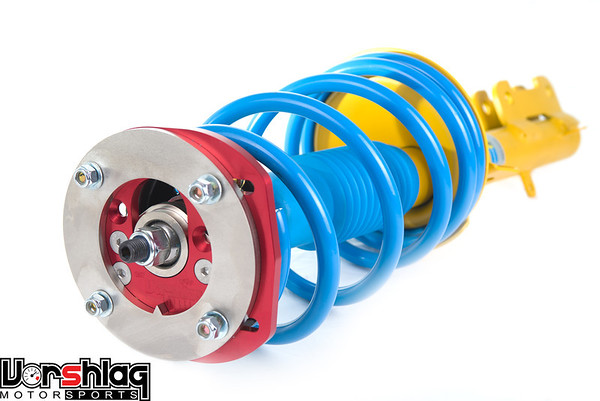
Our shortened Bilstein StreetPro shock/spring/camber plate set-up is one of the only OEM style struts that has a shorter strut body than everything else out there. This is one of those "tweener" suspension choies that works. It also costs about half of what the MCS TT1 system costs, with springs and camber plates. For many folks, this is what they need - for good street ride quality, added suspension travel at a lowered height, and some track worthiness.

Stock springs are soft and allow the S197 chassis to flop around, roll, brake dive, and be mushy
The S197 Mustang comes with VERY soft spring rates and utter crap OEM dampers from the factory. There are two reasons why: first, the suspension is tall and soft to work for "everyone" that buys these cars, to work in every environment and for every age group (16 year old to 95 year old). They can work with snow chains, plow through snow drifts, pound down dirt roads, all of that. Second, the dampers Ford puts on these cars are CHEAP to save costs. Their budget is likely around $40 per corner, so you can imagine how good those will work. Big sloppy noodles, but with soft and tall springs it rides OK for normal street stuff.


Appropriate use of tall ride heights on a Mustang, heh (that's my new Rallycross SN95!)
If you are reading this forum you are not part of the "lowest common denominator" customer that Ford has to design these cars around - you are probably a gear head. You might even be a canyon driving enthusiast, HPDE driver, Time Trial or autocross competitor, and if so, you are the right person for coilovers. If you just want a lowered "Stance" and don't care about performance handling or ride, then just buy the lowering springs and hard park that bitch.
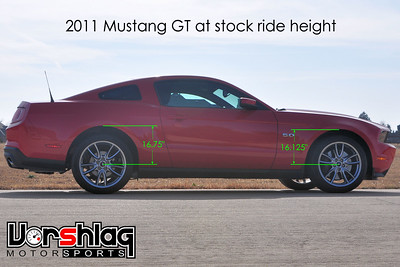
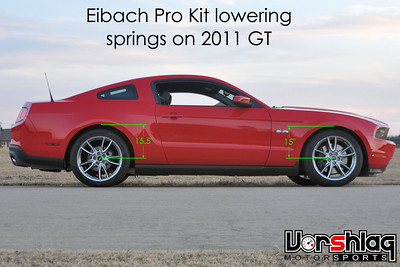
Do you spend more on hair product than on brake fluid? Then slap some lowering springs on and floss...
When you want more on-track competitiveness than a 30% stiffer lowering spring can allow, you move to coilovers. And I don't mean Chinese built stance coilovers, I mean quality adjustable dampers from places like AST, Moton, MCS, Penske, Ohlins, JRZ. The sweat shop coilovers aren't worth anything because they are built by people that have never seen your car, much less tested and perfected with one. They make "one size fits all" inserts and bodies that "fit your car", but the longevity and performance are not worthwhile.

The car above is cornering on 295mm Rivals, 18x11" wheels, AST 4150s, 550#/in front springs, and hauling much ass
Lowering the CG height and firming up the spring rates by 200-400% are very real improvements. Increasing the damping forces by 100-400% are very real improvements. These are not "debatable" or opinion based statements, but fact based. Testing shows this, over and over and over again. Real coilovers are needed to go fast on track, beyond the casual "once a year" track day driver that is rolling around at 6/10ths.
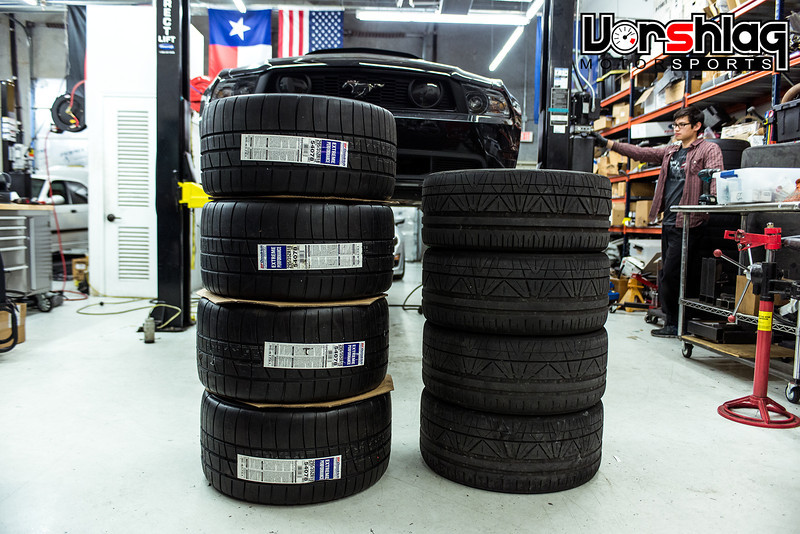
Wheels and tires are the single biggest improvement. But once you have that added grip, you'll need dampers to match...
If you've added 30+ mm of tire or are tired of passing everyone in the "Green group", you are likely the right candidate for coilovers. Now this isn't everyone, of course, and you need to budget $2500-3500 for a proper coilover damper, springs, ride height adjusters and spherical top mounts. Going fast often costs money. But after tires, there is no other single modification that can lower your track times as much as proper coilovers.


Left: The "Before" with stock shocks/springs, camber plates, 18x10" wheels and 295 tires. After: Lowered 2.5", 4x stiffer springs, real dampers
We've tested this "theory" with our 2013 Mustang GT (that had a big bar and camber plates and 295mm tires on it both times), back to back with OEM shocks/springs and then again with monotube coilovers plus real spring rates, and saw a solid 4 second drop on a 2 minute course. That's very real, and very significant. And not what you'd see with Konis and lowering springs. We've done those track tests as well and they tend to make more like a 1 second improvement.


Left: Stock S197 tires/suspension. Tall, lots of lean, and positive front camber. Right: Stock Boss302 with 18x10" wheels, 275 tires, camber plates.
You don't see fast track drivers at even HPDEs on Konis and lowering springs. Twin tube shocks are never used on racing cars, either (unless the rules require it for some weird cost reasons, but even spec racing classes are moving to monotubes because they are so much more robust). Twin tube type shocks only have two small advantages over a monotube - a little more stroke for a given body length but mostly it comes down to less cost. There is no comparison when it comes to performance - due to radically smaller piston sizes, reactions to small movements, and damping force range. Sure, some drivers have a lot of talent and this can make up for their lackluster suspension choices, but they would simply be faster on a well tuned coilover set-up with firmer spring rates and better damping.

Coilover shocks tend to have adjustable damping on one or more circuits. Low speed rebound is very common, aka: singles. Some have low speed compression as well - aka: doubles. Remote reservoir shocks are getting a little crazy and the costs are significantly higher, but the added stroke is sometimes worthwhile on very low race cars. Not what you'd see on a dual use street/track car.

If you are doing track or autocross events and don't have some goofy class rules that prevent it, quality monotube coilovers should be high up on your wish list, in front of everything else except better tires. I've seen literally thousands of folks over the years that stared off on OEM stuff, then went to lowering springs and Konis (aka: bumpstop warriors), then cheap coilovers (worse), then finally moved to real coilovers. It is amazing how many people that have done this have told us "I wish I just would have skipped those early steps and gone right for coilovers from the start!" If tracking or autocrossing is a passion of yours, and it is something you plan on doing for years to come, don't short change yourself... budget for real dampers early. Do shocks before you throw more power at your Mustang, or any bolt-on doo-dads or braces, before you do wings or splitters, BBKs or roll bars.


With increased mechanical (tire) and aero grip comes even more need for quality dampers and higher spring rates
Tires and dampers are going to account for at least 80% of your on-track performance improvements, if not more. Don't skimp on what maters most!
Cheers,

Our shortened Bilstein StreetPro shock/spring/camber plate set-up is one of the only OEM style struts that has a shorter strut body than everything else out there. This is one of those "tweener" suspension choies that works. It also costs about half of what the MCS TT1 system costs, with springs and camber plates. For many folks, this is what they need - for good street ride quality, added suspension travel at a lowered height, and some track worthiness.
Stock springs are soft and allow the S197 chassis to flop around, roll, brake dive, and be mushy
The S197 Mustang comes with VERY soft spring rates and utter crap OEM dampers from the factory. There are two reasons why: first, the suspension is tall and soft to work for "everyone" that buys these cars, to work in every environment and for every age group (16 year old to 95 year old). They can work with snow chains, plow through snow drifts, pound down dirt roads, all of that. Second, the dampers Ford puts on these cars are CHEAP to save costs. Their budget is likely around $40 per corner, so you can imagine how good those will work. Big sloppy noodles, but with soft and tall springs it rides OK for normal street stuff.
Appropriate use of tall ride heights on a Mustang, heh (that's my new Rallycross SN95!)
If you are reading this forum you are not part of the "lowest common denominator" customer that Ford has to design these cars around - you are probably a gear head. You might even be a canyon driving enthusiast, HPDE driver, Time Trial or autocross competitor, and if so, you are the right person for coilovers. If you just want a lowered "Stance" and don't care about performance handling or ride, then just buy the lowering springs and hard park that bitch.


Do you spend more on hair product than on brake fluid? Then slap some lowering springs on and floss...
When you want more on-track competitiveness than a 30% stiffer lowering spring can allow, you move to coilovers. And I don't mean Chinese built stance coilovers, I mean quality adjustable dampers from places like AST, Moton, MCS, Penske, Ohlins, JRZ. The sweat shop coilovers aren't worth anything because they are built by people that have never seen your car, much less tested and perfected with one. They make "one size fits all" inserts and bodies that "fit your car", but the longevity and performance are not worthwhile.

The car above is cornering on 295mm Rivals, 18x11" wheels, AST 4150s, 550#/in front springs, and hauling much ass
Lowering the CG height and firming up the spring rates by 200-400% are very real improvements. Increasing the damping forces by 100-400% are very real improvements. These are not "debatable" or opinion based statements, but fact based. Testing shows this, over and over and over again. Real coilovers are needed to go fast on track, beyond the casual "once a year" track day driver that is rolling around at 6/10ths.

Wheels and tires are the single biggest improvement. But once you have that added grip, you'll need dampers to match...
If you've added 30+ mm of tire or are tired of passing everyone in the "Green group", you are likely the right candidate for coilovers. Now this isn't everyone, of course, and you need to budget $2500-3500 for a proper coilover damper, springs, ride height adjusters and spherical top mounts. Going fast often costs money. But after tires, there is no other single modification that can lower your track times as much as proper coilovers.


Left: The "Before" with stock shocks/springs, camber plates, 18x10" wheels and 295 tires. After: Lowered 2.5", 4x stiffer springs, real dampers
We've tested this "theory" with our 2013 Mustang GT (that had a big bar and camber plates and 295mm tires on it both times), back to back with OEM shocks/springs and then again with monotube coilovers plus real spring rates, and saw a solid 4 second drop on a 2 minute course. That's very real, and very significant. And not what you'd see with Konis and lowering springs. We've done those track tests as well and they tend to make more like a 1 second improvement.


Left: Stock S197 tires/suspension. Tall, lots of lean, and positive front camber. Right: Stock Boss302 with 18x10" wheels, 275 tires, camber plates.
You don't see fast track drivers at even HPDEs on Konis and lowering springs. Twin tube shocks are never used on racing cars, either (unless the rules require it for some weird cost reasons, but even spec racing classes are moving to monotubes because they are so much more robust). Twin tube type shocks only have two small advantages over a monotube - a little more stroke for a given body length but mostly it comes down to less cost. There is no comparison when it comes to performance - due to radically smaller piston sizes, reactions to small movements, and damping force range. Sure, some drivers have a lot of talent and this can make up for their lackluster suspension choices, but they would simply be faster on a well tuned coilover set-up with firmer spring rates and better damping.

Coilover shocks tend to have adjustable damping on one or more circuits. Low speed rebound is very common, aka: singles. Some have low speed compression as well - aka: doubles. Remote reservoir shocks are getting a little crazy and the costs are significantly higher, but the added stroke is sometimes worthwhile on very low race cars. Not what you'd see on a dual use street/track car.

If you are doing track or autocross events and don't have some goofy class rules that prevent it, quality monotube coilovers should be high up on your wish list, in front of everything else except better tires. I've seen literally thousands of folks over the years that stared off on OEM stuff, then went to lowering springs and Konis (aka: bumpstop warriors), then cheap coilovers (worse), then finally moved to real coilovers. It is amazing how many people that have done this have told us "I wish I just would have skipped those early steps and gone right for coilovers from the start!" If tracking or autocrossing is a passion of yours, and it is something you plan on doing for years to come, don't short change yourself... budget for real dampers early. Do shocks before you throw more power at your Mustang, or any bolt-on doo-dads or braces, before you do wings or splitters, BBKs or roll bars.


With increased mechanical (tire) and aero grip comes even more need for quality dampers and higher spring rates
Tires and dampers are going to account for at least 80% of your on-track performance improvements, if not more. Don't skimp on what maters most!
Cheers,
Last edited:

Budwise
Member
Nice post sir, as always. I wish I could afford such goodies 
SoundGuyDave
This Space For Rent
- Joined
- Apr 9, 2007
- Posts
- 1,978
- Reaction score
- 29
I agree with what Terry just said, 110%. Tires are the biggest change you can make in terms of grip, but after that, it's all about dampers controlling the suspension properly. I'm one of those 3+ suspension kit guys, and he's right, if I would just have gone to real coil-over dampers the first time...
Everybody do yourself a favor, and read Terry's post again. Then re-read it again. There's nothing in there that's opinion-based, it's all 100% real-world proven, and the results are easily reproducible. In short, it's pure truth.
Everybody do yourself a favor, and read Terry's post again. Then re-read it again. There's nothing in there that's opinion-based, it's all 100% real-world proven, and the results are easily reproducible. In short, it's pure truth.
Similar threads


- Replies
- 9
- Views
- 971

- Replies
- 6
- Views
- 1K


- Replies
- 35
- Views
- 6K


Support us!
Support Us - Become A Supporting Member Today!
Click Here For Details