Way OT and I'm sorry but someone wanna explain roll-oversteer to me?
LOL!! Yeah, it's OT, but at least we should be getting SOME hard tech in this thread!
First, another term: Anti-squat. This is a function of the angle of the lower control arms. Put simply, the more angle down from the chassis to the axle, the more anti-squat the car has, which translates to resistance to the rear end dropping under acceleration. Sounds like an awesome thing to have, right? Too much, however, and you get a by-product, roll-oversteer. Picture the rear suspension in your head, viewed from the driver's side. At the bottom of the axle tubes, you have the lower control arms, in this case angled upwards to the left, and at the top of the center section, you have the upper control arm, acting as the third link in the suspension of the car. Under straight-line acceleration, we all know that we get weight transfer to the rear. With the angle on the control arms, this uses that weight transfer to further plant the rear tires. Still awesome, right? Here's where it all goes wrong, though: turns. Keep the same suspension picture in your head, but now instead of applying weight to both the left and right ends of the axle due to chassis weight transfer, we're going to move it FROM the left to the right (left turn)... Relative to the body, the driver's side of the axle will droop, and the passenger's side will rise. Now, due to the angle of the arms, the distance between the front and rear mounting points on the lower control arms will be drastically different from side to side. Under that condition, viewed from above, the axle will be cocked relative to the chassis centerline, causing the rear end to actually steer towards the outside of the corner. In other words, you turn the steering wheel to the left, the front tires turn to the left, and the rear suspension rolls over and turns to the RIGHT. Instant oversteer. Since this oversteer is dependent on a roll condition, however, it gets the moniker "roll-oversteer." This is yet another example of why the drag guys just can't turn a corner to save their lives, but they can hook up a bajillion horsepower. We can't hook up 300 measly horses, but man, can we TURN!!!! Two different setups for two different purposes.
Please note, that EVERY 3-link car exhibits a roll-steer tendency, but proper geometry in the angles of the control arms goes a long way towards minimizing the effect. Too much anti-squat (control arm relocation brackets) will cause roll-oversteer. Too low of a static ride height (super-slam bling springs) will cause roll-
understeer, because the axle will pivot the other way, due to the arms being angled BADLY uphill to the axle. Ford got the rear geometry right in stock trim, and it's fine up to around a 1" to 1-1/4" drop, but anything past that will start producing noticable roll-steer effects.
Fridge: Take a look at Maximum Motorsports for a quality, rod-end adjustable PHB. I believe they use Aurora rod ends, which are some of the finest, and they are also maintenance free. Periodically, I use WD40 to just flush all the rod ends on my car, primarily to get rid of any grit that may be in there. That's it. The Max Motorsports bar is (relatively) inexpensive, well made, and RACE PROVEN. There aren't many Mustangs competing in American Iron, Camaro-Mustang Challenge, or SCCA's AS series that don't have Maximum Motorsports parts on them, from Fox bodies, through SN95's and onto our S197. The MASSIVE marketing diatribe looks to me like a bunch of buzz-words strung together...
RED ANODIZED: Yeah, so what? It's dyed metal kids...
Nylafiber Matrix Race: The whole point of a rod end is ZERO deflection, so now you're sandwiching nylon in between the cage and the ball. This is supposed to help how? The rod ends that I use on my car are metal to metal fit, with a VERY thin coating of Teflon (think microns, or millionths of an inch thick) to minimize stiction in the joint. Nylon can and will deform, and is nowhere near as slippery as Teflon.
Compared to poly, it's a world of difference. Please note that when you have the suspension cycle through a turn, you need ARTICULATION, which poly doesn't do so well...
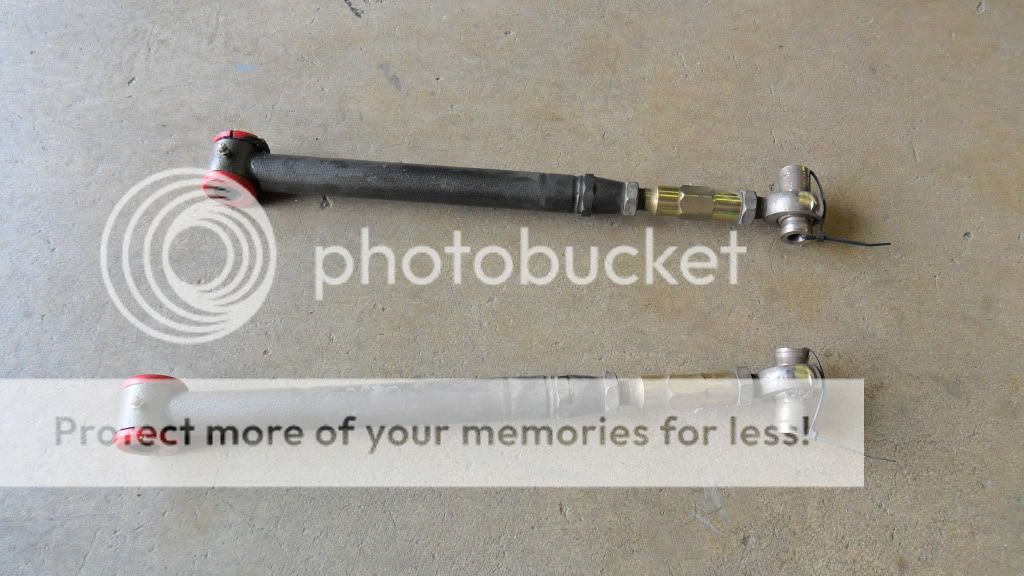
Those are my old ones, and they lasted a bit under a season on track. Note the bushings have spit out the steel sleeves, and the one at the top of the pic has completely shattered.
I have no direct experience with the UMI rod ends, but I would think they would have the same issue with the poly surround. Again, no direct experience. Strictly my opinion, but if you are thinking about different lower control arms, either get rubber bushings (deflection allows compliance with pitch, roll and yaw), or true rod ends.


 Okay then, you may be a candidate for some hardware.