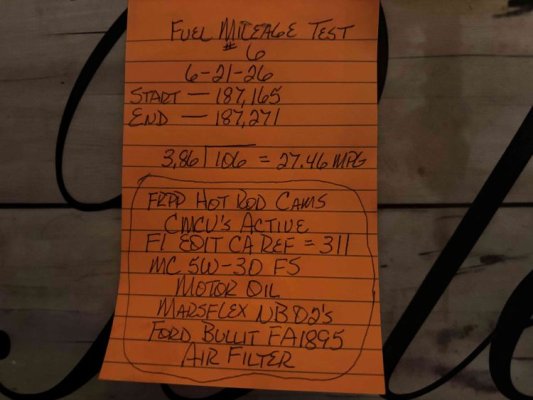
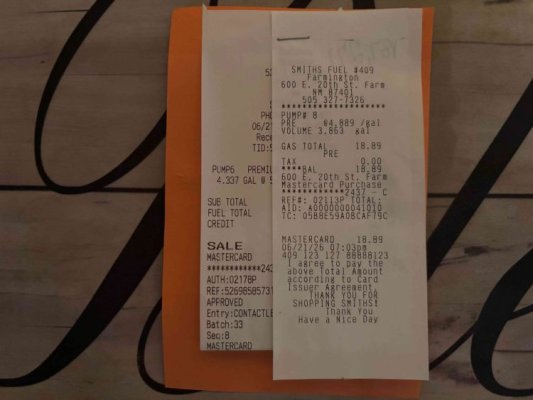
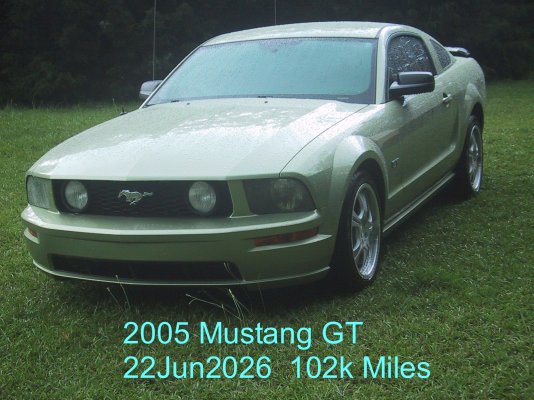
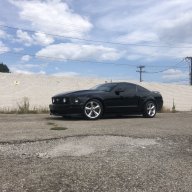
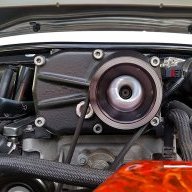
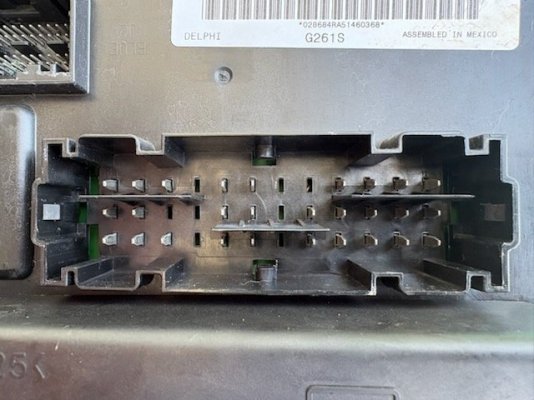
Was sitting around last Sunday morning & decided to take my Stang on another fuel mileage test run (#6.....) since all work was done (the heater hose connector changeouts, CHT sensor & spark plug replacement......) just to see how she'd do (last time was 9-18-25......) ........results posted below:
Now this wasn't on my radar of expectations from these results, so I got to digging back thru my data records today to see where this may have come from (matched all of the fuel mileage test dates w\ the closest dates of tune cal revisions & subsequent datalog data that might reveal areas where this improvement developed from.........the fuel test dated 4-22-25 was the closest match......test @ 27.1 MPG vs this 6-22-26 test @ 27.46 MPG....), so I've listed the relevant changes below that showed up from the data for those so interested:
Note: All fuel mileage tests were run over the same stretches of city\hwy roads in the exact same manner (used cruise control set @ 75 MPH w\ HVAC on--whether using heater or AC over the hwy sections) using E10 91 oct fuel (car is setup in tune cal for E10--14.08 EQ stoichAFR thru my HPTuners MPVI2+ interface--official EQ stoichAFR setting all the OEM's use w\ the US EPA & 91 oct thru my SCT X4 tuner--this should set the appropriate KS algorithm frequency associated & enable VID Octane Adjust feature.....).
1. The far & away obvious change was due to the
MAF recurve done in response to the air filter changeout (a component\part) from a clean K&N E-1997 08-09 Bullitt replacement to an OEM Ford 08-09 Bullitt FA1895 replacement I bought\used to perform a test after watching a Motor Oil Geek video that had the folks from Donaldson on--a well renowned US air filter manufacturer--which exposed the MAF curve being off to the tune of 3.5%--over fueled......due to resolution issues (read excess air turbulence thru MAF section at lower RPM's....). Further digging revealed that the suspect K&N filter wasn't the 1st filter I had bought & installed that I ran in service for over 1 yr (the 1st 3 fuel mileage test results were under this K&N filter--10-17-24 @ 26.1 MPG, 2-7-25 @ 26.5 MPG, 4-22-25 @ 27.1 MPG---changed 1st filter out on 8-17-25 due to visual excess dirty condition & installed the 2nd filter NIB condition from K&N....)--it was the 2nd filter (had bought 2 of them to facilitate cleaning w\o having the car down waiting on filter drying & reoiling.......) that caused this (the corresponding last 2 worst fuel mileage tests results--24.5 MPG @ 8-29-25, 25.7 MPG @ 9-18-25--followed the timeline to a tee.....) after running tests to confirm that no oil had touched the MAF sensor hot wire to skew the results at the time........thus exposed the manufacturing defects\offsets across them from K&N that doesn't exist w\ Ford due to OEM parts having to meet OEM warranty replacement QA\QC criteria as well as EPA scrutiny for Ford to obtain CoC (certificate of conformity) signoff--thus MUCH tighter manufacturing tolerance control\accuracy.
2. The
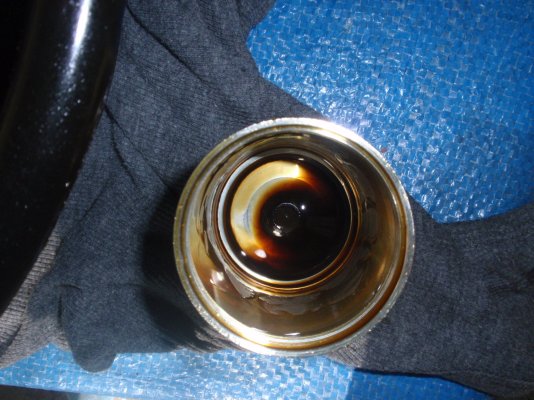
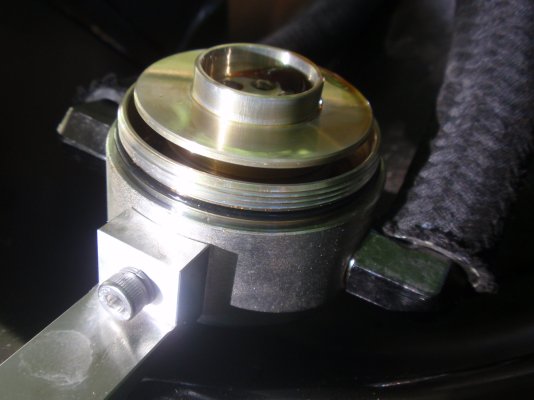
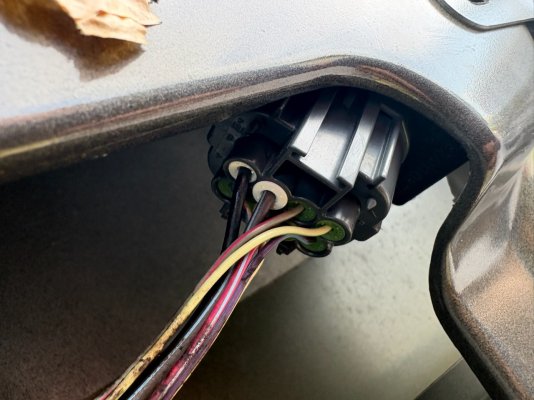
CHT sensor changeout (a component\part) that was done during the heater hose connector replacement.........can't find any conclusive data that showed this part having an effect.......but the pictures do show that the old sensor was missing a piece when compared to the new sensor that could be important to this sensor's accuracy--thus affects the ECU SD airmass calcs thru the tune calibration that can influence MPG as well as other things--thus needs to be mentioned.
3.
Spark plug changeout (a component\part) that was also done during the same heater hose connector replacement.......same general sentiment as #2 but plugs do reveal\verify the slightly over rich condition that was mentioned in #1.
4. Changed
IM Dynamic Airflow setting from GT 10.90L to Bullitt 9.81L (tune calibration change) .......from looking at the results, this doesn't really jump out concerning MPG (the GT 10.90L setting was present during all of the prior tests, only the last test--#6--had the Bullitt 9.81L setting), but it could, as well as for any available HP\TQ differences. This setting has direct influence on the Ford ECU SD ETC airmass calcs thus as such has to be mentioned for integrity's sake.......IM air volume setting that Ford used in tandem w\ this 08-09 Bullitt CAI (was the last setting that I had overlooked to change so that all pertinent OEM Ford settings\maps that was used in my tune cal matched to the OEM 08-09 Bullitt CAI\08 OEM IM for full tune cal compliance......done at the 1st of this year......). The 1 noticeable change seen was in Cat CE Ratio or emissions.........using the GT 10.90L, this CE ratio avg around B1 @ .035, B2 @ .039 vs the Bullitt 9.81L CE ratio avg around B1 @ .049, B2 @. 055.......proving the Bullitt 9.81L setting was used by Ford to improve Bullitt's available HP\TQ output vs the GT but didn't negatively affect emissions output in any conceivable way.
5.
Balanced TF (transient fuel) Accel\Decel FI PW settings for IR\port fuel puddle or "TAU" (tune calibration change) .......finally got this fully dialed in around the 1st of this year to fully properly match up to my FR 62mm TB's sweep rates to completely remove momentary throttle tip-in transient fueling leanouts--causing intermittent tip-in detonation--thus cleanup & optimize engine throttle response........all settings were increased to match TB (using a formula I devised to come up w\ a multiplier to convert the OEM 55mm TB's in-tune PTA\EA mapping to match the FR 62mm TB's corrected, calibrated in-tune PTA\EA mapping for ETC SD airmass calcs....) then balanced between accel vs decel to dial this in during OL PE\WOT throttle sweeps off gear shifts to clean up any initial throttle tip-in knock detected (manual trans....), thus no inkling\thought of saving fuel was in mind...........but the results speak for themselves........any increased MPG attributed from this work came from improved engine efficiency across the board, but can't clearly define it thus mentioned for integrity's sake.......definitely didn't negatively affect the emissions either. This work was finished after the 9-18-25 #5 fuel mileage test results were recorded.
All else in tune calibration was still set the same across the board as all else was finished product...........all as listed below along w\ 3.91 gears on 26.1 dia tires for a mean final ratio of 4.02..........so FR Hot Rod cams can be very fuel efficient as well as emissions efficient in a 4.6L 3V V8 while also putting out very good TQ\HP numbers for what they were intended to do (Greg Banish also said in 1 of his books that this is 1 of the overlooked benefits of running full VCT-compliant lopey cams due to their natural EGR tendencies.........depending on how well their characteristics are dialed in thru continuous VCT tuning across the board, not just WOT--the only in-tune method of affecting\changing an engine's pumping efficiency on the fly vs RPM.........is where DynoSim 6 engine dyno simulation software comes into play--recommended by both Billy Godbold--Comp Cams had a hand in helping the author--Larry Atherton w\ Motion Software--in developing it--along w\ John Baechtel, author of "Performance Automotive Engine Math"--another highly respected ex-GM engine development engineer--that GREATLY reduces the amount of time to test\develop optimized VCT cam timing mapping.......bought this in early 2023.....) & it appears that I'm on track to fully achieving it (1 of my goals I set to achieve self-tuning my ride after reading about this from Greg Banish since my car will be primarily touring & street duty--CL part throttle--but still get as much HP\TQ out of her that's there to get across the board during OL PE\WOT.........).
Now just need to get healed up enough to get my timing refresh\upgrade work done & GSport-GESI EPA-cert hi flow cats installed to eliminate the recorded exhaust backpressure bottleneck created by these FR Hot Rod cams flowing thru my current MagnaFlow #5461336 CARB-cert cats from 4,200 RPM on up (been putting this off for too long............).