
Apparently a link to this has appeared on the SEB forum and now they are complaining on Facebook. Yay.


With the tight wheel/tire clearance that Terry has, I don't think a PHB will cut it without rubbing problems. Just a thought.

It won't. We tried. The Watts and the Whiteline rear bar were requirements to run the tires we did without cutting the fenders.
But, you could say SP allows cut fenders, so no excuse there for a fully prepared car.
The change in transitional response was the real draw though. We tested it back to back before the 2012 Nationals and the Watts was a winner.
And Whiskey, we've been in many Fays2 equipped cars, not just S197 Mustangs, with rattling rose joints. When required to move that much, at those speeds, that often, they just don't hold up. But, rattling cars isn't against the rules either, so a fully prepared car is allowed to rattle, or to have the spherical joints replaced every six months.
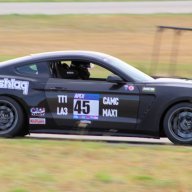
The only complaints against the PHB and spherical suspension arms is that if you want to use your car for something other than autocrossing, it's a PITA to deal with. The red car had a LOT of compromises for an autocrosser, as it is daily driven, used for time trials and for autocross. It was heavy, used poly and rubber when a spherical would have more performance, still had AC and emissions equipment, and big brakes. We weren't willing to cut it up or deal with no AC in Texas. That's why we bought the black GT. It was slated to be a dedicated ESP build.
 ) or deal with rattling suspension in an autocross only car. It's one of the many reasons I have been patiently waiting for the ESP Build thread on the 2013 but I fear it may never get one now and I may never get to see it in person (despite wanting to!).

It's because the majority of the rules make sense. It's the rest of the rules that don't make sense that all the problems come from.
The priority should be that all of the rules make sense, not just most of them.
its been a while since they've been on, but i remember putting a couple of extra washers behind the swaybar bolt head with the head pointed towards the outside of the car, this gave me enough clearence with the bolt sticking out of the nut. you can accomplish the same by cutting the bolt a bit shorter. The lowest position on the lca was the only problem, the middle and top was ok. if you don't put the swaybar bolt in the the outside with the lca in the the lowest position its almost impossible to adjust the swaybar later without taking the lca bolt loose.Care to explain?
Links?Apparently a link to this has appeared on the SEB forum and now they are complaining on Facebook. Yay.
Are you saying that the metal inner sleeve has split open or that the bushing pieces have?I've had MORE problems with Sam's/Hellwigg's rear bar making noise due to a really poorly designed metal bushing sleeve that is a giant roll pin rather than a bushing that can be torqued against. Mine has split open like a flower and wont allow me to get the axle side bolt tight enough to stop it from making clunking noises. I plan on fixing that next year with a simple bushing spacer redesign. I need to call Sam to see if I can get two new poly bushings for the axle end mounts before I can do that.

Thanks for the reply.its been a while since they've been on, but i remember putting a couple of extra washers behind the swaybar bolt head with the head pointed towards the outside of the car, this gave me enough clearence with the bolt sticking out of the nut. you can accomplish the same by cutting the bolt a bit shorter. The lowest position on the lca was the only problem, the middle and top was ok. if you don't put the swaybar bolt in the the outside with the lca in the the lowest position its almost impossible to adjust the swaybar later without taking the lca bolt loose.
Links?
I mentioned this a couple of pages ago on post #50, so why not show up with a phb and protest everyone, or write a clarification letter and get them all declared illegal. (i almost did this but decided against it as i can run about whatever i want in SM driveline wise).
Seriously, these ~$100 brackets would be on 100% of the cars on the ESP grid if allowed. It is worth a letter writing campaign. Anyway, he read the rule, agreed with our group's logic, took the parts off that night, and was 100% legal on the 2nd day of the event. Everyone was satisfied and nobody had to involve a protest committee or a DSQ, which is more of a "nuclear option". What can I say? I am a passionate person and SCCA solo has been a big part of my life since... 1987? "Finding Solo" literally changed where I went to college, it changed who my friends were, it changed my professional goals, it led me to CREATE Vorshlag, and is still to this day a part of my livelihood and one of my favorite motorsports/hobbies. But it is far from perfect, and a very small number of people have a very large amount of control over the rules, processes and outcome of these events. And I don't always agree with their logic, or completely lack thereof. I agree, the Cortex unit has some nice features. If you have a dedicated race car it should be on your short list of Watts Link candidates. I like most of the units out there, actually.To me, the Cortex is the best unit, has roll center adjustment, rod ends on the prop side and looks well made. the whiteline unit looks well made, but doesn't have roll center adjustment and really doesn't need poly bushings on each side.


btw, i drive around with a rod end phb, its not bad at all if you lube them twice a year.


I also check around ask numerous people and will write a letter if i'm wanting to put a part on my car and i'm not sure about its legality. that's one reason i'm not running LCA relocators right now (i've owned some for 6 months and ran them at a local event), no one has given me a clear yay or nay, but i don't sit around complaining about it.I get that you asked the ESP guys and none of them cared, but maybe you should have wrote a letter 1st for clarification.


 Asking for a clarification in this case burned us HARD, and I won't ever do THAT again.
Ha! That will be the day.SP just had openings for their board, did you put your name in so you could have some say? it might have been smart if you want to get some positive rule changes.....
Are you saying that the metal inner sleeve has split open or that the bushing pieces have?
I have a little noise coming from mine, but it certainly isn't from inability to get the axle-side bolts tight (I shaved the faces of the bushings down so that there is a solid stack of metal between the bolt heads and the nuts, and there is no poly being subjected to axial compression).
However, there may be a little angular misalignment between the bolt axis and the axle-side bushing in my case, so you might want to check this specifically. I haven't figured out yet what I might try.
Norm
When the bushing is under axial compression, however much clamping force is lost to bushing compression is doing absolutely zero as far as retaining the sleeve axis concentric with the bolt axis. And this will be the clamping force that comes from the first xx ft-lbs you apply to the fastener. Overall, the joint will still be "tight", but not all of the tightness will be through the right pieces.As I said in the PM (I hope that was clear =\) The metal sleeve on the inside is actually what has opened up because it is a glorified roll pin rather than a solid metal bushing (like used in the endlinks that attach to the chassis). The movement was from the bolts loosening up because trying to torque them down further continued to result in the metal sleeve opening up further. Eventually, right before I took it all off for winter, it was at a point where the only way to get them to STOP making noise was to compress the poly bushing and the metal sleeve to the point where the bushing looked like a marshmallow squished between two crackers. Neither is ideal. My solution should hopefully help with that.
When the material is as stiff as poly and it's supposed to "squish" a little, 1/8" is huge. Off the top of my head, polyurethane is something like 20 times as stiff as OE rubber, so compressions on the order of 0.02" are not negligible. And when you trap the material axially, the radially compressed material can't escape that way out the near side.I'm curious though, no axial compression of the bushing is a good thing? I understand distorting the hole in the poly bushing but what if it was just a TINY bit? Say an 1/8th of an inch at most?
When the bushing is under axial compression, however much clamping force is lost to bushing compression is doing absolutely zero as far as retaining the sleeve axis concentric with the bolt axis. And this will be the clamping force that comes from the first xx ft-lbs you apply to the fastener. Overall, the joint will still be "tight", but not all of the tightness will be through the right pieces.
When the suspension moves, the LCA rotates a tiny bit, but once it starts moving the axial LCA force will add a sliding component to the motion. Eventually, you'll bottom the sleeve to bolt clearance out, audibly.
When the poly faces are constrained such that you don't even get all of the little compliance that a poly bushing has, you've just added some roll stiffness that you weren't planning on. Remember that the chassis is still rolling more than the axle, however slightly. At 2° of relative roll between the bar end and the axle bracket, there will be a finite amount more axial compression at the diagonally opposite "corners" of the poly as viewed from the rear of the car. In structural analysis terms, the boundary conditions have changed even from the case where the poly faces are not constrained.
Not to mention that you then have compression between two surfaces where stiction is typically present, and subjected to relative motion. Think squeaking.
Be a little careful with whatever you fabricate or modify. I don't know how any "percentage of metal" interpretation/"clarification" would ultimately turn out.
Norm
Terry - just how deep into the CP trophies do you think you could get your 2013 and still keep it street-legal and mostly ESP-ish? Seems the red car was less than half a second away from that exactly the way it sat.