
Loss of Boost - where to even start?

MrAwesome987

Senior Member
Joined
Mar 6, 2019
Posts
945
Reaction score
302
Location
Upstate SC
My 09 GT has a Department of Boost manifold with an M122 on it. Longtubes and Brenspeed Detroit rocker SC cams.

I've had pretty much the same setup for about 25k miles and it usually makes around 10-11 psi at full throttle.

Recently, I've noticed that it's topping out around 6-8 psi.

My first inclination was maybe the blower pulley was slipping on the blower shaft, but I marked it and checked it multiple times - it hasn't moved.

I have not verified the gauge yet.

What do I check next? What would cause the loss of boost?
 

MrAwesome987

Senior Member
Joined
Mar 6, 2019
Posts
945
Reaction score
302
Location
Upstate SC
Ok that sounds like a good place to start.

How do you verify throttle body and bypass valve are opening/closing completly? I assume for the throttle I can take the CAI off and work the pedal with the engine off.
 

Pentalab

Senior Member
Joined
Mar 5, 2013
Posts
5,500
Reaction score
1,312
Ok that sounds like a good place to start.

How do you verify throttle body and bypass valve are opening/closing completely? I assume for the throttle I can take the CAI off and work the pedal with the engine off.
The TB is operated with an electric motor. With my aeroforce gauges plugged into OBD port, it will read the gas pedal position (0-100)..and also the TB opening position (0-100). At idle, the pedal will be 0..... while the TB is slightly open.

U could have a defective bypass valve on the blower. If not fully closed under boost, you will lose a lot of boost.

Or belt slipping or tensioner with not enough tension.
 

Midlife Crises

Senior Member
Joined
Jul 20, 2019
Posts
2,314
Reaction score
1,826
Location
Fairbanks, Alaska
The bypass valve in the manifold is pulled open by a vacuum actuator. The actuator is spring loaded to close the bypass when there is no vacuum. With the engine not running you should be able to see the actuator and move it by hand. Take note of its position, start the engine and see the new position. Shut the engine off and it should return to the closed position. You could also connect a hand operated vacuum pump to the actuator and see if it operates the way it should.
 

Pentalab

Senior Member
Joined
Mar 5, 2013
Posts
5,500
Reaction score
1,312
The bypass valve in the manifold is pulled open by a vacuum actuator. The actuator is spring loaded to close the bypass when there is no vacuum. With the engine not running you should be able to see the actuator and move it by hand. Take note of its position, start the engine and see the new position. Shut the engine off and it should return to the closed position. You could also connect a hand operated vacuum pump to the actuator and see if it operates the way it should.
it should be fully open at idle. Fully close with boost. He could be losing vac somewhere.
 

DieHarder

Senior Member
Joined
Nov 9, 2019
Posts
1,851
Reaction score
1,072
I'd suspect a vacuum leak or the bypass valve vacuum actuator is acting up. As Midlife says get a hand operated vacuum pump (for brakes) and use it to test the bypass valve vacuum actuator. If good, check the "T"/FRPS and connections to the manifold and replace rubber lines (if needed). Possible those lines have been heat cycled so many times they're losing the ability to seal or there's a leaky connection. You could also try getting small spring clamps meant for motorcycle carb/gas lines for a better seal.

For comparison sakes I'm running the same setup (sans cams/headers) and only see 6 - 8 lbs boost so I'll go thru my setup to ensure no leaks as well.
 

MrAwesome987

Senior Member
Joined
Mar 6, 2019
Posts
945
Reaction score
302
Location
Upstate SC
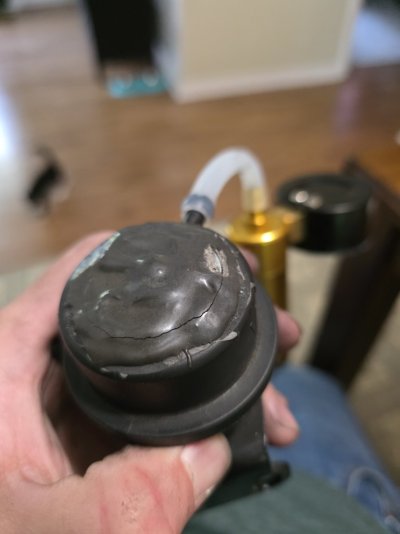
I found my problem. When I first installed the supercharger, I had read that some recommended modifying the bypass valve actuator since I had cams (due to low vacuum). I drilled a hole in the end of the actuator and removed the spring, then jb welded it back together. After test driving it, I quickly found that modifying the actuator was not necessary for my car at all. So I took the actuator back off and put the spring back in and then resealed it with jb weld. The car operated in this state for 4 years or so, until recently the boost was down from 10-11 to about 5-7. Turns out my jb weld job failed. See attached picture. I'll order a replacement.
20250627_193022.jpg

Before removing the bypass valve, I also checked the throttle body. Does this throttle body action look correct? Here is a video of it moving from idle slowly up to WOT and then a quick release.

It also sucks a good bit of oil from the PCV system it seems. There is a lot of oil coating the inside of the throttle elbow and supercharger. I do have a catch can but it must not be doing a very good job...

Thanks for the help.
 

Midlife Crises

Senior Member
Joined
Jul 20, 2019
Posts
2,314
Reaction score
1,826
Location
Fairbanks, Alaska
It’s awesome that you found the actuator problem and your throttle body action looks normal to me.
It’s sad that all the PCV catch cans on the market are so easily overwhelmed and most are not installed in a way to do anything at all. Some are stupid expensive and are no more than a wide spot in the pipe.
 
Back
Top