

You are using an out of date browser. It may not display this or other websites correctly.
You should upgrade or use an alternative browser.
You should upgrade or use an alternative browser.
75w-140 or 85w-140 hot climate
- Thread starter Miker
- Start date
GriffX
Senior Member
According to my plot above the 85w140 is always thicker than the other (?)If you want to run a thicker oil then look at the second number. There is really no difference between 75w-140 and 85w-140 when at operating temp. If you want to use a thicker oil look for like 75w-90 gear oil. It will remain thicker after it heats up than the 75w-140.

According to my plot above the 85w140 is always thicker than the other (?)
Yes, sorry I got the numbers backwards. The higher the second number the higher viscosity it has at operating temps. I edited my post.
GlassTop09
Senior Member
Ok, now that we know for sure that you are running the OEM Ford Trac-Lok clutch type LSD, IMHO I'd go w\ your speed shop's recommendation & use 1 bottle of the Ford X3 friction modifier w\ the 85W-140 GL-5 dino oil to ensure that the clutches get enough of this to prevent chattering (caused by excess friction while under clamping loads when biasing axle TQ from 1 side to the other) when they heat up due to this type of clutch LSD is using preload tension (what the S-spring is used for in this Trac-Lok diff) to put some initial clamp load on the clutch discs so they won't be loose during no load & to aid them in proper transferring of axle TQ when needed--thus the term "friction modifier" & is why this Ford Trac-Lok diff is rated w\ a TBR (torque bias ratio) of 2.0........when 1 bottle of friction modifier is used.So I am ordering the M-4033-KA 8.8" "Track Pack" Finned Diff Cover. Going with the 85w-140 dino Lucas. Should I add 1 or 2 bottles of the X3 Ford friction modifier?
The only thing a 2nd bottle of friction modifier is doing is LOWERING the friction coeff across the clutch discs even further thus making the Trac-Lok diff's TBR lower which reduces the diff's ability to transfer engine TQ across axles when needed..........so I'd only use a 2nd bottle of FM if I experienced rear diff clutch chattering during turns after initial use of the 85W-140 GL-5 dino oil w\ 1 bottle of FM........
The main advantage of a synthetic gear oil vs a dino gear oil is heat tolerance.........but they are also a little "slicker" as well for the same reasonings as in engine oil usage. This is why Eaton says not to use a synthetic gear oil or friction modifier w\ the Tru-Trac diff........it won't cause any physical damage to the diff per se but it WILL LOWER the diff's TBR rating substantially due to the loss of friction across its helical gearing from synthetic oil\friction modifier usage..........1 of the main reasons why folks switch to this Eaton Tru-Trac diff vs the Ford Trac-Lok diff in the 1st place, myself included........it's TBR is much higher than the Ford Trac-Lok (the 3 gear pack has a TBR of 3.5 vs the Trac-Lok's 2.0.........when a GL-5 spec dino oil is used w\ the Tru-Trac diff) which provides a huge advantage in power application to rear axle at speed during cornering\coming out of corners\turns when pushed.......even on the street.
But if you can't stand a noisy diff when normally street driven then this Eaton Tru-Trac diff is not for you as this diff has no preload applied to its internal gearing like a Trac-Lok diff does to its clutch packs thus will make some noise from driveline accel\decel & decel\accel due to gear lash makeup under straight line, no TQ biasing load operation............even w\ 85W-140 GL-5 dino oil but this oil makes this Tru-Trac diff much quieter under these operating conditions & IMHO, it also holds up much better heat-wise than the Eaton recommended 80W-90 GL-5 dino oil w\o affecting its TBR at all (I've actually run both in the same axle thus how I know.....I have a habit of actually testing stuff out.......) .......a manual trans makes this aspect of a Tru-Trac diff worse than an auto trans as autos are much better at maintaining a more constant & less harsh gear loading thruout the drive train.......just a fact. Tru-Trac's are quiet as a church mouse when turning since all internal gear lash is made up while torque biasing is being applied.
Race car life.....................don't understand why folks won't say this about an Eaton Tru-Trac because it's true.
That's the reason for the sump in this 8.8" housing........to give any metal particles shed from pinion\ring gear wear a place to wash\settle out of the gear oil.........is also why Ford placed the lower drain plug on both this Track Pack diff cover & their LP Girdle diff cover where they did (adjacent to this sump) & also why these drain plugs are magnetic.........the type\appearance of metal the plug captures on it can give an indication of the internal situation & what's in this sump w\o pulling the cover off which you'd never get w\ the OEM stamped steel cover.........if it looks like "sludge" captured on the plug, this is normal pinion\ring gear & bearing wear & if the amount of metal sludge captured diminishes over time or becomes non-existent, this indicates the gears\bearings are finishing\have finished breaking in thus the sump is good to go & the gear oil is\should be in good condition. If there are any larger metal shavings\chunks captured on the plug this indicates there is metal shearing going on w\ the gears thus the cover needs to come off ASAP for inspection\repair & sump cleanout because the gear oil has already broken down & lost its lubricity from being excessively overheated thus has overstayed it's time in operation (the main cause of this shearing occurring......usually from not being checked\changed out periodically thus assumed to be OK..........).There is a lower "sump" in the housing right below the ring gear which in my case was full of metal slime. No fun to get it out with towels.
IMHO, this is another huge advantage of using this Ford 8.8" Track Pack diff cover w\ a Lube Locker LLR F880 gasket...........if the diff oil is changed out on some regular time\mileage schedule & a quick internal inspection is warranted\desired...........saves a lot of time & hassle to do it if DIY .......
Just to put this out here, I try to tie my rear axle fluid changeout to my TR3650 trans fluid changeout schedule since the car will be up in the air anyway (4 yrs\60k or sooner if I've been beating on it or I perceive an internal issue) as IMHO, ATF & gear oil are cheap insurance & this Track Pack cover makes this a breeze to do on the rear axle......as well as the color\texture\odor of the drained fluid vs the new fluid going in will also give indication of internal operating condition as well.
My 2 cents again......................FWIW.
Last edited:
Thank you for the detailed explanation.
I have gathered up all the parts, just waiting on the cover and gasket. I found a receipt where the diff was serviced for a leaking pinion seal at 118,000 miles at the dealership. That was in 2015 and it has 155K on it now. They did put the 75w-140 in it. So the oil is 10 years old but only has 37K on it so at least it should be fairly clean to work on.
I have gathered up all the parts, just waiting on the cover and gasket. I found a receipt where the diff was serviced for a leaking pinion seal at 118,000 miles at the dealership. That was in 2015 and it has 155K on it now. They did put the 75w-140 in it. So the oil is 10 years old but only has 37K on it so at least it should be fairly clean to work on.
The lube locker gaskets work superb. When I had the Eaton tru-trac lsd installed, it went in at the same time as the white line watts link. The white line watts link comes with a super thick aluminum differential cover + new ss bolts, with drain and fill plugs. The differential cover has to be super thick, since it also hold the 4 x 60mm bolts and also a single 40mm bolt, as part of the watts link assy. Then in went the 75W-140 plane dino oil. Also put a catch can on pass side of the axle. Zero issues, and dead quiet.
I use Amsoil 75w140 with FM ...no issues so far. ( stock rear end )
about the catch can... a long rubber hose ( oil resistant of course ) connected to the "valve " on the right side of the axle...routed up to the rear right frame - like in the old days, would do the same job. just cheaper
about the catch can... a long rubber hose ( oil resistant of course ) connected to the "valve " on the right side of the axle...routed up to the rear right frame - like in the old days, would do the same job. just cheaper
rocknrod
Member
I was suspect but I used that gasket on my stock differential cover and it works great.The lube locker gaskets work superb...
Well I got the cover and Lube locker gasket this afternoon. Put the car up on jacks and went for it. Pretty straight forward. The inside was really clean as I suspected it would be but the oil was black. There wasn't a gasket just a tiny bead of silicone that stayed on the cover. looked like it was a poor job and I could see it had been weeping. Cleaned everything up, moved the vent from the axle to the top of the cover and went for the install.
There was no way that cover was going to fit past the panhard bar. I had stands on the axle so I moved them to the pinch weld so the axle could drop some. Still a no go. Grrr!
Since I had the stands on the pinch welds I dropped the panhard bar from the passenger side. That gave me the room I needed. Got everything buttoned up, filled with lube and hammered the bar back up and it's off about a 1/2 inch. Going to use a ratchet strap in the morning and pull it back in alignment.
Since it's all jacked up I'm going to install some new brake pads I've had for a while. More fun! Wish me luck!
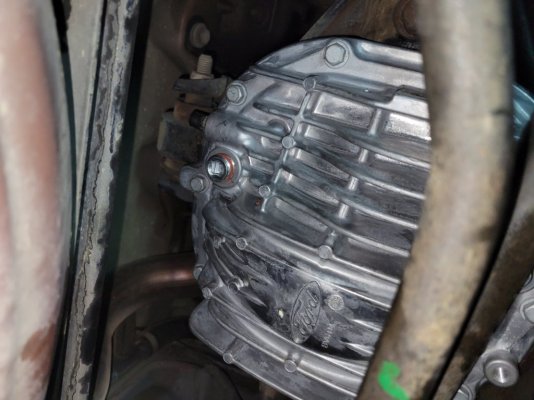

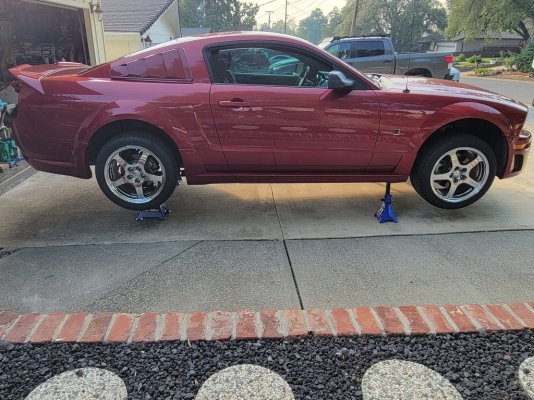
View attachment 100489
There was no way that cover was going to fit past the panhard bar. I had stands on the axle so I moved them to the pinch weld so the axle could drop some. Still a no go. Grrr!
Since I had the stands on the pinch welds I dropped the panhard bar from the passenger side. That gave me the room I needed. Got everything buttoned up, filled with lube and hammered the bar back up and it's off about a 1/2 inch. Going to use a ratchet strap in the morning and pull it back in alignment.
Since it's all jacked up I'm going to install some new brake pads I've had for a while. More fun! Wish me luck!
View attachment 100489
Last edited:

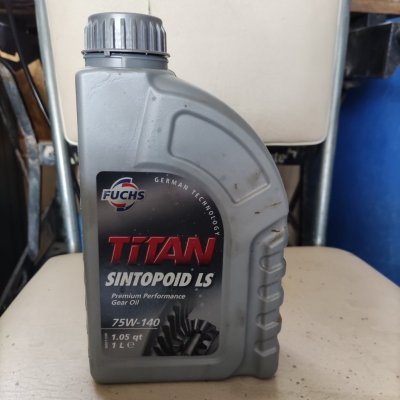
Since I live in Europe, the last time I replaced the differential oil I ordered three bottles of this stuff from Germany and added a bottle of friction modifier.
ss1978
Junior Member
Hallo und Grüße aus Deutschland,Ok, da wir nun sicher wissen, dass Sie das OEM Ford Trac-Lok Kupplungs-LSD verwenden, würde ich meiner Meinung nach der Empfehlung Ihres Speed Shops folgen und 1 Flasche Reibungsmodifikator Ford X3 mit dem 85W-140 GL-5 Dino-Öl verwenden, um sicherzustellen, dass die Kupplungen genug davon bekommen, um ein Rattern (verursacht durch übermäßige Reibung unter Klemmlast beim Verschieben des Achsdrehmoments von einer Seite auf die andere) zu verhindern, wenn sie sich erhitzen, da dieser Kupplungs-LSD-Typ eine Vorspannung verwendet (wofür die S-Feder in diesem Trac-Lok-Differential verwendet wird), um eine anfängliche Klemmlast auf die Kupplungsscheiben auszuüben, damit sie sich im Leerlauf nicht lösen und um ihnen bei Bedarf bei der richtigen Übertragung des Achsdrehmoments zu helfen – daher der Begriff „Reibungsmodifikator“ und der Grund, warum dieses Ford Trac-Lok-Differential mit einem TBR (Drehmomentvorspannungsverhältnis) von 2,0 bewertet wird … wenn 1 Flasche Reibungsmodifikator verwendet wird.
Das einzige, was eine zweite Flasche Reibungsmodifikator bewirkt, ist, den Reibungskoeffizienten über die Kupplungsscheiben noch weiter zu SENKEN und so den TBR des Trac-Lok-Differentials zu senken, was wiederum die Fähigkeit des Differentials verringert, bei Bedarf Motordrehmoment auf die Achsen zu übertragen .......... ich würde also nur dann eine zweite Flasche FM verwenden, wenn ich nach der ersten Verwendung des 85W-140 GL-5 Dino-Öls mit 1 Flasche FM ein Rattern der Kupplung des hinteren Differentials während der Kurvenfahrt feststellen würde........
Der Hauptvorteil eines synthetischen Getriebeöls gegenüber einem Dino-Getriebeöl ist die Hitzebeständigkeit … allerdings sind sie aus den gleichen Gründen wie bei der Verwendung von Motorölen auch etwas „glatter“. Aus diesem Grund rät Eaton davon ab, synthetische Getriebeöle oder Reibungsmodifikatoren mit dem Tru-Trac-Differential zu verwenden. Dadurch wird das Differential an sich nicht physisch beschädigt, aber der TBR-Wert des Differentials wird erheblich gesenkt , da durch die Verwendung von synthetischem Öl/Reibungsmodifikator an der Schrägverzahnung Reibung verloren geht . Dies ist einer der Hauptgründe, warum Leute, mich eingeschlossen, überhaupt zu diesem Eaton Tru-Trac-Differential statt zum Ford Trac-Lok-Differential wechseln. Sein TBR ist viel höher als der des Ford Trac-Lok (das 3-Gang-Paket hat einen TBR von 3,5 gegenüber 2,0 des Trac-Lok, wenn ein Dino-Öl der Spezifikation GL-5 mit dem Tru-Trac-Differential verwendet wird), was einen enormen Vorteil bei der Kraftübertragung auf die Hinterachse bei hohen Geschwindigkeiten beim Kurvenfahren/beim Herausfahren aus Kurven/bei Wendungen unter Druck bietet, sogar auf der Straße.
Wenn Sie jedoch ein lautes Differential bei normaler Straßenfahrt nicht ertragen können, ist dieses Eaton Tru-Trac Differential nicht das Richtige für Sie, da dieses Differential keine Vorspannung auf die Innenverzahnung hat, wie dies bei einem Trac-Lok Differential bei den Kupplungspaketen der Fall ist. Daher wird es aufgrund des Zahnradspiels beim Beschleunigen/Verzögern und Verzögern/Beschleunigen des Antriebsstrangs Geräusche verursachen. Kein TQ-Vorspannungsbetrieb, sogar mit 85W-140 GL-5 Dino-Öl. Dieses Öl macht dieses Tru-Trac Differential unter diesen Betriebsbedingungen jedoch viel leiser und meiner Meinung nach hält es auch der Hitze viel besser stand als das von Eaton empfohlene 80W-90 GL-5 Dino-Öl, ohne dass sich dies überhaupt auf den TBR auswirkt (ich habe tatsächlich beide in derselben Achse verwendet, daher weiß ich das. Ich habe die Angewohnheit, Dinge tatsächlich auszuprobieren.) Ein manuelles Getriebe verschlimmert diesen Aspekt eines Tru-Trac Differentials gegenüber einem Automatikgetriebe, da Automatikgetriebe viel besser in der Lage sind, eine konstantere und weniger harte Getriebebelastung während der Fahrt aufrechtzuerhalten. Zug … einfach eine Tatsache. Tru-Tracs sind beim Wenden mäuschenstill, da das gesamte interne Zahnradspiel durch die Drehmomentbeaufschlagung ausgeglichen wird.
Rennwagenleben.....................ich verstehe nicht, warum die Leute das nicht über einen Eaton Tru-Trac sagen, denn es stimmt.
Das ist der Grund für die Ölwanne in diesem 8,8"-Gehäuse. Damit können Metallpartikel, die durch den Verschleiß von Ritzel und Zahnkranz entstehen, aus dem Getriebeöl ausgewaschen werden. Das ist auch der Grund, warum Ford die untere Ablassschraube sowohl an diesem Track Pack-Diff-Deckel als auch an ihrem LP Girdle-Diff-Deckel dort platziert hat, wo sie es getan haben (neben dieser Ölwanne) und warum diese Ablassschrauben magnetisch sind. Die Art und das Aussehen des Metalls, das die Schraube aufnimmt, kann einen Hinweis auf die innere Situation und den Inhalt dieser Ölwanne geben, ohne dass die Abdeckung abgenommen werden muss. Dies würde bei der OEM-Stahlabdeckung nie der Fall sein. Wenn es aussieht, als ob sich "Schlamm" auf der Schraube festgesetzt hat, handelt es sich um normalen Ritzel- und Lagerverschleiß. Wenn die Menge des Metallschlamms mit der Zeit abnimmt oder verschwindet, deutet dies darauf hin, dass die Zahnräder und Lager eingelaufen sind. Die Ölwanne ist einsatzbereit und das Getriebeöl sollte in gutem Zustand sein. Wenn größere Metallspäne oder -brocken vorhanden sind Wenn sich an der Zündkerze etwas abzeichnet, deutet dies darauf hin, dass es in den Zahnrädern zu Metallscherungen kommt. Daher muss die Abdeckung so schnell wie möglich zur Inspektion/Reparatur und Ölwannenreinigung abgenommen werden, da das Getriebeöl bereits zersetzt ist und seine Schmierfähigkeit durch Überhitzung verloren hat und daher seine Betriebszeit überschritten hat (die Hauptursache für dieses Scheren liegt normalerweise darin, dass es nicht regelmäßig überprüft/ausgewechselt wurde und daher als in Ordnung angesehen wird..........).
Meiner Meinung nach ist dies ein weiterer großer Vorteil bei der Verwendung dieser Ford 8,8" Track Pack-Differentialabdeckung mit einer Lube Locker LLR F880-Dichtung...........wenn das Differentialöl in regelmäßigen Abständen gewechselt wird und eine schnelle interne Inspektion erforderlich ist...........spart viel Zeit und Ärger, wenn Sie es selbst machen.......
Nur um das hier klarzustellen: Ich versuche, meinen Hinterachsflüssigkeitswechsel an meinen TR3650-Getriebeflüssigkeitswechselplan zu koppeln, da das Auto sowieso in der Luft hängen wird (4 Jahre \ 60.000 oder früher, wenn ich es stark beansprucht habe oder ein internes Problem vermute). Meiner Meinung nach sind ATF und Getriebeöl eine günstige Versicherung und diese Track Pack-Abdeckung macht dies an der Hinterachse zu einem Kinderspiel ... und auch die Farbe \ Textur \ Geruch der abgelassenen Flüssigkeit im Vergleich zur neuen, die eingefüllt wird, gibt ebenfalls Aufschluss über den internen Betriebszustand.
Nochmals meine 2 Cents......................FWIW.
Ich besitze einen 2013er GT mit Trackpack und höre in schnellen Rechtskurven ein Schleifgeräusch. Mal mehr, mal weniger. Die Achsen und Radlager wurden getauscht. Ich verwende das vorgeschriebene GL 5 mit Reibungsmodifikator. Liqui Moly Vollsynthetisches Hypoid-Getriebeöl (GL5) LS SAE 75W-140.
Do you have any idea what the problem could be?
GriffX
Senior Member
I would inspect the brake caliper. The axle has some play in the c-clip in the differential and because the brake disk is connected to the axle and the caliper to the axle housing, after any braking the pads must be pushed back by the axle in corners.Hallo und Grüße aus Deutschland,
Ich besitze einen 2013er GT mit Trackpack und höre in schnellen Rechtskurven ein Schleifgeräusch. Mal mehr, mal weniger. Die Achsen und Radlager wurden getauscht. Ich verwende das vorgeschriebene GL 5 mit Reibungsmodifikator. Liqui Moly Vollsynthetisches Hypoid-Getriebeöl (GL5) LS SAE 75W-140.
Do you have any idea what the problem could be?
Nochmal in D: Die Bremse ist am Achsengehäuse fest, die Achse am c-clip und das Spiel der Achse drückt die Bremsklötze auseinander. Wenn der Bremskolben zu fest wird, könnte das Geräusche machen. Dieses Spiel ist übrigens auch der Grund warum das Bremspedal einen Leerweg hat, die Beläge müssen immer wieder angelegt werden. Mess mal die Temperatur der Scheiben. Wenn ein Kolben fest ist, ist die Temp rechts/links unterschiedlich.
ss1978
Junior Member
Thanks for the reply. I was thinking about the brake caliper, too. I'll take a look.
ss1978
Junior Member
Ich nochmal. Die Bremse scheint frei zu sein, am Berg rollt es weg, wenn ich sie loslasse, und die Temperatur ist die gleiche.Ich würde den Bremssattel überprüfen. Die Achse hat etwas Spiel im C-Clip im Differential und da die Bremsscheibe mit der Achse und der Bremssattel mit dem Achsgehäuse verbunden ist, müssen die Beläge nach jedem Bremsen in Kurven von der Achse zurückgedrückt werden.
Nochmal in D: Die Bremse ist am Achsengehäuse fest, die Achse am C-Clip und das Spiel der Achse drückt die Bremsklötze auseinander. Wenn der Bremskolben zu fest wird, könnte das Geräusche entstehen. Dieses Spiel ist übrigens auch der Grund, warum das Bremspedal einen Leerweg hat, die Beläge müssen immer wieder angelegt werden. Messen Sie mal die Temperatur der Scheiben. Wenn ein Kolben fest ist, ist die Temperatur rechts/links unterschiedlich.
D: Ich nochmal, die Bremse scheint frei zu sein, am Berg rollt er weg, wenn ich die Bremse löse und die Temperatur auch gleich.
Gruß Sascha
Similar threads


- Replies
- 6
- Views
- 2K

- Replies
- 10
- Views
- 6K


- Replies
- 6
- Views
- 3K
Latest posts
-
-
-
Should I stay away from 2005 to 2008 (spark plugs)?
- Latest: 2019Chieftain-no-more
-


Support us!
Support Us - Become A Supporting Member Today!
Click Here For Details