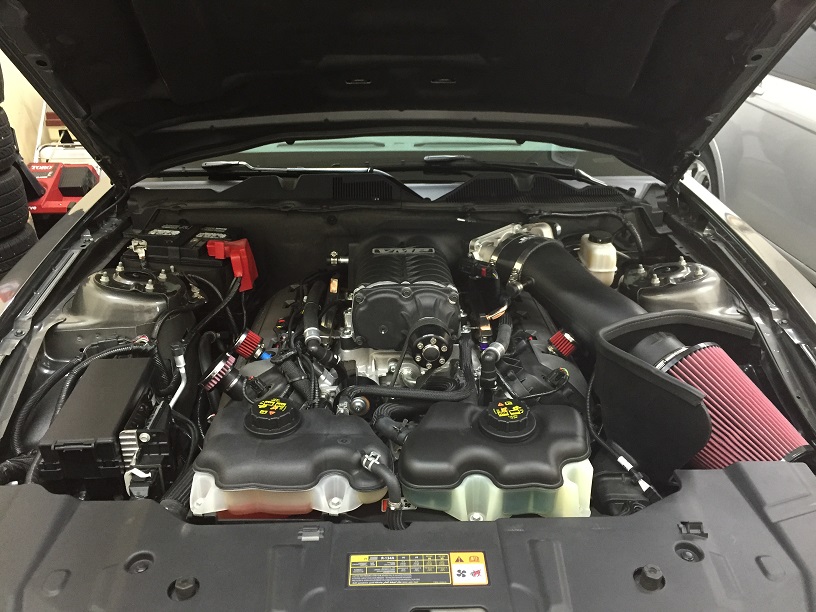
CFM Performance Billet Valve Cover Breather Kit for 2002-2015 Mustang GT

06 T-RED S/C GT

Senior Member
Joined
Jan 8, 2016
Posts
2,270
Reaction score
370
Location
Carnegie, PA
Same here. I have K&N valve cover breathers and a CFM. Intake capped. That's it. :shrug:

I smell a little oil vapor sometimes but I've not had to clean anything up yet. I'm not nice but I don't beat the hell out of the car either.

loyNHoh.jpg

Your 5.0 coyote doesn't require having to uninstall the cam cover nor a cutting tool for removing the PCV valve.. The 3v 4.6 mod motors on the other hand, require cutting the PCV tube housing from the underside of the cam cover in order to remove the valve.. This is just one of my reasons for keeping the factory PCV system intact along with running an air/oil separator !
 

BMR Tech

Traction Vendor
Joined
Dec 15, 2009
Posts
4,863
Reaction score
13
Location
Tampa, FL
A vacuum pump is completely different than a PCV system. PCV Systems were created for emissions purpose.

Vacuum pumps do help with the efficiency of the engine during loaded/WOT conditions where you want to pull enough vacuum to overcome crankcase pressure, and assist with a better ring seal. The ring sealing benefit, is what helps performance. In a non vacuum manifold situation, a vacuum pump will also help remove blow-by / vapors better as well. In a perfect world, a regulated vacuum pump is the best method for a gearhead.

In a non loaded/WOT situation, the PCV system is doing all of it's work. In these conditions (normal driving) is when the PCV system and oil separators etc work their hardest, because manifold pressure is going to be significantly less (more vacuum) than the crankcase pressure - hence the reason why these were implemented for emissions purpose.

In loaded situations - the manifold pressure rises, and once that pressure differential (manifold VS crankcase) favors the higher pressure side of the manifold, the PCV system is practically useless. If you have blow by, which we all do, it will contaminate your crankcase just opposite of the reason it was designed.

After toying with all of these PCV mods, I have simply gone to dual breather tanks on my past several cars. I run the largest fittings and lines (-12) that I can from each valve cover into the front fenderwells into their own tank.

The comment above about changing the oil with breathers is 100% accurate. If you spend a lot of time putting commuting miles on the car, you will definitely want to change the oil much more frequently.

To touch on my specific combos - I use E85 100% of the time in my cars. I primarily race my cars, and I beat on them hard when not racing. In an E85 specific application, I feel that real breather systems are more effective due to the ethanol's ability to absorb moisture/water. When I drain my tanks, they pour water out. A lot of it. In a sealed system, that moisture is building up inside the crankcase and lines, separators, etc.

 

BruceH

BBB Big Bore Boss 322
Joined
Sep 13, 2009
Posts
13,810
Reaction score
21
Location
Pacific Northwest
A vacuum pump is completely different than a PCV system. PCV Systems were created for emissions purpose.

Vacuum pumps do help with the efficiency of the engine during loaded/WOT conditions where you want to pull enough vacuum to overcome crankcase pressure, and assist with a better ring seal. The ring sealing benefit, is what helps performance. In a non vacuum manifold situation, a vacuum pump will also help remove blow-by / vapors better as well. In a perfect world, a regulated vacuum pump is the best method for a gearhead.

In a non loaded/WOT situation, the PCV system is doing all of it's work. In these conditions (normal driving) is when the PCV system and oil separators etc work their hardest, because manifold pressure is going to be significantly less (more vacuum) than the crankcase pressure - hence the reason why these were implemented for emissions purpose.

In loaded situations - the manifold pressure rises, and once that pressure differential (manifold VS crankcase) favors the higher pressure side of the manifold, the PCV system is practically useless. If you have blow by, which we all do, it will contaminate your crankcase just opposite of the reason it was designed.

After toying with all of these PCV mods, I have simply gone to dual breather tanks on my past several cars. I run the largest fittings and lines (-12) that I can from each valve cover into the front fenderwells into their own tank.

The comment above about changing the oil with breathers is 100% accurate. If you spend a lot of time putting commuting miles on the car, you will definitely want to change the oil much more frequently.

To touch on my specific combos - I use E85 100% of the time in my cars. I primarily race my cars, and I beat on them hard when not racing. In an E85 specific application, I feel that real breather systems are more effective due to the ethanol's ability to absorb moisture/water. When I drain my tanks, they pour water out. A lot of it. In a sealed system, that moisture is building up inside the crankcase and lines, separators, etc.


A lot of water collects in the winter when running e85. It's coming out of the crankcase and going into the intake manifold to be consumed in the combustion chamber, except for what the can catches, having vacuum on the crankcase pulls the water vapor out vs whatever the motor pushes out when using breathers. I definitely want moisture laden air pulled out instead of letting it be pushed out.

You must be using a vented catch can that still uses motor vacuum to suck the crankcase air out. Is that what you have, a vented catch can?
 

06 T-RED S/C GT

Senior Member
Joined
Jan 8, 2016
Posts
2,270
Reaction score
370
Location
Carnegie, PA
When he refers to dual breather tanks ! They're considered the same as vented catch cans Bruce.. If i interpreted his post accurately ? I'll also assume he's running a vacuum pump with the breather tanks/vented catch cans, so that crankcase air can be sucked out rather than letting it just get pushed out :shrug:
 
Last edited:

06 T-RED S/C GT

Senior Member
Joined
Jan 8, 2016
Posts
2,270
Reaction score
370
Location
Carnegie, PA
Bruce ! I replied back via PM, but not sure if you received it ? For some reason, my PM messages display zero sent..

Anyhow I replied to your question by saying that before adding my oil separator, I was seeing crankcase oil from the driver's side hose, into the intake manifold and would then seep out from the throttle body and leave an oil coating on the CAI tube attached to the throttle body..

The passenger side however was always completely dry..
 

BruceH

BBB Big Bore Boss 322
Joined
Sep 13, 2009
Posts
13,810
Reaction score
21
Location
Pacific Northwest
Bruce ! I replied back via PM, but not sure if you received it ? For some reason, my PM messages display zero sent..

Anyhow I replied to your question by saying that before adding my oil separator, I was seeing crankcase oil from the driver's side hose, into the intake manifold and would then seep out from the throttle body and leave an oil coating on the CAI tube attached to the throttle body..

The passenger side however was always completely dry..

That's why people put a can on, to condense the oil mist contained in the crankcase air and capture it before it goes into the intake.
 

06 T-RED S/C GT

Senior Member
Joined
Jan 8, 2016
Posts
2,270
Reaction score
370
Location
Carnegie, PA
That's why people put a can on, to condense the oil mist contained in the crankcase air and capture it before it goes into the intake.

After reading over what the BMR tech posted ! Would you recommend running vented catch cans with an external vacuum pump ? I'm really concerned and confused regarding what he said in reference to manifold pressure vs crankcase pressure rendering the PCV as useless when under WOT/full load :shrug:
 
Last edited:

BMR Tech

Traction Vendor
Joined
Dec 15, 2009
Posts
4,863
Reaction score
13
Location
Tampa, FL
A lot of water collects in the winter when running e85. It's coming out of the crankcase and going into the intake manifold to be consumed in the combustion chamber, except for what the can catches, having vacuum on the crankcase pulls the water vapor out vs whatever the motor pushes out when using breathers. I definitely want moisture laden air pulled out instead of letting it be pushed out.

You must be using a vented catch can that still uses motor vacuum to suck the crankcase air out. Is that what you have, a vented catch can?

I run standard breather tanks, with no vacuum assistance.

I agree with you 100% - vacuum is very effective in pulling those vapors out of the crankcase. But, under boost - pressure is also effective.

Which method is best - I am not sure we know the answer.

What I will tell you is that under boost, you cannot pull the vapors from the crankcase with vacuum (as there is no vaccum in the manifold). In that condition, the system is neutralized due to there being pressure in the manifold AND the crankcase. So in said condition, a real breather system is more affective at removing unwanted vapors - and that is what I base my systems on, not idle and non boost commuting situations where the vacuum to the crankcase is at it's peak efficiency and operation.

A good example of what I am getting at is, the very reason why on boosted applications you rarely see both sides of the system contaminated with oil. It is almost always more bias to the vacuum side. In the Coyote world with boost, this is why you see people say "only put a can on the passenger side - the driver side doesnt need it"

If the driver side on Coyotes and GT500s showed more signs of nasty vapors, then you could be a little more confident in the OEM PCV system removing vapors under boost.
 

BruceH

BBB Big Bore Boss 322
Joined
Sep 13, 2009
Posts
13,810
Reaction score
21
Location
Pacific Northwest
I run standard breather tanks, with no vacuum assistance.

I agree with you 100% - vacuum is very effective in pulling those vapors out of the crankcase. But, under boost - pressure is also effective.

Which method is best - I am not sure we know the answer.

What I will tell you is that under boost, you cannot pull the vapors from the crankcase with vacuum (as there is no vaccum in the manifold). In that condition, the system is neutralized due to there being pressure in the manifold AND the crankcase. So in said condition, a real breather system is more affective at removing unwanted vapors - and that is what I base my systems on, not idle and non boost commuting situations where the vacuum to the crankcase is at it's peak efficiency and operation.

A good example of what I am getting at is, the very reason why on boosted applications you rarely see both sides of the system contaminated with oil. It is almost always more bias to the vacuum side. In the Coyote world with boost, this is why you see people say "only put a can on the passenger side - the driver side doesnt need it"

If the driver side on Coyotes and GT500s showed more signs of nasty vapors, then you could be a little more confident in the OEM PCV system removing vapors under boost.

Kinda like why you only put a can on the drivers side with a 3v. Air is sucked into the motor from the passenger side and exits on the drivers side which is where the pcv valve is. It's the only side that sees the oil vapor under normal conditions. The passenger side is free flowing just like a breather except it has a hose that goes to the air intake instead of a vented top. When under boost a 3v can still push crankcase air out through the passenger side because there is no vacuum pulling air in from the driver side. I understand that with breathers both sides would be able to push air when there is an absence of vacuum (under boost).

The 5.0 and GT500 motors both flow air the opposite way through the crankcase. From the driver side to the passenger side. This is why the pcv valve is in the passenger side and why you see the opposite oil vapor pattern when compared to a 3v.

We all do what we feel is best for our motors. If we didn't care we wouldn't think about it. As long as my dipstick isn't getting pushed out from crankcase pressure while under boost (when I'm running a supercharger) I feel the motor is safe. I can say that having a pcv hasn't caused any issues for me. YMMV.
 

06 T-RED S/C GT

Senior Member
Joined
Jan 8, 2016
Posts
2,270
Reaction score
370
Location
Carnegie, PA
I run standard breather tanks, with no vacuum assistance.

I agree with you 100% - vacuum is very effective in pulling those vapors out of the crankcase. But, under boost - pressure is also effective.

Which method is best - I am not sure we know the answer.

What I will tell you is that under boost, you cannot pull the vapors from the crankcase with vacuum (as there is no vaccum in the manifold). In that condition, the system is neutralized due to there being pressure in the manifold AND the crankcase. So in said condition, a real breather system is more affective at removing unwanted vapors - and that is what I base my systems on, not idle and non boost commuting situations where the vacuum to the crankcase is at it's peak efficiency and operation.

A good example of what I am getting at is, the very reason why on boosted applications you rarely see both sides of the system contaminated with oil. It is almost always more bias to the vacuum side. In the Coyote world with boost, this is why you see people say "only put a can on the passenger side - the driver side doesnt need it"

If the driver side on Coyotes and GT500s showed more signs of nasty vapors, then you could be a little more confident in the OEM PCV system removing vapors under boost.

After reading over your posts ! I have at least somewhat of an idea as to where your coming from.. Although I do agree with your concept that while under boost you're unable to pull vapors from the crankcase with intake vacuum, as there is no vacuum from the manifold just as you mentioned..

However here's my question, just how effective are breathers over running a sealed catch can in removing contaminated oil vapors when the PCV system is only neutralized for just a short period of time under boosted conditions ?

I could totally understand the benefit of running an open breather setup over the sealed PCV system if running under boosted conditions for consistent/prolonged periods of time ? However in the real world, that's very unlikely and unrealistic as the majority of the time, most are driven while under normal driving conditions when the manifold is still under vacuum..

For my particular application, my car is mostly used as a daily driver during car cruise season and for car show events.. Occasionally I'll get on it once in awhile but for the most part, it rarely ever gets driven under boosted conditions to begin with..

So I decided to add an air/oil separator over running open breathers for that particular reason.. I also added the CFM oil cap breather which includes an integrated one way check valve that's designed to relieve crankcase pressure for added insurance protection..

Hopefully I made the right choices for my particular application :shrug:
 

06 T-RED S/C GT

Senior Member
Joined
Jan 8, 2016
Posts
2,270
Reaction score
370
Location
Carnegie, PA
Kinda like why you only put a can on the drivers side with a 3v. Air is sucked into the motor from the passenger side and exits on the drivers side which is where the pcv valve is. It's the only side that sees the oil vapor under normal conditions. The passenger side is free flowing just like a breather except it has a hose that goes to the air intake instead of a vented top. When under boost a 3v can still push crankcase air out through the passenger side because there is no vacuum pulling air in from the driver side. I understand that with breathers both sides would be able to push air when there is an absence of vacuum (under boost).

The 5.0 and GT500 motors both flow air the opposite way through the crankcase. From the driver side to the passenger side. This is why the pcv valve is in the passenger side and why you see the opposite oil vapor pattern when compared to a 3v.

We all do what we feel is best for our motors. If we didn't care we wouldn't think about it. As long as my dipstick isn't getting pushed out from crankcase pressure while under boost (when I'm running a supercharger) I feel the motor is safe. I can say that having a pcv hasn't caused any issues for me. YMMV.

Just to make certain we're on the same page ! Whenever's there's an absence of vacuum while under boost.. Are you referring to just centri and turbo applications or does this also apply to PD type blowers as well ?
 

BruceH

BBB Big Bore Boss 322
Joined
Sep 13, 2009
Posts
13,810
Reaction score
21
Location
Pacific Northwest
Just to make certain we're on the same page ! Whenever's there's an absence of vacuum while under boost.. Are you referring to just centri and turbo applications or does this also apply to PD type blowers as well ?

There is very little if any vacuum at wot even with an na motor.

I don't want to put words into Kelleys mouth but with that disclaimer if I understood his post correctly I'm fairly certain that's why he's running the breather cans, because whether he's at the track or going to the track there is a whole lot of wot involved.

Like I said in the other post, we all care about our cars, sometimes we have different ideas as to what's best for them. I fully understand why Kelley runs breathers and why others run them.

You have been presented with some relevant info. Make a decision and go with it. The pcv oil cap does sound like the best of both worlds. I'd still run a catch can with it though.

I'm going to add that this is one of the best things about this forum. People discuss what they do and why. Most of the time it's not because everyone else does it or because that's what the cool kids do, it's because they have thought about what's happening in their situation and how they want to handle it.
 

06 T-RED S/C GT

Senior Member
Joined
Jan 8, 2016
Posts
2,270
Reaction score
370
Location
Carnegie, PA
There is very little if any vacuum at wot even with an na motor.

I don't want to put words into Kelleys mouth but with that disclaimer if I understood his post correctly I'm fairly certain that's why he's running the breather cans, because whether he's at the track or going to the track there is a whole lot of wot involved.

Like I said in the other post, we all care about our cars, sometimes we have different ideas as to what's best for them. I fully understand why Kelley runs breathers and why others run them.

You have been presented with some relevant info. Make a decision and go with it. The pcv oil cap does sound like the best of both worlds. I'd still run a catch can with it though.

I'm going to add that this is one of the best things about this forum. People discuss what they do and why. Most of the time it's not because everyone else does it or because that's what the cool kids do, it's because they have thought about what's happening in their situation and how they want to handle it.

That's why I joined this site Bruce.. It's because of folks such as yourself who do care about their cars and are just as passionate about them as I am and for that reason, I'm very grateful for all the feedback and support that you've all provided..

I also do put careful thought when it comes to what is best for my car and how to handle it which is just another reason why I value the discussions and feedback from this forum and feel that whenever in doubt, I can ask questions and get straight forward and honest answers in both an adult and respectful manner without fear of being criticized for asking them..

I can also understand Kelly's reasons for running breather cans and why, as he does run his cars at WOT under boost quite a lot at the track.. I just wanted to make sure I understood where he was coming from in his post accurately..

In the meantime, thanks once again for the response regarding the pcv oil cap.. And yes, I do use it with an oil separator/catch can as well..
 
Last edited:

BMR Tech

Traction Vendor
Joined
Dec 15, 2009
Posts
4,863
Reaction score
13
Location
Tampa, FL
06 T-RED, I think your set-up is sufficient based on what you have posted.

You are correct. My car stays in my garage the majority of the time, but when it comes out of the garage - it is not to take a drive around town. It is almost always to race it. 1/8 mile, 1/4 mile or 1/2 mile at a time. OF course, I DO drive it sometimes....but you can bet I am flogging it. I also drive it to the tracks I run at.

My application consists of a lot of boost, a lot of heat, and a whole lot of RPM. I spin my motor to over 8K rpm.

I am a very big fan of a properly set up PCV system. I do not think I would use any of the "off the shelf" solutions, personally. I would use a system that I make myself.

If I were to run the PCV System, I would use a multi stage set-up on each bank.

I would use a simple / typical separator can like you see from many companies, right off the valve cover.....then from that separator I would run the hoses into the fenders to another separator, then back to their intended connections (manifold / intake)

My thought would be to use a thicker/course traditional style media off the valve cover to help break the heavy oil loose....then the finer vapors travel through the long lines to the separators in the fenders and pass through a much finer element before returning to the engine/intake. The longer the path away from the engine, the better the oil falls from the vapor. To maximize oil separation, you want the vapors to cool down and pass through multiple stages of filtration.

As you can see, this is time consuming and expensive. It adds weight and complication. So you can see one of the reasons I dont care to run this on mine.

Back to the way the PCV works. It is intended to remove vapors from a positively pressurized crankcase when the intake manifold is under vacuum. Once that manifold vacuum is lost, which would be WOT (boosted or non boosted) then the system does not do a great job at evacuating the excessive vapors and crankcase pressure.

In other words, when you go WOT the primary benefit of the PCV system is lost. You now have a condition that produces the most blow by (WOT) and the lack of sufficient vacuum to remove the increased blow by. Not only does the increased blow by have a more difficult time escaping the crank case because of the lack of vacuum, but also because of the size of the OEM lines. With absolute pressure on the manifold side, and absolute pressure in the crankcase....the gases and pressure can escape the crankcase through the lines - but now you are pushing, not sucking, a lot of blow by through tiny OEM lines.

I have owned (2) cars that I have had to convert my PCV set-up over to an open breather tank system due to the cars building excessive crankcase pressure. One was a 4.6 4V on 22psi and the other was a 4.6 2V on 16psi. After those experiences, and the fact that said 4V is now at 131,000 miles making over 800rwhp (stock 2004 Cobra engine) - I decided that an open breather system was best for me personally.

There are pros and cons to all of the solutions. The only "perfect" system would be a vacuum pump set up, but even then....it is not Emission legal, so I wouldn't say it is perfect.

My recommendation is, don't over analyze it. Go with what you think will work, and only change it if you have crankcase pressure issues.

Good luck!
 

06 T-RED S/C GT

Senior Member
Joined
Jan 8, 2016
Posts
2,270
Reaction score
370
Location
Carnegie, PA
Back to the way the PCV works. It is intended to remove vapors from a positively pressurized crankcase when the intake manifold is under vacuum. Once that manifold vacuum is lost, which would be WOT (boosted or non boosted) then the system does not do a great job at evacuating the excessive vapors and crankcase pressure.

In other words, when you go WOT the primary benefit of the PCV system is lost. You now have a condition that produces the most blow by (WOT) and the lack of sufficient vacuum to remove the increased blow by. Not only does the increased blow by have a more difficult time escaping the crank case because of the lack of vacuum, but also because of the size of the OEM lines. With absolute pressure on the manifold side, and absolute pressure in the crankcase....the gases and pressure can escape the crankcase through the lines - but now you are pushing, not sucking, a lot of blow by through tiny OEM lines.

I realize when there's zero manifold pressure or vacuum, the PCV valve ends up closing.. But if I also understood correctly, it re-opens when crankcase pressure builds..

Personally I don't have the technical expertise for claiming as to whether or not the info I just provided regarding the PCV valve re-opening is accurate.. Therefore I'm strictly going by the info I had obtained by another member from a different site :shrug:
 
Last edited:

BMR Tech

Traction Vendor
Joined
Dec 15, 2009
Posts
4,863
Reaction score
13
Location
Tampa, FL
I realize when there's zero manifold pressure or vacuum, the PCV valve ends up closing.. But if I also understood correctly, it re-opens when crankcase pressure builds..

Personally I don't have the technical expertise for claiming as to whether or not the info I just provided regarding the PCV valve re-opening is accurate.. Therefore I'm strictly going by the info I had obtained by another member from a different site :shrug:

It depends.

Think about how the system works.

If the crankcase pressure opens the PCV, that crankcase pressure must be higher than how much pressure is on the top of that valve.

The way it would work is, the boost at positive manifold pressure will more than likely exceed the pressure in the crankcase at WOT - so the boosted manifold will hold the PCV shut. However, there is still a single line that the pressure can escape from...

My primary point is, that single line under boost at WOT is not enough to effectively remove crankcase pressure IMO - and ends up being pushing out, not sucked out. If you want to empty your lungs, would you rather push your breathe through a straw, or 1" tube?
 

JeremyH

3V Fuel Guru
Joined
Jan 10, 2009
Posts
20,857
Reaction score
206
Location
Virginia Beach
I have the exact take on it as Kelly. A modern vehicle with boost, having tighter tolerances doesn't absolutely need the vacuum pull to get stuff out and help seal rings in my opinion. I like to keep it simple and effective. Breathers are cheap and easy and prevents any oil from going back into the intake from the crankcase. while allowing crankcase pressure to vent.

I have been running breathers on my mustangs for 15+ years. My observations have been the passenger side and oil cap breather being open all the time allow it to escape and see the most oil collection and the breather filters need cleaned more often. The other side with the pcv check valve only vents under boost when there is enough pressure to come out that side. My driver side gets very little oil on it compared to the other side and rarely needs cleaned. You do want to check and change your oil more often on a full breather car as you do get moisture over time. Not significantly different. And I change the oil in my car once a year anyway regardless of miles.

I understand guys like closed system with vacuum from the case where they can collect the oil and don't have any smell that bothers some. So it boils down to what you prefer and want for your car.
 

06 T-RED S/C GT

Senior Member
Joined
Jan 8, 2016
Posts
2,270
Reaction score
370
Location
Carnegie, PA
It depends.

Think about how the system works.

If the crankcase pressure opens the PCV, that crankcase pressure must be higher than how much pressure is on the top of that valve.

The way it would work is, the boost at positive manifold pressure will more than likely exceed the pressure in the crankcase at WOT - so the boosted manifold will hold the PCV shut. However, there is still a single line that the pressure can escape from...

My primary point is, that single line under boost at WOT is not enough to effectively remove crankcase pressure IMO - and ends up being pushing out, not sucked out. If you want to empty your lungs, would you rather push your breathe through a straw, or 1" tube?

Like I said Kelly, I'm far from having the technical expertise when it comes to how the PCV system fully works and still in the learning process..

So thanks to yourself, Bruce and Jeremy.. I'm beginning to have at least somewhat of a better understanding of how the system works and when you brought up the scenario between pushing air out through a straw or a 1" tube.. it makes far more sense to push air through the larger volume, less restrictive 1" tube without question..

In the meantime, I truly valve and appreciate your continued support and for being patient with me as well..


-Rocky :cheersman:
 

BMR Tech

Traction Vendor
Joined
Dec 15, 2009
Posts
4,863
Reaction score
13
Location
Tampa, FL
No problem Rocky.

I really like the PCV/Sealed system. Honest.

Just not with a substantial amount of boost. Ford did not intend to evacuate pressurized crankcases with as much blow by as a boosted car makes, unfortunately.

I actually made a whole new PCV system on one of my cars. I modified the VCs with larger openings and used a larger universal PCV valve, and used all -12 lines and fittings. If I can find a pic, I will try and share it. That was years ago, after my first issues with crankcase pressure on my '96 Mustang.
 

Support us!

Support Us - Become A Supporting Member Today!

Click Here For Details

Back
Top