

You are using an out of date browser. It may not display this or other websites correctly.
You should upgrade or use an alternative browser.
You should upgrade or use an alternative browser.
Help me choose a suspension setup
- Thread starter Screamin_dutch
- Start date
The slow guys always say shit like this.
flame suit on, fire away, I dont care, I'll just laugh as I lap you.......again.
I figured someone would come back with that one.

But remember this: unless you're truly exceptional, there's always someone faster than you. If being the fastest is what you're all about, then you're almost always going to lose and you'll almost always be unhappy as a result, since being fastest is what you care about, right?
No, being fast and caring more about having fun than being fast are not mutually exclusive. You can care about being fast without prioritizing it at the top. And unless you're aspiring to be a professional racer, I'd argue that you're daft if you prioritize being at the top over having fun (again, you can be both, and you can care about both, but what I'm talking about here is which takes priority).
I've no idea how "fast" I am. My best lap time at Laguna Seca (on the very rare occasion that I got timing information at all), on street tires (Bridgestone RE-11s), was 1:55, after having about 3 years of track driving under my belt. Maybe that's slow with that equipment. No idea. I do know I enjoyed it thoroughly. To me, that's what counts the most.
JJ427R
Senior Member
- Joined
- Jan 14, 2015
- Posts
- 3,305
- Reaction score
- 1,207
Norms graph of my track times at BIR before and after brace install.
That's not a snyde comment by me either, it's fact because he wrote it.
Series 1 is without the bracing. Series 2 is with it.

I agree with you on this, I really could care less what guys like Terry Fair and Racer47 have to say with the snyde comments to try to boost their egos. I've been nothing but honest and only tried to explain how much difference I feel this brace made for me in my car and show the data that I have regarding it. People can interpret it however they wish. If it makes me more confident on track and my times faster, that is all that really matters.Make the modifications to your car that put that smile on your face, and ignore anyone who says that it's not a worthwhile modification just because it doesn't make your car faster (whether or not it helps you go faster is a different question).
I think of Terry Fair on this, as in one of his racing posts I read he talks about running great, but finishing second to that faster Corvette (actually I think it was a couple times??) and then tries to give excuses why he got beat.But remember this: unless you're truly exceptional, there's always someone faster than you. If being the fastest is what you're all about, then you're almost always going to lose and you'll almost always be unhappy as a result, since being fastest is what you care about, right?
That's not a snyde comment by me either, it's fact because he wrote it. 
That's what happens when you actually race. Sometimes you win sometimes you don't. In fact, many guys that race never win anything. Winning is hard. Try it sometime and you'll know. When you are 10 seconds off the pace, no one cares about your chassis recommendations. That crap only happens online. In real life, at the race track, the back marker cars are not trying to tell the front runners how good their brace is. Or how good their car feels. The back markers are normally asking the front runners for advice. If jj427r would have shown up for the cruise for a cause high speed autox, he would have seen me beat the entire field of 45 mustangs including several that showed up on a trailer plus about a dozen s550s. I don't think he would be trying to sell me on some brace after watching that. And that's not a snyde comment by me either, it's fact because I was there racing and winning

The slow guys always say shit like this.
flame suit on, fire away, I dont care, I'll just laugh as I lap you.......again.
!
If jj427r would have shown up for the cruise for a cause high speed autox, he would have seen me beat the entire field of 45 mustangs including several that showed up on a trailer plus about a dozen s550s.
How fast did u get up to on the high speed autox ? What was a typ lap time ?
That's what happens when you actually race. Sometimes you win sometimes you don't. In fact, many guys that race never win anything. Winning is hard. Try it sometime and you'll know. When you are 10 seconds off the pace, no one cares about your chassis recommendations. That crap only happens online. In real life, at the race track, the back marker cars are not trying to tell the front runners how good their brace is. Or how good their car feels. The back markers are normally asking the front runners for advice.
I can't speak in place of anyone else, but I don't dispute that at all.
But the audience here isn't just racers. In fact, it's not even mostly racers. It's mostly people who drive at HPDEs, for which the curators emphatically state are not races.
So your point is entirely valid when the audience is looking solely for modifications to make the car go faster. But it is not entirely valid when the audience is looking for modifications that make it easier to go faster. There is a subtle but important difference between the two.
If jj427r would have shown up for the cruise for a cause high speed autox, he would have seen me beat the entire field of 45 mustangs including several that showed up on a trailer plus about a dozen s550s. I don't think he would be trying to sell me on some brace after watching that. And that's not a snyde comment by me either, it's fact because I was there racing and winning
Except that I'd argue that you're not the target audience for his comments. Other people like him are. See the difference? And I'd wager there are more like him here than there are people like yourself.
The bottom line is that there's room for both. In fact, you need both. We all start from the bottom, and not all of us have enough raw talent to win like you, something that you already recognize. But we're all interested in going faster (for some of us, that interest is constrained, e.g. not all of us are interested in running on slicks), and sometimes that can be accomplished just by making it easier to do so without changing the raw capabilities of the car.
I like your replies and I kinda agree to a point. Making the car easier to drive normally entails raising its performance envelope. So at any given speed you are now only at 80% of the cars limits instead of 90%. The problem is arguing in favor of some brace on a car already stiff enough to run 90% or more. That brace is not doing anything measurable.
I could add stripes and claim my car feels better. Then I could ask for a gofundme page to pay for my testing to "prove" that it is faster because no one has tested it before. Its similar nonsense.
Aftermarket part makers, make stuff that sells. It does not need to work. It only needs to make a profit. Just because a brace exists, doesn't mean it does anything. It certainly is not good for 2 seconds of lap time. Those claims are ridiculous. Thats why actual racers here and on facebook are calling it bs.
I could add stripes and claim my car feels better. Then I could ask for a gofundme page to pay for my testing to "prove" that it is faster because no one has tested it before. Its similar nonsense.
Aftermarket part makers, make stuff that sells. It does not need to work. It only needs to make a profit. Just because a brace exists, doesn't mean it does anything. It certainly is not good for 2 seconds of lap time. Those claims are ridiculous. Thats why actual racers here and on facebook are calling it bs.
Last edited:
JJ427R
Senior Member
- Joined
- Jan 14, 2015
- Posts
- 3,305
- Reaction score
- 1,207
Pure speculation on your part because you also said you have never tried one on your car, so you really have no idea what they do. You can say they do nothing but how do you really know that? I respect all your racing knowledge, but you also should respect what Pentalab and myself have been saying, that these do in fact do something and you will notice a considerable change in stiffness of the car, regardless how stiff you feel they are. I have no reason to make up some claim about these as I have nothing to gain at all from this.Aftermarket part makers, make stuff that sells. It does not need to work. It only needs to make a profit. Just because a brace exists, doesn't mean it does anything. It certainly is not good for 2 seconds of lap time. Those claims are ridiculous. Thats why actual racers here and on facebook are calling it bs.
You also cannot say the brace did not help to improve my lap times by two seconds, as you do not know that for sure either. We really don't know for sure if it was me improving that much, the brace, or combination of both??? As you racers have said we have no data to prove that.
I gave my lap time information to Norm from before and after the brace. Seems pretty coincidental my times improved that much after the brace was installed doesn't it? Even after 5 years on track with the same car? Was is just psychological or was it the brace. I guess we'll never really know and we'll just continue to disagree.
Regarding the racing, nothing more I would love than to be able to race, (and I actually did race a snowmobile for a short time in the late 70's early 80's so I am familiar with racing) but that has just not lined up in the cards for me, that why I now do HPDE days. Give me a car to race and I'll do it in heartbeat....
Congrats on your win in the autox.
I like your replies and I kinda agree to a point. Making the car easier to drive normally entails raising its performance envelope.
Perhaps. I actually don't know. But even if that's true, it doesn't imply that extending the performance envelope will make the car easier to drive. In fact, it might do quite the opposite (read on and you'll hopefully see what I mean). Additionally, there's the question of who finds it easier to drive. That's not an idle or flippant question, either, it's a real one. Most cars come from the factory with some understeer built in because for most people, a car that understeers is easier to drive at the limits (or more precisely, to recover from going over the limits) than is one that oversteers. But removing at least some amount of the understeer is one of the first things we do to extend the performance envelope. It makes the car "harder" to drive, but it pays off because it makes the car more flexible in its handling.
Another example, not from the realm of automobiles but rather from the realm of aviation, is the F-16. The F-16's aerodynamic design makes it so hard to fly without a computer that they had to implement a fly-by-wire system just to make it possible for humans to fly it at all. But that aerodynamic design makes it perform substantially better than more traditional stable designs, which is why they settled on that approach in the first place.
But even so, I expect that most performance improvements make it easier to drive the car faster, if only because they expand the performance envelope of the car. But that doesn't automatically imply that a modification which does not improve the performance of the car can't make it easier to drive at the limit.
So at any given speed you are now only at 80% of the cars limits instead of 90%. The problem is arguing in favor of some brace on a car already stiff enough to run 80%. That brace is not doing anything measurable.
Oh, I agree it's not likely to be doing anything measurable, particularly in the hands of a driver who is sufficiently capable that they can objectively measure performance improvements. But as I argue, that type of person is precisely the type of person who cannot (with caveats) determine the effects of modifications which would improve driver confidence but which would otherwise yield no gains. They'll be able to feel a difference in how the car handles, but that difference won't help them improve their lap times. But that difference may well help a less experienced driver improve their lap times, which is really the point here.
Someone who can consistently drive the car at its limits may be able to tell that a modification makes it easier for him to drive at the limits, but (a) that doesn't automatically translate to said modification being useful for someone less experienced and (b) a modification that makes it easier for a less experienced driver doesn't necessarily make it easier for a more experienced driver.
I could add stripes and claim my car feels better. Then I could ask for a gofundme page to pay for my testing to "prove" that it is faster because no one has tested it before. Its similar nonsense.
Well, sort of. The difference is that while the modifications we're talking about probably won't raise the limits of the car (which is really what you need for the car to objectively be faster), they must at least change the feel (more precisely, the response characteristics) of the car. Stripes don't even do that. An exceptionally good driver won't be faster with the kinds of modifications we're talking about here, but that driver must at least be able to feel a difference in the way the car drives. If that driver doesn't even feel that, then yes, I fully agree that the modification would be of the same sort as racing stripes (even worse, actually, since it then wouldn't even change the appearance!).
Aftermarket part makers, make stuff that sells. It does not need to work. It only needs to make a profit. Just because a brace exists, doesn't mean it does anything. It certainly is not good for 2 seconds of lap time. Those claims are ridiculous. Thats why actual racers here and on facebook are calling it bs.
And I agree with them that, absent real evidence, it's likely that it doesn't do anything to raise the limits of the car. But does it make it easier for the driver to achieve an improvement of 2 seconds in his own driving, something that he might be able to achieve anyway with a bit more experience? On that, I cannot say. But I cannot discount that possibility, and neither can anyone else who is at roughly the same level of skill and hasn't driven a car both with and without that specific modification. It's at least logically possible, something that can't be said of racing stripes.
So let's say we have a modification that makes it easier for a relatively inexperienced driver to drive the car at (or at least closer to) its limits. It's a modification that wouldn't make any difference at all to someone who can take cars to their limits all day long (the sort of driver you'd need to assess the objective performance improvement of a modification). The amount of improvement seen by the inexperienced driver will diminish as that driver gains experience. That might make the modification worthwhile initially, but its value won't last. Assuming the driver reaches a state where he can wring every last bit of performance out of the car, he'll then be able to remove the modification without any impact to his lap times. Was the modification worth doing under those circumstances? Only that driver can really say.
I think what we can say unequivocally is that there are almost certainly other modifications that a similar amount of money and effort can go towards that will yield the same improvement, but in a permanent fashion. That makes those modifications superior to the kind we're talking about, and I don't think a reasonable person can likely disagree with that.
One additional thing: the biggest performance mod by far is the driver mod. You have to be pretty advanced to be at the point where a modification to the car will yield greater performance improvements than would more experience. I expect that most here aren't at that level of experience/capability. But that means at least one of the following possibilities is in play for most here:
- The performance modifications they're making are not the best use of their money/time, and they'd be better off spending it on more seat time
- The performance modifications they're making are primarily for the purpose of changing the car's characteristics to better suit their tastes, and any performance improvements are really just a happy coincidence
).
Last edited:
By the way, here's a question that will clear everything up with respect to this discussion:
If you had to choose between a modification that would make your car faster than everyone else's, but which also made it so that the car was absolutely no fun at all (to the point of being painful) to drive, versus a modification that made the car an absolute blast to drive but made it just a little slower than the first modification, which would you choose?
If all you care about is winning, you'll choose the first modification and will be miserable while driving your car -- but you'll win. Anyone else with any sanity would choose the second one.
If you had to choose between a modification that would make your car faster than everyone else's, but which also made it so that the car was absolutely no fun at all (to the point of being painful) to drive, versus a modification that made the car an absolute blast to drive but made it just a little slower than the first modification, which would you choose?
If all you care about is winning, you'll choose the first modification and will be miserable while driving your car -- but you'll win. Anyone else with any sanity would choose the second one.
Or anyone who has to win to eat! (Which is not me, I'm just playin'.)
Yep, that sort of person would choose the first option. But then, if that person had to choose the first option so that his job wasn't any fun at all anymore, it might be time for him to consider a different line of work.
Yabbut: Some folks thrive on the "misery" of uncomfortableness. Ask your neighborhood petty crook, or crime boss. It's not the result, the outcome: it's the process.
Someone very close to me did a complete autocross transformation of a Honda S2000. It and he were both very, very fast, but when they went over the narrow and high tipping point for a quick curve, the adventure was molto interesting. They learned to win and stay within their traction envelope, but consistently spoke of the anxiety "high" of being very close to the edge.
What is uncomfortable and to-be-avoided for me is the liquor of life for another.
(Sometimes I, too, just like to hear myself talk.)
Someone very close to me did a complete autocross transformation of a Honda S2000. It and he were both very, very fast, but when they went over the narrow and high tipping point for a quick curve, the adventure was molto interesting. They learned to win and stay within their traction envelope, but consistently spoke of the anxiety "high" of being very close to the edge.
What is uncomfortable and to-be-avoided for me is the liquor of life for another.
(Sometimes I, too, just like to hear myself talk.)
By the way, here's a question that will clear everything up with respect to this discussion:
If you had to choose between a modification that would make your car faster than everyone else's, but which also made it so that the car was absolutely no fun at all (to the point of being painful) to drive, versus a modification that made the car an absolute blast to drive but made it just a little slower than the first modification, which would you choose?
If all you care about is winning, you'll choose the first modification and will be miserable while driving your car -- but you'll win. Anyone else with any sanity would choose the second one.
Ok, I have to ask as ONE thing has not been mentioned yet. ABS/Traction control/Yaw control. (or is that 3 things? LOL) I prefer a fully "analog" driving experience without some computer overriding my inputs to the car. Would electronics make me go faster? Probably, but would take away some of the fun factor.
Best lap at WGI long course: 2:16, Summit main: 1:26
Ok, I have to ask as ONE thing has not been mentioned yet. ABS/Traction control/Yaw control. (or is that 3 things? LOL) I prefer a fully "analog" driving experience without some computer overriding my inputs to the car. Would electronics make me go faster? Probably, but would take away some of the fun factor.
Yep. I don't touch the ABS system because firstly, disabling it would light up my dash like a Christmas tree (speaking of which, it's getting to that time of the year ... so Merry Christmas to all of you in advance!), and secondly, it keeps me from flat-spotting my tires. But I do turn the traction control all the way off (as much as the system allows, at any rate) because the car is just more fun to drive that way and it forces me to really drive the car.
Some of the traction/stability control systems in cars these days are apparently so good that professional drivers like Randy Pobst get better lap times with them on than with them off. So if winning is all someone cares about, then the hot ticket is for them to get a car with a traction/stability control system that's that good and run with that ... right?

JJ427R
Senior Member
- Joined
- Jan 14, 2015
- Posts
- 3,305
- Reaction score
- 1,207
I run with advancetrac turned off, first few times I tried it though I locked up my rears so had to get used to it. Traction control on will eat up brakes. I also find because I drive an automatic with hand controls and don't have downshifting ability, I'm much harder on brakes, I've melted the piston seals on my rear calipers and have replaced those a couple times, I check em before every track day. My rear calipers are stock, front are 4 piston StopTech, Ferodo Racing DS2500 pads on all 4 corners. Roush slotted rotors on rear, Frozen Rotors cryo slotted on front.
I also have to remove my center caps as they will shrink and fall out.
I also have to remove my center caps as they will shrink and fall out.
Last edited:
Vorshlag-Fair
Official Site Vendor
So then when is a driver considered truly capable? I consider myself more than capable at this point.
Of course you do. And I can explain why. See the definition of the Dunning–Kruger effect:
...people that assess their own ability as greater than it is. It is related to the cognitive bias of illusory superiority and comes from the inability of people to recognize their lack of ability. Essentially, low ability people do not possess the skills needed to recognize their own incompetence.
Having seen your incredibly slow lap times (in some cases 10 sec/lap slower than the slowest road race class, Spec Miata), a supreme lack of lap time consistency (with best lap times as much as a 7 sec different from one session to the next), and your loud and repeated endorsement of your own driving abilities... I'd say this applies here. And of course a meme says a 1,000 words...
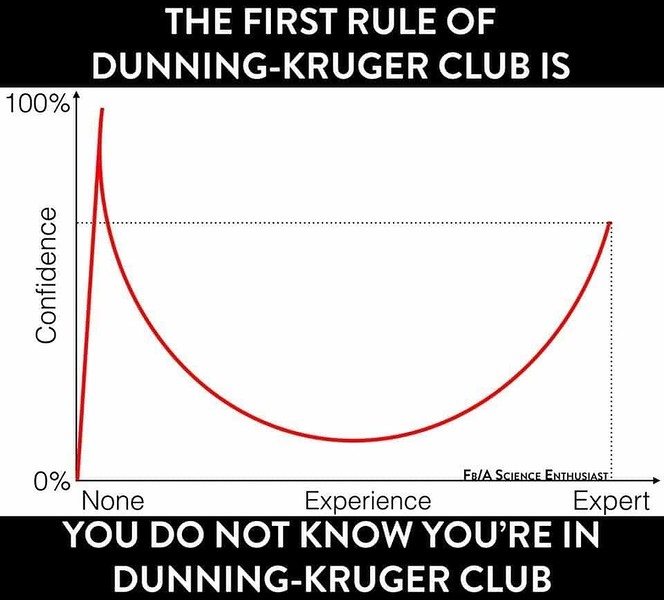
There's an old saying about "never insult a man's ability to drive, fight, or f**k", but it's hard not to when they give you all of the evidence (lap times) then argue against this painful reality. Just putting in "25 track days" does not make you: fast, consistent, or somehow make your opinion of some bolt-on doo-dad worthy of merit. Lap times say so much... and when they just aren't anywhere near where a fast person's would be, your opinion gets ignored. As it should.
I've worked with instructing HPDE students for over 30 years, and try to help new folks or even "the regulars" who want to learn how to go faster. The best way to help folks see "where they are" is to take them for a ride-along on a 90% pace or faster lap. Experiencing a lap first hand in a car that is 10-20+ sec a lap faster than they are has an AMAZING effect: it resets their parameters. I cannot count how many folks have said this - " I had no idea how slow I was until I rode with (someone fast)". With helmet-comms you can hear the moment they realize this. I've seen people get emotional, start to tear up... hell, when I am right seat with a student see them make a "quantum leap" over the course of several sessions or days, -I- get emotional too. It's very rewarding to see someone you have been coaching get to the next level.
And at the hundreds of track events I've driven / instructed / competed at, I always see some "regulars" that are stuck. These folks often have years of experience - yet are still super slow. These are the folks that give HPDE a bad name - they "don't see" cars behind them much less give point-bys, tend to be in higher powered cars that can block others on straights in lower power but faster lap time capable cars, usually refuse instruction, yet they always think they are super fast. I usually see them bragging in paddock (or online), usually have the biggest trailer/rig, with some of the highest end equipment.
Of course "JJ427R" is going to take this the wrong way - as the Dunning-Kruger afflicted always do. He will fly off the handle, respond once again with threats of violence, or throw in some completely nonsensical and off topic "example" of his driving greatness. I hope I am wrong this time....
JJ427R
Senior Member
- Joined
- Jan 14, 2015
- Posts
- 3,305
- Reaction score
- 1,207
I've worked with instructing HPDE students for over 30 years, and try to help new folks or even "the regulars" who want to learn how to go faster. The best way to help folks see "where they are" is to take them for a ride-along on a 90% pace or faster lap. Experiencing a lap first hand in a car that is 10-20+ sec a lap faster than they are has an AMAZING effect: it resets their parameters.
I've worked with several different instructors at BIR's Performance driving school the last 8 years, and yes we/they use communication in the helmets.
I have also had a couple of the instructors drive my car as I rode along, and I also rode with a couple of the instructor in their cars. I also have done a ride along with a Porsche Club instructor at Road America in a Porsche GTS, probably one of the best rides of my life! I have very much confidence in my driving ability, and that has been expressed as well by the instructors that I have worked with, as well as people I've driven on track with, so I'm not just "assessing my own ability" as you say.
Sorry my lap times don't live up to your standards. I've never claimed to be the fastest guy out there, I still pass other cars on the track so I'm not by any means the slowest guy either. I am also very courteous in letting faster cars by me. I know track etiquette very well.
The only comment I will make about you is I've caught you lying about me on this site as well as facebook, to try to cover your ass on stupid comments you and Jason make. Trying to say I was deleting posts when it was your cronie Jason deleting a post that he made. To me a liar is one of the lowest forms of person on the earth, If you lie on forums such as this, you'll lie to your customers as well.
The post he deleted on facebook was regarding a comment he made where he stated "Sounds like you'd be a good one to test parts"
My wife responded " he probably would , but he just said he would never test any for Vorshlag"
Shortly after he deleted it.....
Last edited:
Similar threads
- Replies
- 36
- Views
- 3K
- Replies
- 6
- Views
- 441

- Replies
- 6
- Views
- 1K


Support us!
Support Us - Become A Supporting Member Today!
Click Here For Details