
Fullboogie
King of the Ski - OG Jr.
Well, we've done our best to figure out if you're a dumbass, but you passed the test. Good luck, man - what a crappy job to have to do.

Haha, I did try and pull it with the washer still on there one time that was a couple years ago though.Well, we've done our best to figure out if you're a dumbass, but you passed the test. Good luck, man - what a crappy job to have to do.

Haha, I did try and pull it with the washer still on there one time that was a couple years ago though.



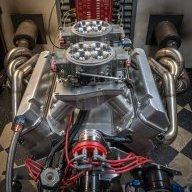
Okay, I called IW and they recommended removing the outer alum. part of the balancer and using a puller while heating the hub. Well the hub remains in place with two grade 8 bolt broke in it. I bought a 700 ft lb impact today and heated the hub with a torch and no go.
Does anyone have a front cover sitting around that could check something for me?
What I want to know is, is there a backer that the front seal buts up to or does the seal just mount flush with the front cover? If there is no backer behind the seal I can push the hub and seal through the cover. The hub will clear the hole.
Next option may be to destroy the front cover to be able to get everything apart and then have my machine shop remove the hub.
No backer for the front seal on the cover...here is a picture of Paul's cover I coated
Holy shit, its like its welded on there or something.
It looks strait as the day I put it on.Do you think it slipped a little and the keys are displaced with the metal fusing the crank and hub? What you are describing sounds like it will take a lathe to get off.
This is not good, that's fo sho
I guess I will have to get IW to get me a new hub and redo the groove it for the second key.Assuming you can get the cover off you could just cut the hub off along one of the keys. If you cut to deep all it will do is get into the key, not the crank. Once the hub is split it will come off……or at least it should.
What a PITA!!!



Wow. that's extreme!
You gonna have it all back together in a few weeks?
saw the piston in the other thread. That blows.
Hopefully the machine shop will be able to remove without damage to the crank. Post up what they find, I would be interesest to know what happened.

Just some suggestions as I have seen this issue before...
After careful failure analysis the reason for this failure mode is more than likely one, or a combination of more than one, of the following:
FWIW if more than 5 tons of force by either a press or puller is required to remove the hub from the crankshaft snout I strongly recommend not pressing the hub off in a higher tonnage press. More than likely the hub is now seized on the crankshaft snout and further pressing will only increase the damage to both the crankshaft and hub. I suggest using a cut off wheel and VERY CAREFULLY splitting the hub in several places and peeling the hub off the crankshaft snout - similar to peeling an orange. Often times the hub doesn't have to be sliced completely through, combined with heat not to exceed 275*, to relieve just enough press to allow the hub to be removed from the crankshaft snout without further damage to either. This is how I've seen the machine shop at my work remove these hubs. Only then will there be a chance of salvaging the crankshaft snout.
- Antiseize not used, or incorrect type of antiseize used, at time of initial hub installation. Nickel based antiseize should always be used whenever possible in lieu of aluminum or copper based antiseize
- Crankshaft snout to harmonic balancer hub press fit not within prescribed tolerances. This could be due to the crankshaft snout OD being too large, balancer hub ID being reamed incorrectly (too small), or a combination of stack up tolerances of both resulting in a press fit which is too tight. The crankshaft snout diameter being too large is a relatively easy fix as most times it's only a couple of tenths to large. This can be corrected by polishing the snout of the crankshaft to the proper OD. If the hub is too small that's a more difficult process as the hub should be reamed with a multi flute reamer to the correct ID. This is extremely difficult due to the key ways. When the hub is originally manufactured, the ID is reamed to the correct size and then the key ways are cut. Often times this tolerance check is over looked during installation of the hub or ignored as the press fit "is only a couple of tenths out of spec". This can easily lead to the problem you're having.
- Crankshaft key(s) are sheared
- Multiple crankshaft key ways in either the hub, crankshaft snout or both, are slightly misaligned due to one or both being machined a few degrees out of tolerance. Correctly machining a second key way in a crankshaft snout after production is not as easy as it sounds although it can be done by a competent and well tooled machine shop.
Why did the balancer hub go on the crankshaft snout with no issues? When installing the hub, the hub is being pressed on to the snout of the crankshaft. This pressing action tries to shorten the length of the hub and actually makes the bore of the hub slightly larger. Removing the hub pulls on the hub trying to stretch the length of the hub effectively making the bore of the hub smaller and actually makes the hub a tighter press fit on the snout of the crankshaft. This is the reason a bearing splitter yeilds better results than a flange or jaw type puller.
Proceed with caution as you see fit


