

Naturally. Unless you use some sort of rod/spherical end.Okay, that’s fine .... except that if it’s the “right way,” then the same has to be applied to the UCA, panhard, and sway.

You are using an out of date browser. It may not display this or other websites correctly.
You should upgrade or use an alternative browser.
You should upgrade or use an alternative browser.
New Suspension. Stiff steering.
- Thread starter TylerM
- Start date

1950StangJump$
Senior Member
- Joined
- Apr 1, 2010
- Posts
- 968
- Reaction score
- 108
Okay. I'm still not convinced that it should apply to poly bushings and rod ends, but I suppose there is no reason down side to torquing under load, so that's the right move.
On a two post lift, is it good enough to simply use a transmission jack and lift up gently at the diff housing until the car is starting to come off the back of the lift, or do you think the tires have to be on the ground (ramps)?
On a two post lift, is it good enough to simply use a transmission jack and lift up gently at the diff housing until the car is starting to come off the back of the lift, or do you think the tires have to be on the ground (ramps)?
08MustangDude
Banned
- Joined
- Aug 27, 2018
- Posts
- 307
- Reaction score
- 38
I put in a set of quick struts, they do not need to be torqued at ride height.
FACTORY Lower control arms, rubber bushings, the bolts should be torqued at ride height.
Sway bar bushings, doesn't matter, but you need to make sure
both wheels are at the same height so the bar does not move
on you when you remove either side clamp.
Bolts on these kind of bushings should be torqued ride height:
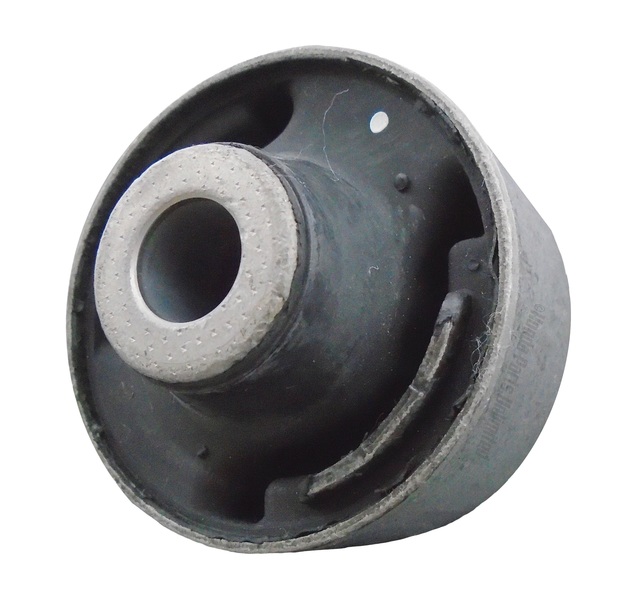
If you tighten these with the suspension hanging, they may be stressed at ride
height, and even more on uplift of the strut IF the sleeve doesn't slip and set; they will
wear/tear faster. The entire bushing twists first, rather than glide on the sleeve like with
poly. It's rest position should be ride height. Basically, torquing the control arm
bushing with the arm hanging; it will twist through a greater range of motion before
breaking free from the sleeve. It should break free, slip and realign itself, then lock into
the correct position. Under the same conditions though, a hot-bonded bushing will simply
fail.
Poly bushings are totally different. It really doesn't matter where the suspension
is when you tighten the bolts. The poly moves on the metal sleeve instead of sticking
to it like rubber. This is where the squeak comes from when the lubrication layer
between the sleeve and poly is not there. They work on the same basic principal as
main bearings do on a crankshaft... Anyhow, eventually, the center ovals out, where as
rubber bushings tear, or the sleeve stays free from the rubber and wears down every
time the bushing twists.
Sway bar bushings work the same way, the bar twists in the bushing, except for
like VW, Audi where they have roller bearings or plastic sleeves to twist in, and they
are attached/bonded to the sway-bar and need cut off if you were to switch to rubber
and clamps. Or, you have to buy the whole thing, sway bar with everything attched
for $280.
FACTORY Lower control arms, rubber bushings, the bolts should be torqued at ride height.
Sway bar bushings, doesn't matter, but you need to make sure
both wheels are at the same height so the bar does not move
on you when you remove either side clamp.
Bolts on these kind of bushings should be torqued ride height:
If you tighten these with the suspension hanging, they may be stressed at ride
height, and even more on uplift of the strut IF the sleeve doesn't slip and set; they will
wear/tear faster. The entire bushing twists first, rather than glide on the sleeve like with
poly. It's rest position should be ride height. Basically, torquing the control arm
bushing with the arm hanging; it will twist through a greater range of motion before
breaking free from the sleeve. It should break free, slip and realign itself, then lock into
the correct position. Under the same conditions though, a hot-bonded bushing will simply
fail.
Poly bushings are totally different. It really doesn't matter where the suspension
is when you tighten the bolts. The poly moves on the metal sleeve instead of sticking
to it like rubber. This is where the squeak comes from when the lubrication layer
between the sleeve and poly is not there. They work on the same basic principal as
main bearings do on a crankshaft... Anyhow, eventually, the center ovals out, where as
rubber bushings tear, or the sleeve stays free from the rubber and wears down every
time the bushing twists.
Sway bar bushings work the same way, the bar twists in the bushing, except for
like VW, Audi where they have roller bearings or plastic sleeves to twist in, and they
are attached/bonded to the sway-bar and need cut off if you were to switch to rubber
and clamps. Or, you have to buy the whole thing, sway bar with everything attched
for $280.
1950StangJump$
Senior Member
- Joined
- Apr 1, 2010
- Posts
- 968
- Reaction score
- 108
... Bolts on these kind of bushings should be torqued ride height:
....Poly bushings are totally different. It really doesn't matter where the suspension
is when you tighten the bolts.
That's how I understood it too . . . you just did a better job of explaining it.
And where does all this information leave us at the issue of the steering getting very stiff at center? Such as binding? If that is the case then the SVT front LCA's have poly bushings. As far as I am concerned the struts and springs are not binding. Which leaves the steering gear or alignment.
Note. When driving down the road in a straight line for a few, the first turn of the wheel is the worst in terms of resistance.
Sent from my SM-G960U using Tapatalk
Note. When driving down the road in a straight line for a few, the first turn of the wheel is the worst in terms of resistance.
Sent from my SM-G960U using Tapatalk
1950StangJump$
Senior Member
- Joined
- Apr 1, 2010
- Posts
- 968
- Reaction score
- 108
Well, I wasn't trying to hijack, as I saw hashing out this "torque under load" to be important to you. So, I think where this leaves you . . . it's unlikely that you torqueing when not under load is the problem.
Nonetheless, as much as I argued the contrary, I think you should start with that and see where it leaves you.
EDIT: Any chance the suspension changes left you with the steering shaft now rubbing on headers?
Nonetheless, as much as I argued the contrary, I think you should start with that and see where it leaves you.
EDIT: Any chance the suspension changes left you with the steering shaft now rubbing on headers?
I understand the importance. I have reread all of the literature related to my components and the installs. Nothing stated about torquing under load. Anywhere. Nonetheless I will try it to see if it helps. I did not want to lose sight of the main issue.
I plan to check the coupler and u-joint for the steering gear when I retorque it down as well. I retorqued the strut nuts with the car on the ground last night and no noticeable difference this morning.
Sent from my SM-G960U using Tapatalk
I plan to check the coupler and u-joint for the steering gear when I retorque it down as well. I retorqued the strut nuts with the car on the ground last night and no noticeable difference this morning.
Sent from my SM-G960U using Tapatalk
08MustangDude
Banned
- Joined
- Aug 27, 2018
- Posts
- 307
- Reaction score
- 38
If you had it up off the ground, and the steering was stiff with no road
contact, I am going to go with strut bearing caps, too much drag for
some reason.
contact, I am going to go with strut bearing caps, too much drag for
some reason.
If that is the case then they are already being replaced with MM CC plates.If you had it up off the ground, and the steering was stiff with no road
contact, I am going to go with strut bearing caps, too much drag for
some reason.
Sent from my SM-G960U using Tapatalk

01yellerCobra
Senior Member
It doesn't take much to pop off the tie rod ends. Pop them off and see if the steering is still stiff. If it is then it's rack or steering shaft related. If it goes back to normal then it's related to the suspension. At that point you can turn each wheel by hand and see if one or both are hard to move.
bl817
Member
- Joined
- Feb 24, 2017
- Posts
- 91
- Reaction score
- 10
underdrive pullies installed? noticed my steering a tad harder when I installed mine.
As far as I know, there are no under drive bullies installed.underdrive pullies installed? noticed my steering a tad harder when I installed mine.
Sent from my SM-G960U using Tapatalk
08MustangDude
Banned
- Joined
- Aug 27, 2018
- Posts
- 307
- Reaction score
- 38
It would narrow it down to the hydraulics or rack, if you pop the tie-rod ends out of
the knuckles and see if it is still stiff. If it's freed up after doing so, then more
then likely it's the strut bearing caps. Doubt the end links would be the issue.
the knuckles and see if it is still stiff. If it's freed up after doing so, then more
then likely it's the strut bearing caps. Doubt the end links would be the issue.
01yellerCobra
Senior Member
It doesn't take much to pop off the tie rod ends. Pop them off and see if the steering is still stiff. If it is then it's rack or steering shaft related. If it goes back to normal then it's related to the suspension. At that point you can turn each wheel by hand and see if one or both are hard to move.
Hmmmm.....It would narrow it down to the hydraulics or rack, if you pop the tie-rod ends out of
the knuckles and see if it is still stiff. If it's freed up after doing so, then more
then likely it's the strut bearing caps. Doubt the end links would be the issue.
So I finally got the bumpsteer and CC plates in. While the tie rods were unhooked I tested the steering. Still getting stiff but only when the steering wheel reaches vertical at the 12 or 6 o'clock positions. So now I am narrowing down to an issue with the steering gear or power steering pump. Going to flush the power steering and add fluid/bleed before I start changing anything else out.
I had a friend help me and he said everything underneath looked normal as we were checking. Steering shaft and u-joint looked fine. No jerking or anything anywhere.
Sent from my SM-G960U using Tapatalk
I had a friend help me and he said everything underneath looked normal as we were checking. Steering shaft and u-joint looked fine. No jerking or anything anywhere.
Sent from my SM-G960U using Tapatalk
Update incase anyone has the same issue. Replaced the intermediate steering shaft and solved everything. The car turns freely and butter smooth now. Found mine online for $60 on Ebay. Matching part numbers and rust free.
Sent from my SM-G960U using Tapatalk
Sent from my SM-G960U using Tapatalk

Update incase anyone has the same issue. Replaced the intermediate steering shaft and solved everything. The car turns freely and butter smooth now. Found mine online for $60 on Ebay. Matching part numbers and rust free.
Sent from my SM-G960U using Tapatalk
Nice!
hoyabob2003
Junior Member
- Joined
- Jan 11, 2011
- Posts
- 7
- Reaction score
- 2
Awesome! Glad you solved it and posted the knowledge here for us to learn. Thanks!
Last edited:
Similar threads


- Replies
- 6
- Views
- 587


Support us!
Support Us - Become A Supporting Member Today!
Click Here For Details