
3" exhaust and why?

ctt326

Brenspeed Hater
Joined
Jan 15, 2012
Posts
1,083
Reaction score
0
Location
Fort Wayne, IN
The increase in area is about 16% by going from 1-5/8" to 1-3/4" header tube. This means that the velocity drops by 16% and the pressure drop decreases by about 35% (since pressure drop or resistance is proportional to velocity squared). Or, the flow can increase by 16% without any increase in backpressure. To summarize the nerd-speak, a small difference in diameter can make a big difference in flow.

Chris

Bernoulli's equation deals with fluids. You would need density, specific weight, or specific gravity of the gas to solve the problem. Also Q(flow rate) needs to be known as well. You can't just solely take the difference in area and assume...I don't feel like working this out. The above is not true for the velocity of a gas.

 

one eyed willy

Pizzle fo shizzle
Joined
Jul 1, 2008
Posts
7,533
Reaction score
26
Location
Lakeland FL
Bernoulli's equation deals with fluids. You would need density, specific weight, or specific gravity of the gas to solve the problem. Also Q(flow rate) needs to be known as well. You can't just solely take the difference in area and assume...I don't feel like working this out. The above is not true for the velocity of a gas.


one eyed willy equation: shitz bigger yo, makes it better!
 

S197gt07

Senior Member
Joined
Jul 7, 2010
Posts
4,064
Reaction score
1
Location
Newburyport, MA
Fettuccine's principle

:roflmao:

Jason - Give ARH a call, I know for a fact that on the 3v you can remove the transmission without removing their headers. I know you have the T-56, so maybe its possible to remove that too without header removal. Have them build you a set of stepped headers, with a 3" collector!
 

Department Of Boost

Alpha Geek
Joined
May 26, 2010
Posts
8,808
Reaction score
31
one eyed willy equation: shitz bigger yo, makes it better!

Tru dat!:thumb2:

Burrito’s Principal:

The bigger it is the more gas it flows.

:roflmao:

Jason - Give ARH a call, I know for a fact that on the 3v you can remove the transmission without removing their headers. I know you have the T-56, so maybe its possible to remove that too without header removal. Have them build you a set of stepped headers, with a 3" collector!

That sounds like a winner! Thanks!
 
Last edited by a moderator:

tjm73

of Omicron Persei 8
Joined
Jun 9, 2010
Posts
12,092
Reaction score
1,641
Location
Rush, NY
I was recently researching some info on this topic for a build I'd like to do (but probably won't ever get to do).

About 10 years ago some one did some research and arrived at a couple guidelines for exhaust sizing.

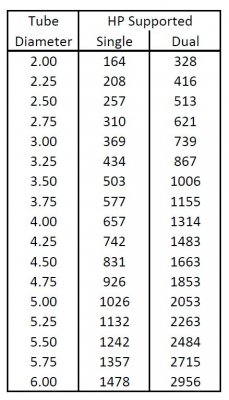
The guideline goes like this. An exhaust system will flow 2.2 cfm for every horsepower to equal an open exhaust for flow and every square inch of an exhaust pipe inner diameter flows 115 cfm.

IMO, you build for flow and then engineer in sound control without sacrificing flow.

I then took this and used Excel to create the attached chart. Of course this is theoretical and not an absolute for sure, but it's a good starting place and the guidelines are supposed to be from a reputable car and component testing person.

What I didn't see addressed was what happens with the length of the system and how many bends and how sharp they are. It would all influence the flow capability. THey did talk about the two types of mufflers. Chambered and absorbitive. Chambered is supposed to reflect the exhaust sounds back onto it's self to cancel out the frequencies while the other absorbs and dissipates the sound. THe conclusion was a combination of both did the best job.

I have also read that mufflers need to be sized to volume of the gases that will be exhausted through them.
 

Attachments

  • exhaust.JPG
    exhaust.JPG
    51.2 KB · Views: 31
Last edited:

Greg Hazlett

Stepping on the Pink Bus
Official Vendor
Joined
Nov 2, 2009
Posts
23,982
Reaction score
340
Location
Chesapeake, VA
^^ good info but how would that translate to the collectors on the headers?

Or does it not matter?
 

tjm73

of Omicron Persei 8
Joined
Jun 9, 2010
Posts
12,092
Reaction score
1,641
Location
Rush, NY
I was researching for turbo application after the turbo(s).

I've not yet found any info on header tube diameter. Only anecdotal observation s from magazine articles I've read. IN general terms it seems like once you crest the 500ish hp threshold engines start to respond positively to 1.75" header tubes. But it also seems that nitrous and N/A headers need slightly different things.

I suppose you could divide your target hp into 8 individual cylinders and calculate the header tube diameter just the same as I calculated the dual and single exhaust diameter capabilities. Flow and area remain constant only how much goes though a given section should matter. Maybe I'll play with the formula I created.

Of course someone will always come along with a combo that flies in the face of the "guide lines".

EDIT: Divide your target HP by 8 then look at this chart....
 

Attachments

  • primaries.JPG
    primaries.JPG
    35.8 KB · Views: 32
Last edited:

stkjock

---- Madmin ----
Staff member
Administrator
Super Moderator
Joined
Jul 10, 2007
Posts
40,526
Reaction score
3,335
Location
Long Island NY
:lol: based on the chart above, I should upgrade from my 3" to 3.25 or 3.5"
 

Sky Render

Stig's Retarded Cousin
Joined
Feb 24, 2011
Posts
9,463
Reaction score
358
Location
NW of Baltimore, MD
I've got 3" Magnaflow. I hate how the driver's side over-axle pipe clanks on the axle vent every time I go over a hard bump.
 

HellsBells

620/677
Joined
Sep 30, 2010
Posts
5,576
Reaction score
9
Location
SoCal
I was recently researching some info on this topic for a build I'd like to do (but probably won't ever get to do).

About 10 years ago some one did some research and arrived at a couple guidelines for exhaust sizing.

The guideline goes like this. An exhaust system will flow 2.2 cfm for every horsepower to equal an open exhaust for flow and every square inch of an exhaust pipe inner diameter flows 115 cfm.

IMO, you build for flow and then engineer in sound control without sacrificing flow.

I then took this and used Excel to create the attached chart. Of course this is theoretical and not an absolute for sure, but it's a good starting place and the guidelines are supposed to be from a reputable car and component testing person.

What I didn't see addressed was what happens with the length of the system and how many bends and how sharp they are. It would all influence the flow capability. THey did talk about the two types of mufflers. Chambered and absorbitive. Chambered is supposed to reflect the exhaust sounds back onto it's self to cancel out the frequencies while the other absorbs and dissipates the sound. THe conclusion was a combination of both did the best job.

I have also read that mufflers need to be sized to volume of the gases that will be exhausted through them.

Do you have any data to support any of this? Or at least the name of the "reputable car and component testing person"?

It's also agreed that no exhaust piping is best post-turbo.

Another flaw in the reasoning (I'm not going to call it your reasoning since you said you heard it from someone else--not attacking you personally) is that exhaust is not a constant volume. People always make this mistake and oversimply the issue. Exhaust gas comes out in pulses and that makes the entire ordeal much harder to calculate. They don't even come out in consistent pulses since the motor revs up and down. Every motor will also make different amounts of exhaust gas at the same power level, depending on how it's making power.
 

tjm73

of Omicron Persei 8
Joined
Jun 9, 2010
Posts
12,092
Reaction score
1,641
Location
Rush, NY
About 10 years ago some one did some research and arrived at a couple guidelines for exhaust sizing.

The guideline goes like this. An exhaust system will flow 2.2 cfm for every horsepower to equal an open exhaust for flow and every square inch of an exhaust pipe inner diameter flows 115 cfm.

David Vizard is the source of the guide line.

Further sourced some info and theory from http://www.pontiacstreetperformance.com/psp/exhaust.html
 

nyuk98GT

Infrequent poster
Joined
Dec 28, 2011
Posts
315
Reaction score
20
Location
Chesterfield, MO
Bernoulli's equation deals with fluids. You would need density, specific weight, or specific gravity of the gas to solve the problem. Also Q(flow rate) needs to be known as well. You can't just solely take the difference in area and assume...I don't feel like working this out. The above is not true for the velocity of a gas.

ctt326:

Couple points of clarification, if I may:

Gases, vapors, and liquids are all classified as fluids.

A detailed analysis is not needed. Take the average exhaust temperature, assume ideal gas behavior, and calculate the pressure drop for the two cases (stock exhaust, larger diameter exhaust). I think you will find that the pressure drop is, in fact, proportional to velocity squared. The exponent may not be exactly 2.0 as Bernoulli's shows but it is close enough for car enthusiasts to determine whether it is worth upgrading the exhaust piping.

Peace.

Chris
 

ctt326

Brenspeed Hater
Joined
Jan 15, 2012
Posts
1,083
Reaction score
0
Location
Fort Wayne, IN
ctt326:

Couple points of clarification, if I may:

Gases, vapors, and liquids are all classified as fluids.

A detailed analysis is not needed. Take the average exhaust temperature, assume ideal gas behavior, and calculate the pressure drop for the two cases (stock exhaust, larger diameter exhaust). I think you will find that the pressure drop is, in fact, proportional to velocity squared. The exponent may not be exactly 2.0 as Bernoulli's shows but it is close enough for car enthusiasts to determine whether it is worth upgrading the exhaust piping.

Peace.

Chris

Alright alright you got me. I had to break out the fluid power book.
 

brent_G

Custom User Title
Joined
Apr 29, 2012
Posts
2,067
Reaction score
1
Location
Vass, NC
ive seen turbo 4 cylinders with 4 inch downpipes. 3 inch on each bank of a v8 is probably the bare minimum for a turbo v8 IMO.
 
Back
Top