Vorshlag 2011 Mustang 5.0 GT - track/autocross/street Project

Status
Not open for further replies.

Sky Render

Stig's Retarded Cousin
Joined
Feb 24, 2011
Posts
9,463
Reaction score
359
Location
NW of Baltimore, MD
That's really interesting that driving styles can affect the ABS module's behavior.

I have also noticed anecdotally that women seem to be smoother race car drivers than men.
 

Norm Peterson

corner barstool sitter
Joined
Feb 5, 2011
Posts
3,615
Reaction score
327
Location
RIP - You will be missed
That's really interesting that driving styles can affect the ABS module's behavior.
My understanding is that street ABS calibration needs to consider various stability issues, such as split-mu braking (bare pavement one side, wet/snow/slush other side). Extremely violent (and probably combined lateral/longitudinal) maneuvers with high rates of onset might be enough to "confuse" a street calibration.


Terry/Rehagen - let me know if I'm off base with that.


Norm
 

Ike

Member
Joined
Jan 21, 2014
Posts
97
Reaction score
0
I think the kit looks cool.

Why not go with no ABS or traction control?
 

NoTicket

Member
Joined
Jun 2, 2013
Posts
303
Reaction score
0
Terry,

Most of the time I have seen misbehaving ABS is due to BBKs. The brake balance gets all out of whack, and all of a sudden ABS is slightly unpredictable, and is activating well before the grip threshold.

Maybe it was a result of the GT500 rear brakes on the car. May want to think about changing out the booster as well. Of course, you guys may have already. As much as I love reading your posts I have not read all of them.
 

Vorshlag-Fair

Official Site Vendor
Joined
Nov 12, 2010
Posts
1,592
Reaction score
116
Location
Dallas, TX
Why not go with no ABS or traction control?

Hmm.... I've seen this a lot lately, and I think people are confusing ABS and traction control a bit. Both systems (plus stability control) are controlled in the same module, but they are very different systems. Let's go over this quickly.

Modern (2000+) 4 channel factory equipped ABS systems are VERY GOOD. The ABS system modulates the brake caliper at all four wheels independently (in a 4 channel system) to avoid lockup, hundreds of times per second. A human being has one brake pedal that can be modulated "ones of times per second", and it controls all 4 brakes. The benefits of ABS on a street car are directional control while threshold braking, plus avoiding lockup slows the car down much quicker - both benefits make people crash less. In racing a modern ABS system allows a driver to wring 100% of braking deceleration out of all 4 wheels at will - just mash that pedal HARD - and this ups driver confidence considerably. ABS is a real driver aid that works very well on most modern cars. The S197 Mustang's ABS system is somewhat legendary (very very good) and in NASA American Iron it is penalized considerably because it works so well. S197 racers can brake later than other racers in the same class, its as simple as that. Ford Racing has done racers big favors by developing several low cost versions of replacement ABS modules specially tuned to racing conditions - for high coefficient of friction brake pads and high grip racing tires. A typical Bosch racing ABS system costs $10,000.... but the Ford Racing modules are around $500.

Modern Traction Control systems started to include stability control as well in the past 10 years, and combined these systems work out to be pretty BAD on most late model factory built cars. It applies rear brake and/or pulls throttle to control wheelspin and yaw. This system is also designed by the OEMs to prevent crashes BUT it is also used to prevent warranty claims, too. Unlike locking tires under braking, spinning tires under acceleration is FUN and a little bit of slip can be faster. Traction/Stability control systems prevent wheelspin on the drive wheels plus tries to prevent any yaw in the chassis (pivoting around the center) in hard driving/wet/ice conditions, to help avoid spins. Unfortunately they are NOT geared towards motorsports uses and when activated in racing conditions THEY SLOW DOWN good drivers, even in the wet (we tend to not race in the snow and ice). A bit of yaw is helpful in track and especially autocross conditions, to "pivot" around tight corners. I will often go through even high speed corners with some "slip angle", and it allows for higher lateral loading. Forward acceleration on track is also better with these OEM systems turned off.

Please don't confuse a motorsports traction control systems with an OEM one - these racing oriented systems are made for very different purposes, and they can work very well. Any form of Traction Control is banned in many forms of racing because it takes out a big driver element, and it ends up making the racing between the software engineers. There was a big stink in F1 last year when some F1 engineers accused other F1 teams of sneaking traction control features into their KERS (Kinetic Energy Recovery System) systems.

Terry,

Most of the time I have seen misbehaving ABS is due to BBKs. The brake balance gets all out of whack, and all of a sudden ABS is slightly unpredictable, and is activating well before the grip threshold.

Maybe it was a result of the GT500 rear brakes on the car. May want to think about changing out the booster as well. Of course, you guys may have already. As much as I love reading your posts I have not read all of them.

Again - we've been having TRACTION CONTROL faults from an early stage, even when we were racing in STX class on street tires, and these have gotten much worse lately. The ABS system works fine. :beerdrink: I have not had a single ABS issue in 2 years, even with the 14" rear GT500 brakes.

We NEVER EVER race with the AdvanceTrac traction /stability control system turned on, not even "halfway on". We start every autocross and track session with the "Hold the brakes, press the Traction Control button, hold for five seconds" procedure to turn AdvanceTrac ALL THE WAY OFF.

DSC_6635-M.jpg


Doing track or autocross events with the stability/traction control system turned on (in either mode) will make the car SLOWER (for most drivers), abuses the rear brakes, and pulls HUGE amounts of throttle to reduce torque to the wheels. Even in the rain I turn it off, but some folks will leave it on in wet conditions. I tried it in the wet once and it was MURDERING the rear brake pads and rotors, trying to keep the car from yawing at all. Yes, even in a downpour I turn it OFF.

_DSC2747-M.jpg


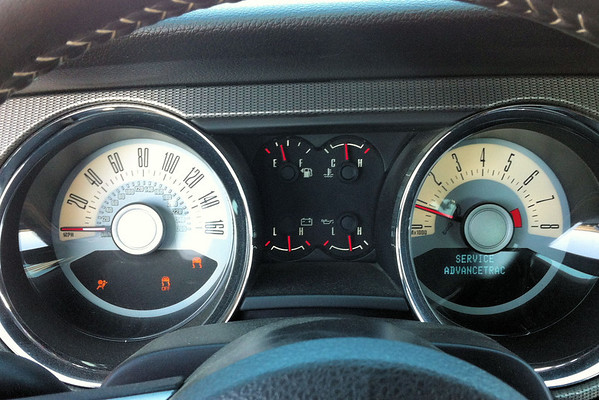
What has happened to us on track, many times, is that the AdvanceTrac system sometimes freaks out and TURNS ITSELF BACK ON. Then it goes bonkers applying the brakes to keep the rear tires from any amount of slip or yaw. Once it turns itself back on it cannot be turned back off without coming into the pits, shutting the engine off (there's usually a fault code displayed), restarting, and going through the whole traction control defeat sequence. Huge PITA and usually the session is ruined. We've even seen it go into the "Service Advantrac" mode, when it is really pissed off (see below).

IMG5479-M.jpg


It used to do this occasionally on street tires, but as we've upped the grip levels it seems to do it much more often on track. Lately it is happening on my first or second hot lap in a session, like what I saw last weekend in my two fastest sessions of the weekend (Saturday TT session 2, Sunday TT session 2) - where I somehow still squeaked out my best laps, even in a fault mode with the brakes applied in some corners at wide open throttle. I'm so ready for that nonsense to end. We are installing the Boss 302S/R ABS/traction control module today. This new module PERMANENTLY DEFEATS all AdvanceTrac modes, which is what I want. It might not be what YOU want, and it is not meant to be installed into a street driven car.

Now the Anti Lock Brake (ABS) system is something I am actually very fond of, and I use it often on track. I don't try to "ABS stop" every corner, but I do push the braking pretty hard on this car and the ABS system keeps me from locking up a tire - which ruins the tire (flatspot) and reduces braking capabilities greatly, often leading to an off track excursion. I've had the ABS system freak out a few times, but it was only ever in an autocross situation where the car was yawing hard, transitioning over a bump, and I was braking violently. On track it has never failed me once.

DSC_0007-M.jpg


The new module also tweaks the ABS settings, supposedly setting a higher threshold for the anti-lock modulation when equipped with race tires and race brake pads. I will report back on the new settings but Rehagen reports really good things about this -CA module in their Pro racing uses, so that's a very good sign.

Thanks,
 

NoTicket

Member
Joined
Jun 2, 2013
Posts
303
Reaction score
0
Sorry I must have misread that you were having ABS and traction control issues.
 

sheizasosay

Alive
Joined
Jun 28, 2011
Posts
1,024
Reaction score
4
ABS VERY GOOD. ABS crash less. ABS real driver aid , low cost.

BAD OEMs NOT THEY SLOW DOWN.
motorsports traction control systems OEM


TRACTION CONTROL

NEVER EVER ALL THE WAY OFF. SLOWER. HUGE MURDERING OFF.


freaks out and TURNS ITSELF BACK ON. PITA. PERMANENTLY DEFEATS YOU.

Don't feel bad Noticket. This is all I see when I'm reading. ;)
 

Boaisy

Dark Knight
Joined
Dec 11, 2013
Posts
4,194
Reaction score
7
Location
Memphis, TN
I was getting the Service AdvanceTrac towards the end of Autocrosses until I replaced the differential. The spider gears were busted.
 

JPC

Junior Member
Joined
Feb 8, 2014
Posts
37
Reaction score
1
Location
Allen, TX
Terry, great post. I learned alot. Please keep us informed how the Ford Racing module does on the track.
Is it easily changeable? IE plug the race module in the nite before race day than back to OEM for daily driving?
 

Dubstep Shep

WUB WUB VROOM VROOM
Joined
Jun 22, 2013
Posts
3,382
Reaction score
0
Location
Houston, TX
How hard is the module to switch?

It would be nice to be able to switch module out at the track and then back to the OEM for the drive home.
 

Norm Peterson

corner barstool sitter
Joined
Feb 5, 2011
Posts
3,615
Reaction score
327
Location
RIP - You will be missed
What has happened to us on track, many times, is that the AdvanceTrac system sometimes freaks out and TURNS ITSELF BACK ON. Then it goes bonkers applying the brakes to keep the rear tires from any amount of slip or yaw.
There is a lengthy thread here where there are a few documented cases of Advanctrac going bonkers in street driven cars and what it took to get to an apparent solution. There appears to be a certain driving sequence that sets it off in these cases. Have your episodes sounded at all similar to the description given in post #1 in the original thread here?

The fix is to install a later revision of the ABS module
first linked thread said:
The new ABS Control Module Part # is: BR3Z2C219C
The earlier glitchy modules ended in A or B
What module did your car come with? A, B, or C?


Kind of separately, it doesn't seem like the M-2353-CA could have any adverse effect on pre-Advanctrac Mustangs beyond at most defaulting TC to "off". But wouldn't you still gain the better utilization of sticky rubber under extreme braking?


Norm
 
Last edited:

kona302

Member
Joined
Mar 24, 2012
Posts
161
Reaction score
0
Location
south texas
Ferrari accused the Red Bull team, if I'm not mistaken. The car sounded different when exiting corners. Maybe it was because they haven't had a pole position since july 2012.
 

2013MustangGT

Budget Boss
Joined
Nov 15, 2012
Posts
227
Reaction score
0
Location
Van Alstyne, TX
How hard is the module to switch?

It would be nice to be able to switch module out at the track and then back to the OEM for the drive home.

It's not hard to switch out. It's a PIA. The ABS module is located under the stock CAI. The CAI needs to be removed and the snorkel needs to be removed too. Then it's just 4 T20 screws. The main thing is you need to keep it clean. You don't want dust in the module. It's really designed to be put in and left in. If you not having the advance track coming on every time your pushing your car I wouldn't suggest putting it in.
 

Vorshlag-Fair

Official Site Vendor
Joined
Nov 12, 2010
Posts
1,592
Reaction score
116
Location
Dallas, TX
Project Update for March 20, 2014: As usual this started out as a "quick update" but grew into a monster, and it only covers two weeks worth of events and car prep. We had a great time with NASA at Motorsports Ranch Cresson March 7-9th, so I'll go over that race weekend. Then I'll discuss the last nagging problems we're having with the car, which slowed down the lap times once again (AdvanceTrac faults!). We stripped all of the graphics off the red Mustang in preparation for Goodguys and USCA events as well as installed a set of BFG Rivals. We also got a chance to install the new BMR "UTCA033" spherical Upper Control Arm for the 2010-14 Mustang as well as a new set of Cobra seats (Monoco) in one of our Tester's GTs. Then we get ready for USCA this weekend.... let's go!

NASA @ MSR-C, March 7-9th, 2014

In my last update we went over the modifications and rear flares that were involved to the rear fenders to clear the big 345/35/18 Hoosiers back there (see below). The front flares we made last August were always intended to clear the 335/30/18 up front, and this was the first event where we got a chance to run this new tire upgrade.


Mmmm..... big flares.... big tires.... NASA @ MSR means it was time to finally use these in anger!

We drove at MSR track in January with SCCA Club Trials to a 1:18.675 on used 315mm A6 tires, so I was hoping for a 1-2 second time drop with a sticker set of the wider Hoosiers on the same 1.7 mile course... if we even ran the 1.7 course. You see the NASA Texas Time Trial group is normally too big to fit on the 1.7 so we normally use the longer 3.1 mile course - and have done so for the past three years (2011-13). We've had as many as 47 cars enter into TT group at our events, but this time we only had 26 signed up about 4 days before the event, so Dave B made the call, "TT will be running the 1.7". The cut-off for minimum TT entries to run the 3.1 was 32 cars, and we just didn't make it in time (but we did by the end of the race weekend!)


The 1.7 mile course everyone ran at the NASA event Jan 8-9th

The main thing I lacked at the Club Trials event in January was simple, SEAT TIME. I almost never run the 1.7 mile course at MSR, and have a lot more seat time on the (seldom used) 1.3 and 3.1 courses. I only drove the Mustang at speed for two sessions on the 1.7 mile course in January and put my best laps in early, in the 2nd session. Amy co-drove with me that day and drove in the last two sessions of the day, when it was warmer (it was very COLD at the start of that event, in the 29-35°F range). Well for this weekend Amy was at a wedding for a cousin out of state, so I was going to get to run the car as much as I wanted. Instead of learning the new tire set-up (and this track) during the four daily TT sessions on Saturday and Sunday I decided to head out to MSR on Friday afternoon to get some laps in at the "Test-N-Tune" event normally held the day before any NASA Texas event.

Friday Test and Tune at MSR

MSR is fairly close to our shop and after trying a new route (thanks Google!) I got there in under 1.5 hours. Problem is I didn't leave the shop until after 1:15 pm, as the guys were thrashing to get the car prepped and loaded. And normally I bring along one of our techs for each day to these local events but all of our guys had something going on that weekend, so I went out by myself. So no crew, no Amy, no Brandon (our photographer) - what could go wrong?


I had planned on getting there a bit earlier to reserve good paddock parking for my trailer and 2 others (Matt and Costas), but when I rolled up after 2:30pm the place was PACKED. NASA has commandeered the covered grid area for tech/scales, so they moved grid area to one of the parking lots normally used for paddock - which made the remaining paddock spaces disappear. I got the best spot I could find, unlaoded the car quickly, and went to the clubhouse sign up for the T-n-T event. Only $100 to run in the afternoon, but for all MSR run member and test days you must wear a fire suit and full race gear. No worries, I always bring my gear bag. They said that with our TT3 prepped car with the times it runs I could run with either the "race cars" (W2W prepped cars) or the "sports cars" (mostly HPDE and TT folks). There were 6 sessions left (30 minutes each), so I hopped in the car, set-up the new AiM SOLO DL, and went out to drive.


One of our testers Jamie Beck was there with his AST/Vorshlag/Whiteline/Cobra equipped 2013 Mustang GTs (above) to run in HPDE3 on Saturday and he was nice enough to snap these pictures of me driving - the only pictures I got all weekend of our car (I shot pics of TT cars in sessions that I wasn't driving on Sat/Sunday). We had just rebuilt his rear axle (diff bearings were shot, swapped in a new Torson and 3.31 gears from 3.73s - he loves it) and had some new gauges, a shift light, Ford Racing Sparco wheel and some "blip shift" device he was testing in HPDE3. He also borrowed my "loaner" AiM SOLO timer, which came in handy. So I went out Friday on the 335F/345R scrub set I had picked up for this car and was going to do just a couple of shake down laps, but once I got up to speed and scrubbed off the old rubber the car was flying around the track and I was having a blast.


I came in after 10-15 laps and hopped out under the "Tech shed" area to take a quick look and make sure nothing was leaking or rubbing. Well don't you know that the underside of the back of the car was dripping in gear oil. WTF?! I took a peek and thought I saw the problem... drove to the paddock spot, shimmied out of my driving suit, got the back of the car in the air and yep, the differential vent line for the vent/catch can system we built long ago had popped off the fitting on the rear axle. That was an easy fix. I cleaned up most of the leaked fluid, which looked like much less than a pint, and got back out on track.


After that was fixed I drove in two more 30 minute test sessions with the race group and got a TON of laps in - more than I normally get in several TT weekends. Fine tuned suspension set-up, tire pressures and worked on my driving lines. Adjusted the new seat a little bit - took the bottom seat cushions (they are Velcro'd in place) out of the new Cobra Evolution seat and got a lot better seating position, but then the submarine belts were too long, and the belts I have in the car aren't very good (I have new Schroth Profi2 harnesses going in today).


Since I was on scrubs and normally mired in traffic I was just out there getting seat time and learning this track better - something I have lacked in the last few events (I didn't know the 1.7 course well at the January Club Trials nor the MSR-H track in that direction at the January NASA TT event). Put a tank of fuel through the car, had a lot of fun, and used up a good bit of brake pad material. The scrubs were A6s so they got greasy after 4-5 laps and times would drop, but the Mustang seemed to be passing everything out there and I never had to worry about anything crowding the mirrors, which wasn't what I expected.


The best lap I saw was a 1:19.2 but that was with passing 2 cars on that lap, so I didn't worry about it too much. I came in at 5 pm, even through there was another session I could have run it. I got the front of the car in the air and pulled off the front wheels, which I needed to re-use for the new tires. Then I quickly moved the trailer (to leave room for Costas), unhooked the truck, and hauled the two loose wheels to PST. I got there by 5:20, whew. But... they closed at 5. Doh!


They said they'd get the tires swapped first thing Saturday morning, but they opened at 8 am and I also had a TT meeting at 8 and had to be ready to leave the grid at 8:40. I told them I'd be there early and hope for the best. Got back to my paddock spot, changed the rear wheels for the other pair with fresh 345mm A6 tires mounted, checked the fluids, and then wrapped up for the day by 6:30 pm.


Jamie joined me for dinner and we met Marc Sherrin and a bunch of other TT drivers at the "Rib Shack", which was a literally a shack out in the woods, but they had some good BBQ. (this is the first of 4 BBQ meals for the weekend)


Saturday March 8th - NASA TT Day 1

Arrived at the track Saturday morning at 7:30 am, stopped at the gas station in front of the track to get ice for the cooler. Noticed the line into the track was 30+ deep so I went ahead and ordered a bacon and egg breakfast burrito from On The Brazos BBQ next to the gas station. Best breakfast burrito I've ever had in my LIFE! This thing was HUGE, and chowing on that $3.50 burrito made the wait for the front gate go by quickly. Once signed, wrist banded and inside the gate to my paddock spot. Costas had arrived at some unholy hour and was already unloaded. Our single-trailer width paddock spot grew to three trailers stuffed in there with Costas' 28' and Jamie's 24' trailers jammed in front of our 36'. Their cars plus the Mustang, Toth's Audi and Cody's E36 M3 were all parked together next to Glen's CMC Camaro over the rest of the weekend, too.

After I got inside the gates I raced over to PST to buy a freakin tire gauge (it wasn't loaded in the trailer), and they had my two front sticker tires mounted and balanced by 7:45 am - they rock. Thanks AJ! Ran back to my paddock spot, mounted the front wheels with sticker A6 tires, checked all the fluids and put a tiny bit of oil in it.


Which is all I normally need to do to this car - just keep it full of fluids and drive it. This Mustang is a TANK, I tell ya. Bled tire new tires' pressures down to where I thought they needed to be in the 36° temperatures we saw in the first TT practice session - 29psi front, 27 psi rear, shooting for 33F/31R hot (it overshot that goal by a good bit, as each tire grew by 6-8 psi). First session for TT was of course early and cold, so the track was very slick.


Wind chill put ambient temps in the high 29-30°F range, brr! So I figured there would be no grip on track. At least - for once - I had plenty of seat time on the Friday before an opening TT race session and felt pretty good about the set-up, and I hoped I could drive better than I did in January at the SCCA Club Trials. I have watched my laps from that event, plus many others, and knew I was leaving time on track just in my driving (braking too early, lifting in corners that I should take flat, and being "smooth"). Even after 27 years of autocross and track experience I still have plenty of areas to improve with "the nut behind the wheel".

As I was installing the front wheels I was farting around with the front spacers - something just didn't look right and had the front wheels on and off a couple of times, getting the wheels to fit right. I was confused and knew something on the car needed to be changed with respect to the spacers when I ran the different set of wheels (one pair of 12's has very different offsets from the later set of 18x12s). We had a quick TT meeting in at 8 am, and I was very rushed all morning. I then got the car to grid but something was nagging me.. ballast! I drove back to my paddock spot and looked for the 35 pound plates, but they were still at the shop. I had like 2 minutes to spare so I grabbed a 25 pound plate and hoped that would be enough. Bolted it on and drove back to grid. I ended up getting there as the one minute warning whistle blew. Crap! Go go go!


I am belted in and look over to the passenger seat and see... the harness belts on the passenger seat were unlatched and the seat cushions were sitting on the floor - all of which which would fly around and be a huge distraction on track. I had to get out of my harness, get out of the car, go around to the other side and secure the belts and cushions. Long story short - I didn't make it out in the first grid spot as planned for the first session and had to rush out and catch the field once I had all of my crap together. Not having Amy or anyone else from the shop with me this weekend was a constant struggle to make it to grid on time and get the car checked over between runs. I had some help from Jason Toth and Paul Costas but they had their own cars (and students) to attend to.


Went out dead last in TT, about a minute after they had left, so I blasted out of the grid and caught the back of the field on the formation lap then scrubbed the sticker tires a bit. Costas snuck out there in his GT-1 car late as well, but held back and left a half lap gap to me, so he had all sorts of clear track on his first couple of laps. Smart! I caught a ton of traffic on every lap, of course, but everyone was cool and I was passing 3-4 cars per lap. Worked my way up through the field and took five laps, which is a lot for this car in TT (normally overheating the tires by then).

I can smell and hear a tire rubbing and smoking, and eventually I figured out that the right rear is rubbing inboard badly. Then I finally remembered which spacer I was supposed to change - the rears! I really needed to get a sub 1:20 lap so I took a few more laps even though I saw and heard the tire rub. Needed a fast lap to get up the grid for TT session 2, so I wouldn't be mired in traffic and slow all day. That was probably a mistake, as when I finally did come in I had damaged the tire a bit more than I figured.


Did manage a 1:20.4, which was 4th fastest and moved me up the grid. Way better than I thought I'd get with that much traffic and these cold temps, so I guess it helped after all. We ended up having 29 cars for the day after 28 signed up, some didn't show, and then we had several new drivers get check rides from HPDE 4 and move up to TT. I came in, pulled the rear wheels and put the correct spacers on back there. Checked the tire, despite the rub, it was still OK and had not cut all the way through the outer rubber and into the carcass. Made quite a big "tire baby" out of the shaved rubber from the right rear. Oops.

continued below
 
Last edited:

Vorshlag-Fair

Official Site Vendor
Joined
Nov 12, 2010
Posts
1,592
Reaction score
116
Location
Dallas, TX
continued from above


Left: Piles of tire shavings... Center: ...make a nice beard! Right: The SCT tool was used to check and clear CEL codes

Went out in TT session 2, our first official timed session, and it was still pretty cold at 46°F and very windy. That's a bit colder than Hoosier A6s like to work well in. Ended up starting P2 on the grid, as some folks didn't run this session due to the cold temps. Marc Sherrin's TT1 C6 Z06 Corvette was leading the field and I caught him into Rattlesnake on the first hot lap, and he let me pass after Wagon Wheel and I got around him and then ran a 1:18.8 - with the pass. Then I caught the tail end of the field (Ken Brwer in TTF, who was having some alternator issues) on the start of Lap 2, got around him and had one more lap of traffic free running. On this hot lap #3 I ended up pulling a 1:17.759, which ended up being my fastest lap of the day. The sad thing is that I put two tires WAY off track in Turn 6 (Horseshoe) on that 1:17.7 lap, so there was a lot more in it! Tires were overheating, I was pushing the SH!T out of the car, so after the 2 off I took a cool down and came in after 3 hot laps. The car was giving me AdvanceTrac faults the whole time, applying brakes in funky places without my input, GRR.


Left: The new AiM SOLO DL unit has CAN and OBD2 data reading capabilities. Right: Crazy barn fire right next to MSR

That 1:17.7 lap ended up being the fastest time of TT session 2, so I was in unfamiliar territory gridded in P1 for TT session 3. We took a lunch break after session 2 and I worked with Costas a bit on his GT-1 car (which ran in all four Super Unlimited races of the weekend and even ran in TT both days). Compared to MSR-Houston his GT-1 Camaro ran extremely reliably all weekend and it wasn't until 1:30 pm Sunday that he had to break out any tools to work on it.


After lunch it was getting colder, down to 41°F and steadily dropping, and the sun was gone so the track got colder. We had all feared rain and it was looming, but it never touched the TT run groups (Blitz group got some spinkles during one race that day, and with them all on slicks it was a slip-sliding spin fest). I ran a 1:18 best lap in 2 attempted hot laps, with a Check Engine light (cam sensor?) and AdvanceTrac faults on both laps. The harder I drove the car the more the AdvanceTrac system would fault and TURN ITSELF ON. I always -ALWAYS- leave the pits with that system completely turned off, as it badly hinders the car with it on or even "halfway on".


Sidebar : Vorshlag's Fight with Factory AdvanceTrac and ABS Systems, 2010-2014

I have talked about a few issues we've had with the factory Anti Lock Brake system and the many issues we've had with the traction/stability control system (aka: "AdvanceTrac") over the past 4 seasons, but I will touch on this again and try to summarize my thoughts on these two different systems. Some of this is a re-print from a post I made on S197forums in an attempt to answer several questions at once.


First, I think some folks reading my posts are unintentionally confusing ABS and Traction Control systems a bit. Both systems (plus stability control) are controlled in the same module on the S197 cars but they are very different systems with different levels of usefulness to racers and track drivers. Let's go over this quickly, and to the best of my knowledge. I am in no way an expert on factory ABS/TC systems other then to know when I've broken them, also known as "exceeded expected conditions". Having driven many hundreds of cars on track and in autocross situations over the past 27 years I've seen the Good, the Bad and the Ugly when it comes to factory ABS/TC (or lack thereof).

We NEVER race the Mustang with the AdvanceTrac traction /stability control system turned on, not even "halfway on". We start every autocross and track session with the "Hold the brakes, press the Traction Control button, hold for five seconds" procedure to turn AdvanceTrac ALL THE WAY OFF.


Doing track or autocross events with the stability/traction control system turned on (in either mode) will make the car SLOWER for most drivers, abuses the rear brakes, and pulls HUGE amounts of throttle to reduce torque to the wheels. If you are brand new to autocross or track driving, and it is raining or otherwise slick, then you might want to leave TS/ESC on. But for most folks in theses sports it is a huge hindrance. Even in the rain I turn TC off; I tried leaving TC on in the wet once and it was MURDERING the rear brake pads and rotors, trying to keep the car from yawing at all. Yes, even in a downpour I turn it OFF.

What has happened to us on track in the dry with the TC system turned off, many times, is that the AdvanceTrac system sometimes freaks out and TURNS ITSELF BACK ON. Then it goes bonkers applying the brakes to keep the rear tires from any amount of slip or yaw. Once it turns itself back on it cannot be turned back off without coming into the pits, shutting the engine off (there's usually a fault code displayed), restarting, and going through the whole traction control defeat sequence. Huge PITA and usually the session is ruined. We've even seen it go into the "Service Advantrac" mode, when the system is really pissed off.


It used to do this occasionally on street tires, but as we've upped the grip levels it seems to do it much more often on track. Lately it is happening on my first or second hot lap in a TT session, like what I saw last weekend in my two fastest sessions of the MSR weekend (Saturday TT session 2, Sunday TT session 2) - where I somehow still squeaked out my best laps, even in a fault mode with the brakes applied in some corners at wide open throttle. I'm so ready for that nonsense to end. We are installing the Boss 302S/R ABS/traction control module now. This new module PERMANENTLY DEFEATS all of the AdvanceTrac's stability and traction controls, which is what I want. It might not be what YOU want, and it is not meant to be installed into a street driven car.

Now the Anti Lock Brake (ABS) system is something I am actually very fond of, and it gives me confidence to fully use the brakes to their absolute limits. I don't "ABS stop" every corner, but I do push the braking pretty damned hard on this car in Time Trial use, and the ABS system keeps me from locking up a tire - which will ruin a tire very quickly (flatspot) and can reduce braking capabilities, often leading to an off track excursion. On track, the factory ABS has never failed me.

Most modern (2000+) 4-channel, factory equipped ABS systems are usually VERY GOOD and most racers love this driving aid (and tire saver!). These 4 channel ABS systems modulate the brake calipers at all four wheels independently to avoid lockup, and make adjustments in the range of "hundreds of times per second". The newer the car the faster these systems work (and the less you will feel any pulsations in the pedal, if at all). A human being has one brake pedal that can be modulated "ones of times per second", and that pedal controls all 4 brakes. So this is one of those situations where a computer can do a job better than than man.


The benefits of ABS on a street car are many, mostly the added directional control allowed while threshold braking, plus avoiding brake lockup can help slow the car down quicker than with locked tires in some conditions - both of these benefits make people crash less. In racing, a modern factory or motorsports ABS system allows a driver to wring virtually 100% of braking deceleration out of all 4 wheels at will - just mash that brake pedal HARD - and this ups driver confidence in braking considerably. ABS is a truly ideal driver aid that works very well on most modern cars, saving money (flatspots) and helping avoid offs.

The S197 Mustang's ABS system is somewhat legendary (very very good for the era and cost of the car) and in NASA American Iron racing it is penalized considerably, simply because it works so well. S197 race cars can seemingly brake later than other car's (with ABS or without) in the same class, and this might be part of the reason why this chassis has dominated the AI class for several years at the National level. Ford Racing has done S197 Mustang racers big favors by developing several low cost versions of "re-calibrated" ABS modules specially tuned to racing conditions - for high friction coefficient brake pads and higher grip racing tires. A typical Bosch motorsports ABS system costs $10,000+ including installation (and 3 or 4 times that to have it tuned by qualified engineers).... but the Ford Racing ABS modules for the S197 are around $500 and seem to just flat work.


Modern factory built Traction Control systems started to pop up a number of years ago and more recently started to include Stability Control as well. Electronic Stability Control now even a federal requirement. When combined, these TC/ESC systems generally work pretty POORLY on most late model factory built cars, at least for racing. These electronic nannies apply front and/or rear brakes and/or pulls throttle and/or timing to control wheelspin and yaw. ESC systems are designed by the OEMs to prevent crashes (and it works when people are in over their head, especially in wet or icy conditions) BUT it is also used to prevent warranty claims, too. So they kind of make cars suck more, for the most part - for racers. For "car muggles" (non-racers) ESC is another great invention to allow people to text and Facebook while driving in the rain and be a little safer.

Unlike locking tires under braking, spinning tires under acceleration is FUN and a little bit of tire slip can be faster than none at all. The same with a little bit of yaw - it can be faster in some situations. Traction/Stability control systems prevent wheelspin on the drive wheels plus try to prevent any yaw in the chassis (pivoting around the center) in hard driving/wet/ice conditions, to help avoid spins. Unfortunately they are NOT geared towards motorsports uses and when activated in racing conditions THEY SLOW DOWN good drivers, even in the wet. They might help racing on super slick surface, but most of us tend to not race in the snow and ice.


This ZR1 racing in TT1 at MSR is using the factory Traction Control system - which is one of the better ESC systems

A very few OEM TC systems are racier than most, but the factory S197 TC/SC system pretty much sucks on track, wet or dry. A bit of yaw is helpful in road course driving and especially autocross conditions, to "pivot" around tight corners. I will often go through even high speed corners with some "slip angle", as this allows for higher lateral loading. Forward acceleration on track is also better with these OEM systems turned all the way off.

Motorsports traction control systems are very different from an OEM one - these racing oriented systems are made for very different purposes, and they can work very well. Most forms of Traction Control are banned in most forms of racing, simply because it takes out a big driver element, and it ends up making the racing between the software engineers. A motorsports TC system just lets you mash the gas pedal and let the computer sort it out. This kind of sounds like the ABS, but the removal of flat spotted tires is a big cost savings and most racers agree that ABS is worthwhile, and most ABS systems are NOT banned in most forms of motorsport.


Hidden traction control systems in F1 may have led to KERS fires on the Redbull RB9

There was a big stink in F1 last year when some folks accused other F1 teams of sneaking traction control features into their KERS (Kinetic Energy Recovery System) systems, and it was evident that one car seemed to accelerate out of corners unlike any other (Seb's RB9) and former team-owner Giancarlo Minardi had a strong case for why there was a hidden TC system on this F1 car. Some cruder/simpler cheater TC systems look for rate of change of engine RPM, and include a soft cut in the ignition to reduce engine speed acceleration and hence wheelspin. Those aren't actively monitoring wheel speed sensors but they still can be effective, and are also banned in series that don't allow TC.

So yes, we've been having TRACTION CONTROL faults from an early stage, even in 2010-11 when we were racing in SCCA's STX class on 265mm max width street tires. These AdvanceTrac issues have gotten much worse when I'm driving on track. The factory ABS system works fine on the R6 and A6 compound Hoosiers and I have not had a single ABS issue in 2 years on the sticky tires, even with the "mismatched" larger 14" rear GT500 brakes and different front to rear tire heights of the 335/30/18 and 345/35/18 Hoosiers. But... with street tires in an autocross I can sometimes make the ABS system go into what is commonly called "ice mode", but as I saw in this last weekend's Goodguys event (on 200 treadwear tires) it is usually only doing this after I allow LOTS of rear wheelspin THEN abruptly switch to heavy braking. That's a weird situation that is mostly my own fault, and again, only happens on street tires with my very abusive over-driving.


The new Ford Racing module turns off all traction control and stability control modes but also tweaks the ABS settings, supposedly setting a higher threshold for the anti-lock modulation when equipped with race tires and race brake pads. I will report back on the new settings but Rehagen Racing reports really good things about this -CA module in their Pro racing uses, so that's a very good sign.


The "M-2353-CA" module (shown above) is the Ford Racing ABS/TC unit we will be testing at USCA this weekend and at TWS at the end of this month on our Time Trial car. Yes, I realize this this -CA unit is not made for street driven cars and it will "make the dash light-up like a Christmas tree" but it already does that now with CELs and AdvanceTrac failures, ha!


This car has seen these AdvanceTrac faults with street tires, the 315/30/18 Hosiers at all four corners and is just as bad with the 335/30/18 front and 345/35/18 rear Hoosiers (which have very different tire heights). The car cannot make a single hard lap now without faulting the TC system and/or going into limp mode, so we have to take drastic measures. Even with the system turned all the way off the TC is turning itself back ON midway through my lap, and flashing all sorts of warnings on the display.


I think with the extra grip of these tires + aero we are running it is just too far outside of the factory parameters? I am not faulting Ford for this - we've taken a simple street driven Mustang farther than they'd probably intended. I also don't want to encourage people with street/track Mustangs to think they need to ditch the OEM ABS/TC modules - this Ford Racing module is an upgrade made for race cars with big, grippy race tires. If you are reading this and are not sure if you need this ABS/TC module, then I've been told that you don't. If you are racing a 2005-up Mustang with the OEM ABS/TC system in place and are seeing all sorts of faults and problems when racing, you'll know.

continued below
 

Vorshlag-Fair

Official Site Vendor
Joined
Nov 12, 2010
Posts
1,592
Reaction score
116
Location
Dallas, TX
continued from above

I also wanted to note that as badly as the Traction Control system has behaved it has mostly only happened to me and Costas when driving this car - Amy is a much smoother driver and it never faults on her.

We will test this new ABS/Traction Control module at the USCA event this weekend (on street tires) and at the Track Guys TWS track event the weekend after (on sticky tires) and I will report back with results after autocrossing and tracking this new M-2353-CA module with those vastly different grip levels.

Back to Saturday's TT Event...

So after the AdvanceTrac issues in TT session 2 and 3 and with the weather getting much colder, I sat out the 4th and final TT session on Saturday. Ended up being a good call as very few folks set their fastest in that session and we saw lots of "offs". I took pictures of the TT group, watched the AI/CMC crash-fest races, and took pictures when Costas was out in the Blitz group. Troy Messer eeked by my best time in his 3rd TT session in TT1, and I ended the day with the 2nd fastest time out of 29 cars in the TT group. And I think it was the 3rd fastest time for the entire day of all NASA race groups, with Costas getting a 1:17.3 in qualifying for the SU race (he was on some 3 weekend old, harder compound tires). That was weird and lots of people thought so as well, but I guess it was just a good day for the 3800 pound pony car. What was funny was I put two stinkin wheels in the dirt on that lap and the AdvanceTrac was going bonkers! I was excited about Sunday, hoping to beat that time - but who knows what tomorrow brings? Would the faults and CELs get worse on Sunday? Would it rain and slow us all down? No idea.


We had a great dinner provided by NASA Texas for everyone that night with killer BBQ cooked by one of the CMC racers, but it was SO cold we had to move indoors to eat. NASA Texas had a new thing that night where they handed out trophies for wins that day and track record certificates when a record was broken.


I picked up those trophies and print-outs for the TT3 win and new TT3 track record as well as for several of our friends/customers who couldn't stick around for the party.


Costas won TTU, set that track record, won both Blitz races overall and won SU class both times on Saturday. Vorshlag customer Eric Johnson won TTE and set the class record, his first class win, so he was very happy with that. Long time Vorshlag tester but first time NASA TT racer Doug Worth did his first TT event in his E36 M3 and won against the "E46 Mafia" in TTB by a couple of hundredths and set the TTB track record, but days later it was taken away after his classing sheet was rechecked came up one point short for TTB class. He has since received a dyno re-class and with 10 more pounds on board is TTB legal for the next event. Bummer.


It was close, and I didn't find out for about 5 more days, but there ended up being a car moved from TTB to TT3 class (sorry Doug!) so we ended up with 5 in class for Saturday, which meant I scored two Hoosiers for that day's win. Whew! That was good news, because I pretty much ruined one of the brand new (and expensive) 345mm rear tires in that spacer snafu. Not having any of our crew or Amy there made it more stressful than normal, and I really missed all of them that day. After a a couple of plates of food and few beers I made it back to the hotel and tried to get some sleep.


Sunday March 9th - NASA TT Day 2

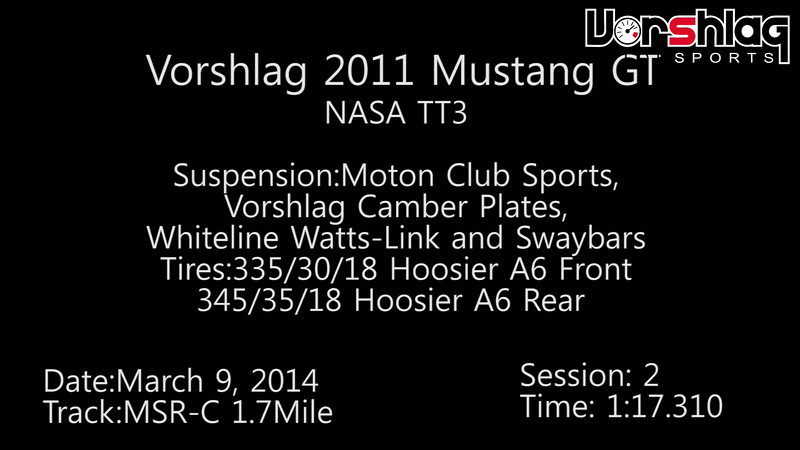
Sunday dawned with Daylight Savings giving us more light but stealing an hour of sleep. I was at the track by 7:30am, got ready for TT for the day but skipped TT session 1 because it was 29°F indicated - stupid cold and well outside of the A6 tire's performance envelope. I went out in TT session 2 gridded in P1 at 10:30, and the sun had just started to peek out of the clouds. I had some nice clear track in front of me and with temps in the 40s I ran a first lap of 1:18.2 and a second lap of 1:17.310. As usual the AdvanceTrac was faulting BADLY the entire time, turning itself back on and applying brakes in that first lap. I think the car sees the g-loading and my spastic driving and calculates "Danger! This car is crashing!" It was blinking lights, applying brakes and FREAKING out. The last 4 corners on my best lap of the weekend and the damned REAR BRAKES were on the whole time. The engine was straining but I kept the throttle matted and cursed my way through that 1:17.310 lap (see in-car video from those two laps, below).


That time was a half second quicker than Saturday's best and a second and a half quicker than the January SCCA Club Trials lap on 315mm Hoosiers, so the new tires were working despite the AdvanceTrac system fighting me the entire time. Frustrating laps, but I was happy to reset the track record (the car's 10th standing NASA TT3 track record) and ended up being fast enough for another win with 7 in class that day.


Indicated 470°F front and 350°F rear brake caliper temperatures were a bit alarming

The brakes worked well this weekend but I got them REALLY hot, as shown in the Alcon caliper temperature indicators that we placed on each caliper. This is a standard data acquisition trick, but I learned the value of it from Costas in January at the NASA MSR-H event. So I picked up a packet of these adhesive strips and the results were a bit startling. The 470°F degree front caliper temps were the most alarming and we will need to address this before our next high speed track event. Again, we were running with driver and ballast at over 3800 pounds (much higher than most S197 racers) and seeing speeds and lap times that are probably atypical for this chassis.


Like many S197 racers we are using a single a 3" brake duct hose coming from the fog light openings right now but we had just re-routed and lengthened these hoses to avoid the 335mm wide front tires at full lock (see new routing, above). I fear that the new cooling hose routing (now located inboard of the splitter's rear mounts) with tighter bends in the hose is causing some additional airflow restriction we weren't seeing before. The rear calipers even saw over 350°F, which was a tick higher than expected. We will replace these Alcon indicators for each event and monitor the max temps reached on each caliper and possibly add a second 3" hose (or move to a 4" hose) up front and maybe even add some under-car ducting for the rear brakes. I have an idea for that which will tie into the new rear bodywork nicely and discretely.


We've run multiple brake cooling hoses to the same corner on other cars we've built before, like this C4 Corvette above. That one used a massive inlet duct, air passed through the frame rail then was diverted out into two duct hoses: a 3" hose routed to a custom brake backing plate for the inside of the rotor and a second 2" cooling hose pointed right at the caliper. This system worked very well and in that car's first 12 hour of racing the pads barely wore halfway, but the rear brakes (uncooled) went through two sets of pads. We might try this "dual cooling" set-up on front of the TT3 Mustang, or a single 4" hose to the rotor, or a dual 3" hose to the rotor. And a ducted rear rotor set-up is coming as well.


The front brake pads are wearing more quickly than we like (again, 3800 pound car + lots of brake heat), as shown above. We just put a new set of front Carbotech XP20 brake pads on the front Brembo calipers for the USCA event and will address the brake cooling needs soon. The old pads (shown) wore down tot he last 1/16th of an inch of material and are only good for "emergency use", to make one session or a drive home from the track for someone that had a pad failure.

In Sunday's TT session 3, the car didn't even make through the first hot lap before the AdvanceTrac faulted heavily. I barely ran a 1:18 lap and it was only getting worse, as was the traffic. I didn't even try to make a 2nd hot lap, and with the start/finish line just before the pit entrance road I just dove into the pits and did a little cool down drive to the corner gas station and back, to get the brakes and systems cooled off before parking the car for rest of the day. The ambient temperatures were getting warmer and a few guys went quicker, so I ended up only 4th fastest in TT for the day after skipping the 4th TT session. If the AdvanceTrac wasn't faulting I would have gone out and could have dropped time. After the car had cooled off I hooked up the truck to the trailer, loaded up the car and our gear, then helped Costas put his car back together (windshield, bodywork, and wheels) after he fixed a nagging brake light switch issue that was a bear to access. Once he was ready for his last SU race, where he won the class all 4 times, I headed out a little early.


That 2nd session 1:17.310 time was good enough for the win (7 cars in class) and reset the TT3 record. A Radical SR8 ran with us in TT on Sunday and was stupid fast, but its a SportsRacer and that's to be expected. Troy Messer found a lot of time in his TT1 Corvette in the 4th session and ran a 1:15.8 and Vorshlag customer Corey Wells put in a fast lap with a 1:17.290 in his TT1 classed ZR1 (street car!) as well.

All in all this was a great weekend and the Vorshlag Mustang really came alive on the bigger Hoosiers I have lusted after for the last three years. Just as I predicted, it dropped a lot of time AND I was able to get in 3, 4, even 5 hot laps before the tires got overheated and greasy - unheard of when running at this weight on the 315mm A6 tires. The extra grip probably caused these additional AdvanceTrac faults and one CEL issue, so we're installing a new ABS/TC module that hopefully eliminates all traces of factory traction control once and for all. Again, I really missed having Amy and our crew there, and the only pictures I got were with my Nikon that I took, and the only shots of our car on track were those that Jamie Beck shot with my camera on Friday in practice. I watched all the video and saw plenty of driving mistakes so there's no telling what this car could have run without the AdvanceTrac faults and my hack driving. I know a 1:16 was possible without the brakes being applied by some stupid computer when I wanted to be WOT. Maybe next year NASA will run the MSR 1.7 course again. I sure hope so, as this course was more enjoyable for me than the 3.1 mile course we normally run in TT.

Making Weight by the Hair of My Chinny Chin Chin!

One little scare I had on Saturday was after TT session 2. I came after running that 1:17.7 lap and was sent to the scales. I wasn't too worried, as I had thrown a 25 pound ballast weight plate into the trunk mount moments before the session began, after I noticed a somewhat lower fuel load than I had wanted (normally I was going to grid with 7/8ths to a full tank). I made weight that time by 2 pounds!!!! And that took two tries...

The first time they put the car on the scales after that session it was 8 pounds light. As per the rules, that would have been technically legal on my first weighing of the day (10 pound grace on first weighing) but I knew that weight couldn't be right. I asked them to roll me off, make sure the scale pads were under all 4 tires all the way, and we rolled it back on. That time it was 3804 pounds on a 3802 minimum. Whew!


I went to the paddock and immediately threw 20 more pounds of ballast and a full tank of fuel went into the car for each successive session all weekend. I was weighed a couple more times; once it was 3835 and another it was 3853 pounds! So getting spooked by that "close call" 2 pound weight check made me run too much ballast all weekend. I'm sure with our crew here I wouldn't have overshot that so badly, but oh well. It was fully 51 pounds overweight on my 1:17.310 lap Sunday.


Jason Toth (the Alpha LS1 Miata owner) made his TT debut on Sunday in an Audi A4 (loaner, shown above left) and had a blast. He borrowed my spare AMB so he graciously ran in TT3, which made for 7 in class. Hoosier pays all the way down to 2nd place so Jeff Tan won a tire that day in 2nd and I won 2 more in 1st. Which was good, because I blew my tire budget all to pieces with the new A6s for this event and BFG Rivals for Goodguys/USCA. I'll save the newly arrived 4 tire winnings for April's NASA TT event and use 3 of these 4 tires from this weekend as my Friday test set if we go down there a day early. Gotta get a replacement 18x12" wheel so we have two complete sets - running around and getting tires swapped and mounted minutes before my first TT session Saturday was a bit too hectic. Congrats to Mike Patterson (shown above right), who won all 4 AI races, reset the track record for that class in the low 1:20 range (on the new Toyo RR tires running 18x9.5" Forgestar F14 wheels he bought from Vorshlag), and ran in TT3 both days as well. He also works as race director for another race group, so he was a busy man!

Official Results: http://timingscoring.drivenasa.com/NASA_Texas_Region/2014 - Official Results/2 Cresson_March/

Vorshlag Photo Gallery: http://vorshlag.smugmug.com/Racing-Events/NASA-MSR-030814/


Left: Saturday's NASA TT results. Right: Sunday's NASA TT results.

Decal Removal + New BFG Rivals + Prep for Goodguys & USCA

We had to steal a tiny sliver of shop time to get the red Mustang ready for the next two "street car" events, so we took it. The guys made sure the car was street legal and re-attached the horns and double checked all of the street car systems like the wipers, lights, signals and the rest. We ran out of time to get the car reinspected (it was a few months out but it just got re-inspected today) but they got it all street worthy and up to snuff. On Thursday March 13th the set of BFG Rivals I found a couple of weeks earlier (TireRack was out of stock on the 335s) arrived in town and I went out to an undisclosed location to pick them up.


On the Friday before Goodguys Olof got the 315/30/18 pair mounted to the front 18x12 wheels and the 335/30/18 pair mounted to the rear 18x12s. Once mounted on the car they were swallowed in the massive rear flares and even the 335s looked small.


continued below
 

Vorshlag-Fair

Official Site Vendor
Joined
Nov 12, 2010
Posts
1,592
Reaction score
116
Location
Dallas, TX
continued from above

Another change we made was to remove the current "livery", which we've had on the car since 2012. The crazy stripes were Amy's idea, and the vendor decals were there to show what we have on the car that we sell. Some of the parts shown in decals are about to be removed (more on that in my next post) and almost all of the vendors we use aren't "Goodguys/USCA" sponsors, so they had to get toned down a bit.

Street Car, Race Car - What's The Definition? Who cares?

The number board, NASA decals and race numbers/class letters make this streetable car look more like a race car than it really is, and I didn't want to put the wrong impression for Goodguys or USCA - because this really is a very streetable car that we often drive around town for various events, unlike some cars that show up at those street car competitions. We have had a few folks complain publicly about how our Mustang is a "race car" showing up and beating "street cars" at NASA events, Goodguys, and other competitions, but I just chalk that up to internet whining. It is even funnier when folks with "street cars" that have gutted interiors, no radio or air con, built or boosted motors and/or wildly illegal emissions systems make these claims about our 2011 Mustang. This really is a full interior car (back seats are reinstalled as of last week), with the OEM air bags, big honkin' radio, touch screen sat NAV, a satellite radio subscription, air conditioning, power windows, all of the OEM glass, OEM seat belts, and a bone stock engine from throttle body to exhaust port. The suspension is refined for competition, but it's still quiet and uses bushings in most of the arms and links.


A ducted hood, splitter and big wing don't make a car a "race car" or really much less streetable than other cars - but these are visible exterior mods that look "racey" and some that don't understand the function of them would even say "ricey". And at the events we race in, this Mustang is usually the heaviest car at the entire event (3802 pounds) and almost always competing against much more radically prepped cars. Is it my fault if someone shows up to NASA TT in a bone stock car and gets beat? Should they expect to win in a totally stock vehicle? Sometimes a fairly stock-ish car can do well in NASA Time Trial, but most of the time these entrants are making significant modifications to otherwise OEM vehicles to be more competitive. When there are contingencies on the line (like free sets of tires for the winners) you better believe I'm going to look at the rules and do what I feel is most beneficial to lowering our lap times. At the 2013 NASA Nationals our car was one of the only ones on the TTU-TT1/2/3 grid that was a registered and inspected street car, and once again the heaviest car on grid.
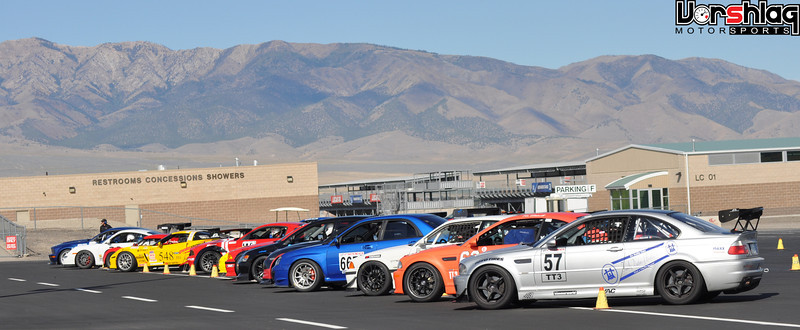


Just know that everyone has their own definition of a "street car", and your's might not sync up with mine. You should see some of the street cars race in Hot Rod's Speed Week! The 80 mile road rally we have to drive on public roads this Friday at the USCA event will separate the street cars from the race cars, and I'm confident that I will have no problems on that drive. In fact I'll probably have the A/C on and playing Channel 51 on Sirius blasting through the 1000 watt stereo, burning 93 octane pump fuel and having fun.
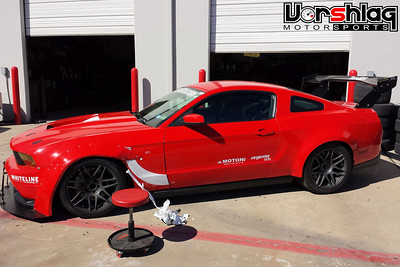


Back to the decal removal. So we left the car out in the sun for a couple of hours to help soften the adhesives, then I started to yanked off the stripes and most of the decals myself. Kyle finished removing the decals and then washed the car. After that I removed the adhesive residue with the Goof Off Heavy Duty spray remover I like (not the Goof Off Industrial Strength, which can sometimes affect the paint - the "heavy duty" version is much safer). Finally, Ryan used his detailing skills and tools to buff and wax the paint. HE wasn't around when Brandon took this picture below, so I stood in for him and pretended to do real work, heh.
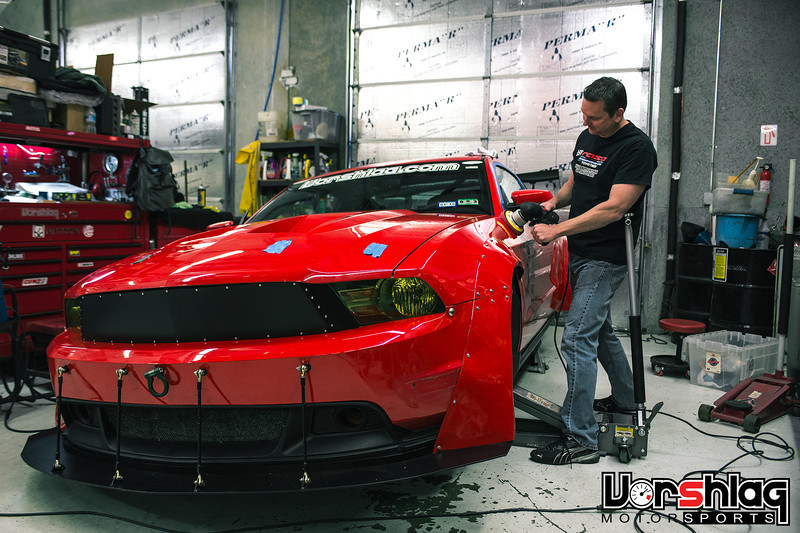


Some of those decals have been on there for about 2 years but luckily we use good vinyl and they came off well. Nothing was brittle and tore except for a few printed decals that came from vendors or race events. One of those left a HUGE glob of adhesive that took a bit of elbow grease to get off, but it all cleaned up well. Some of these stripes and decals went onto VERY fresh paint (due to time constraints) but Shiloh's paint work held up perfectly. Once it was all buffed and waxed it came out nice.


There's the old livery at left and the new "naked" look at right. We had planned on doing some simple black stripes and a few vendor decals but the weather started to turn and we ran out of time. That's going to happen soon, so it won't stay "naked" long. Yes yes, it looks better with a simple red paint job, but this car is a marketing tool for us and it has to show the parts on it that we sell, so they have to go back on at some point.


Goodguys Autocross - Sunday March 16th - TMS

A Goodguys weekend consists of 3 days of car shows, swap meets, and autocross competition. The typical customer for these shows is the 1972-older domestic car or truck owner, and they tailor most of their many events around these folks. The g-machine muscle car scene has taken a strong foothold over Goodguys and the Friday-Saturday autocross competition is chock full of these 1972-older American cars.

Event website: https://www.good-guys.com/slsn-2014

Luckily they also welcome the "late model" 1973-newer American cars on the "All American Sunday Autocross", which we have entered once before (last October, where I got 2nd place by .02 seconds - and lost out on a free set tires from BFG!). Last October we went to the Goodguys event at Texas Motor Speedway for our first time and ran on a used set of 295/35/18 Nitto NT-05s and I was introduced to their autocross course layouts. I had heard they were tight, but this was an eye opener.

With 90% of the course run in 1st gear, several super tight 180° turn-arounds and running through major sections of the course multiple times, I'd really call this more of a gymkhana than an autocross, but that's how they set up all of their events and more power to 'em. Not knocking it - just different from your typical SCCA course, in case you attend one of these. And you should - it is fun and you get to see some serious machinery! I learned what to expect back in October (about the course as well as the unannounced goodies you win for first!) and so when the next Goodguys event was scheduled in Dallas (they do 2 events a year at TMS - Spring and Fall) I signed up. This time I was there for two reasons: first, to get practice for the following week's USCA event (more on that below) and second, to win the fat loots they give to the winner.

DSC_1780-L.jpg

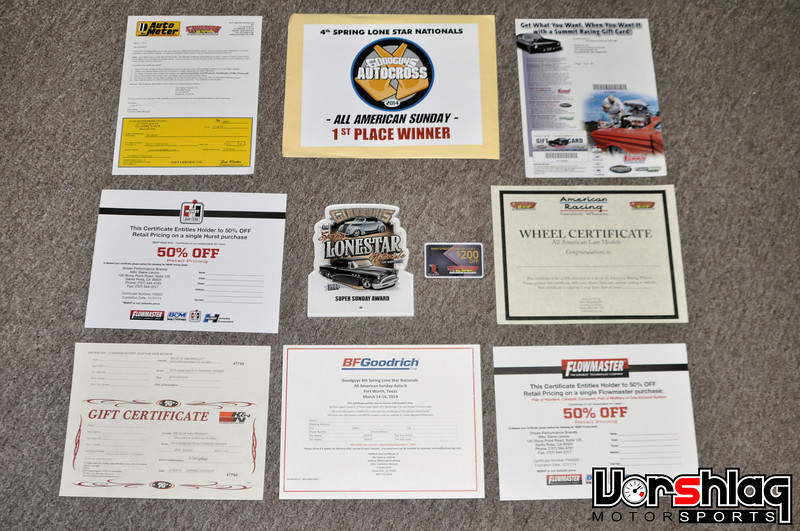
The prize package for the winner of the All American Sunday at a Goodguys event is no joke!

Ya see, back in October I didn't take the Goodguys autocross that seriously because I didn't realize they had such good prizes for the winner. I lost that event by two hundredths and only after the event was over did I realize that there was a free set of BFGoodrich tires on the line. So for this March 2014 Goodguys I came better prepared, with a fresh set of BFGoodrich Rivals and more serious driving attitude. :)


We luckily knew the entire "Goodguys event" drill this time. Since we weren't allowed to bring our truck and trailer inside the Speedway on Sunday we got to the race hotel at 7:20 am to register (for the Sunday autocross event you have to sign up the day of, or become a Goodguys member and sign up about 3 weeks in advance), got to the TMS assigned trailer parking area outside the Speedway, and quickly unloaded the car from the trailer. Yes, it was on street tires and we still trailered the car, but mostly because we are trying to keep these BFG Rivals FRESH and avoid unnecessary heat cycles on them. The more times you drive on any set of tires - where they start out cold and then get hot and then cool off again - the more heat cycles they take. Heat cycles can "age out" a set of competitive tires before the tread is gone, even these Rivals. And at $1300 a set I'm going to SAVE THESE TIRES. Not to mention that Texas Motor Speedway is also about an hour away from our shop, and we had no spare tire.
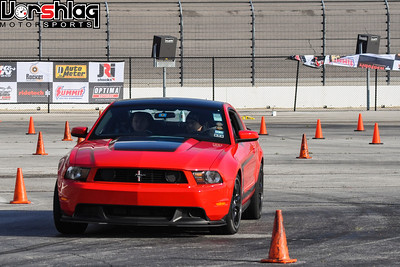
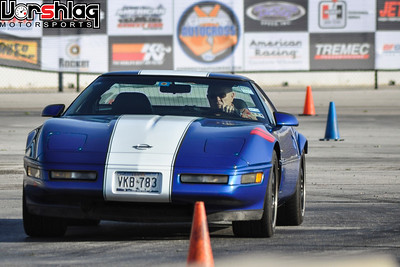

The weather started out in the low 50s when we left the house, but a cold front had swept in the day before (and brought MASSIVE winds and rain that night), and temps were dropping into the lower 40s and the wind was BRUTAL. The winds was blowing so hard that everything was flying out of the trailer - pieces of wood (which we use with the trailer ramps), papers, and anything not bolted down. This did not bode well for the rest of the day. We bundled up in several coats, tossed our helmets (didn't need em!) plus an air gauge in the trunk, and we drove to the Speedway entrance. Once we got inside to the area where the autocross is held we got in line and I went to walk the course.


I realized quickly that this was the same course we ran in October. Exactly the same, really, but one of the Pro drivers (the Fri-day-Saturday group is broken up into groups and the shops and drivers that go to most of the Goodguys events and do well get assigned into the "Pro" category) said it was different by a couple of feet here and there. Regardless, having run this strange layout in October was a big help, since I knew I wouldn't get lost this time like so many did at that event. I walked it one time and got back into the Mustang to stay warm!


When the event finally got underway around 8 :30 am the Pro class drivers went first, which they are allowed to do. They park by the announcer and put on a good show for the crowd, but they aren't competing in that day's events. Many of the 1972-older domestics that ran Friday-Saturday also take runs throughout the Sunday, but they also aren't in competition - just making fun runs. A little frustrating for those of us that are competing in the All American Sunday (1973-newer) event, but they paid their money and they get their runs. It makes the day more interesting, as just late models autocrossing can be boring for this crowd of spectators - which was a surprisingly full crowd all day, considering the weather.
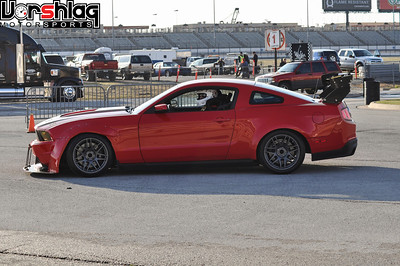
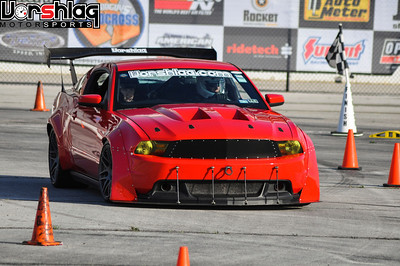

I had one of my student's from Sunday's SCCA Solo School where Amy and I instructed who was at this event, Lloyd in the red Boss302. His son was with him and he wanted to get a ride in our car, so I took a rider on my first run - and only on this run. Last October I took riders on all of my Goodguys runs, but when you lose by .02 seconds you begin to get paranoid. I knew this first run would suck, and it did. The BFG's still had visible decals and mold release and it felt like driving on ice. He had fun and I got that awful run out of the way. You can see in these pictures that we were wearing helmets, which I'm so used to doing, but nobody else was because it isn't required at Goodguys.
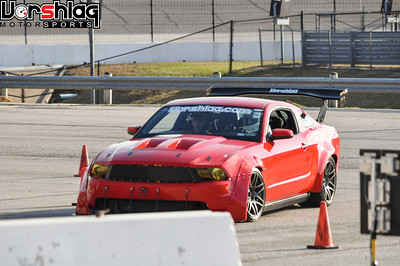
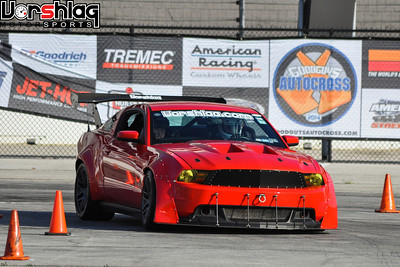

And while the course ran very near fences and concrete barriers it doesn't seem to phase anyone at these events, so I just went with the flow and drove my laps. My first lap was a 77 second run, which was terrible... but after the first round of runs it was in 1st place somehow. Then I made a second run of a 74.4 second run, which was painfully slow and I had wheelspin everywhere, and now I was 4 seconds in the lead. Huh?

The lines were heavy and growing all day and it was taking about an hour between runs, but I was used to this from the October event. By the time I got to the line for my third run it was around 11 am, and they said they'd pick the fastest time run by 11:30 and call them the winner. I pulled up to stage and the guy is plastering decals on the car for "Autocross Winner", and I hadn't even made my last run. "Nobody is close" he said, and then I was told to report to the timing tent after my last run, shown below.
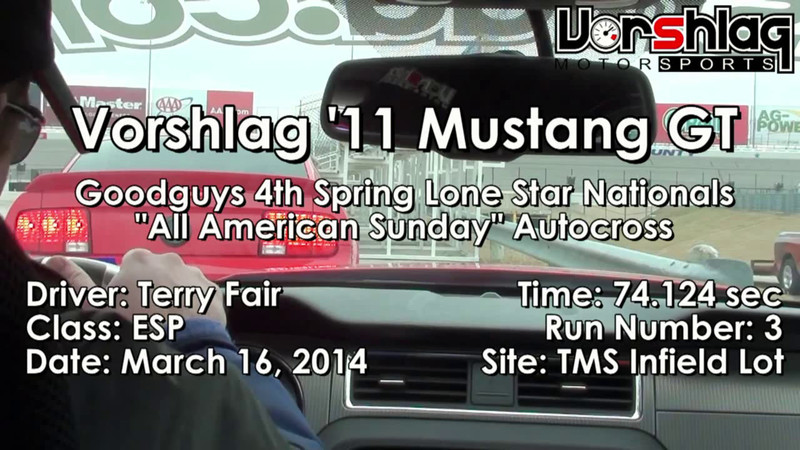


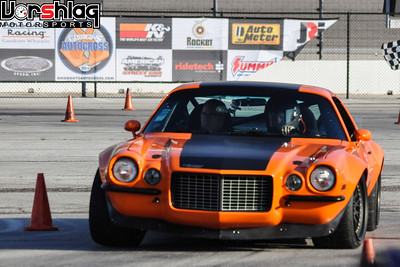
That run felt a little better, and I made all of my 1st gear downshifts shifts smoothly. The wheelspin was more controlled than my other two runs but there was still VERY little grip on this still wet asphalt in these crazy cold conditions. The BFG Rivals apparently don't do as well as the Falkens in cold temps, and Brian Hobaugh was stupid fast on Falkens in his gorgeous orange 2nd gen Camaro, running several seconds quicker that day than me. But he and the rest of the Pro class drivers were in the 1972-older series and luckily their runs didn't get compared or counted with ours'. Next weekend at USCA those cars are in the same class as me, so I am hoping with warmer temps and better driving I can get closer.

AAS...Terry Fair............2011 Ford Mustang............74.124
AAS...Bryan Mills...........1994 Ford Mustang............76.059
AAS...Lloyd Collins.........2012 Ford Mustang............76.684
AAS...Greg Scherer........2002 Pontiac Firehawk........77.788

I copied the first 4 results from the 23 entered in the "AAS" class and it turns out there were two driver's that improved a lot on their last runs and got within 2 seconds of my final time, including my student from the Solo school the day before (nice driving, Lloyd!). Didn't know until the results were posted earlier today.
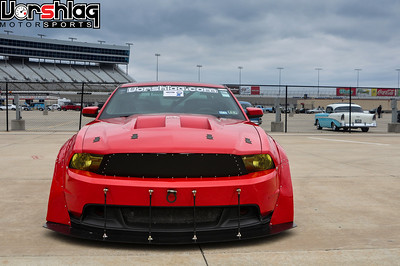
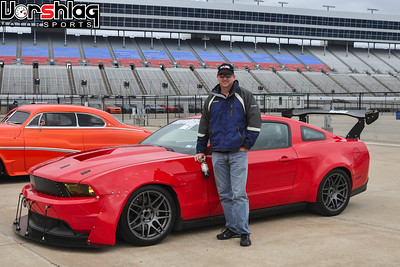

So after I won the autocross I was told to park in the Winner's Circle area with all of the car show class winners and previous day's autocross SM and PRO class winners. Lots of people came by to shoot pics of the big red Mustang, which was fun but weird to watch. Honestly the this car had so little to do with the win, at least within this class - it was mostly about getting through a painfully tight course as cleanly and close to the cones as possible. I think I could have done as well or better in a rental automatic Mustang, and I got beat last year by one of the Pro driver's in his wife's automatic and stock 5th gen Camaro convertible. These Goodguys courses are super tricky and don't emphasize the car's performance all that much.

continued below

 
Status
Not open for further replies.

Support us!

Support Us - Become A Supporting Member Today!

Click Here For Details

Back
Top