Fuel Fill Issue. Sorry to bring this up again

Juice

Senior Member
Joined
Aug 24, 2017
Posts
5,074
Reaction score
2,176
Way overkill of a solution for an almost non existent issue.

I was just under there, and decided to look over the fuel fill/vent plumbing. Here is what I concluded:

Fuel from the filler, fuel goes into the left side of the saddle tank. Than it has to fill the right side of the saddle tank. (no transfer pump when filling) And the vent is exiting the fuel tank on the right side. Hmmm,
makes me wonder just where the 'clog' or 'vaporlock' forms when the car is a bitch to fill. lol

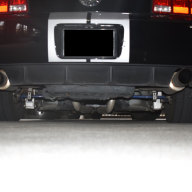
I now have relocated my charcoal canister, and replaced it with a 2013 vintage unit (integral vent valve). Fit nicely on the left side next to the frame rail. And got rid of the ugly ass wart under the spare there, and lost a pound or two. That steal shield is not light.
I did this to potentailly reduce aerodynamic drag. No fill issues since this mod, and OBD is passing the evap tests.
 

datmbn

Member
Joined
Dec 29, 2016
Posts
95
Reaction score
22
Location
Sweden city Motala
I find it rather strange that no one seems to have investigated the causes of the problem.
Some cars work well, so the problem must be solvable !!
I've looked at the problem, and found both cause and solution (I think)
The biggest problem with finding a solution is that the problem consists of 2 different basic problems with several
secondary problems.
Some cars suffer from problem 1 others from problem 2, and some really hopeless ones suffer from both.
1: Ventilation problem.
In order for the fuel to enter the tank, the air that is there must come out.
The venting starts on the right side of the tank, here there is some kind of puff vent box inside the tank, as early cars
had problems with <2006, then it is tank change that applies, which is usually done as a service measure / goodwill.
When the air leaves the tank it then passes through a 16 mm hose back past the rear axle, arrives at a three way intersection,
(from tank-to vent-to intake manifold on the engine via evap valve) then it passes through a vent-valve, a carbon filter,
a dust filter, and a hose stump that opens just behind the rear axle.
As we can see, there are several "probable" points that can cause the air to go slow or completely tight.
A. The hose from the tank goes quite close to the exhaust system as it passes over the rear axle, so it may
has melted/softened to become slow/tight (may have also collected condensation water at some low point)
Solution: change hose or blow clean.
B. The three-way intersection may have caught debris (not likely since it is filters in all directions, but worth checking out)
Solution: Blow clean
C. The vent valve does not open properly, it must be fully open when the car is switched off
Solution: Replace valve or lubricate and shake, coax on it.
D. The carbon filter is more or less tight so that the air passes too slowly
Solution: New filter, or replace the filter with a hose stump (if replacing the filter with a hose stump
you can sometimes feel a small gasoline smell during refueling)
E. The dust filter may be clogd.
Solution: Blow the filter clean or buy new
F. The hose stump can be clogd (quite common for spiders to make nest in the mouth)
Solution: Blow the hose clean.
As we can see, there are at least 6 different reasons why the venting does not work, and thus at least 6 different solutions.
Some cars may also have a combination of these problems, which is why it is good to check them all when you start to tear into this.

2: Problem with "air lock" in the filler pipe
In order for the fuel to enter the tank, free passage is also required, nothing must be in the way, not even air
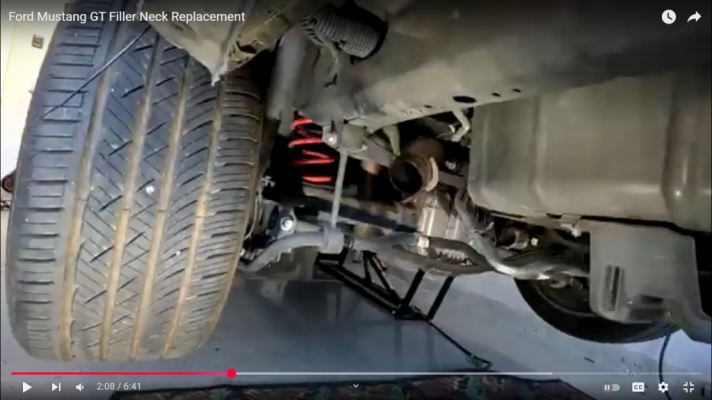
The filler pipe starts in the filler cap goes downwards under a longitudinal beam, and then a little upwards over the rear axle, then
angle down and drop into the tank at about 3/4 of the maximum level.
Seen from the side, the filling tube more or less forms a lying S, which is ok as long as the liquid surface in the tank is lower than
inlet.
If you start refueling with an "empty" tank, the fuel will push the air that is in the pipe in front of it into the tank and fill the "whole"
pipe with fuel, and as long as you do not stop or otherwise get air in, full flow will be maintained.
If you start refueling with fuel level above the inlet of the tank, the fuel will try to push the air in the pipe in front
down in the tank, but fail, because the fuel in the tank is in the way, the air will instead be compressed to some extent and
leave little or no passage.
This condition of "air lock" can also occur during refueling if the gas station has a lot of bubbles in the fuel.
(remedy something by having the nozzle between 11 and 1 a klock , and far out)
In order to remedy this problem, one must try to "stretch" the S as far as possible so that any air can expel the back way
via the filling tube.
The first step will then be to loosen / extend the pipe bracket before the tank, and to cut 5-10 cm of the hose, which then
happens is that you lower the highest part of the filling tube, and that you pull forward the bottom part of the tube that will
come closer to the beam / higher up.
I think this measure is in most cases enough.

The second step (if nothing else works) saw holes in the beam at the appropriate place, and weld in the appropriate pipe as reinforcement.
You can then thread the filling tube that way, thereby creating down sloap all the way (this is what it looks like from 2008 onwards)
Hope this clarified something
My car suffered from problem 1D and I solved it with a hose stump, works perfectly now.
regards Mats

 

07 Boss

Senior Member
Joined
Jan 25, 2009
Posts
4,300
Reaction score
1,417
Location
Sin City
I'm so glad I never had these fueling issues, that shit would wear on me.
 

08-GTCS

Junior Member
Joined
Mar 6, 2025
Posts
18
Reaction score
6
Location
USA
I’m going to post up in here and revive this absolute necro of a post to let future people reading this thread know that the reason SO MANY S197 mustangs have fuel up issues is that the vent and evap lines that run to/from the charcoal canister all run INCHES from the exhaust pipes. In 05-07 these lines were more stainless than plastic. 08+ they were more plastic than stainless and prone to melting. Even a slight disfiguring from getting hot can lead to fuel up issues, and a classic symptom (solution) for a disfigured evap line is having to fuel up with the gas nozzle upside down. So if you have fuel issues, just trace out the evap lines. You’ll find your problem.
 

skwerl

tree hugger
Joined
Aug 6, 2011
Posts
16,347
Reaction score
1,332
Location
central Florida
I’m going to post up in here and revive this absolute necro of a post to let future people reading this thread know that the reason SO MANY S197 mustangs have fuel up issues is that the vent and evap lines that run to/from the charcoal canister all run INCHES from the exhaust pipes. In 05-07 these lines were more stainless than plastic. 08+ they were more plastic than stainless and prone to melting. Even a slight disfiguring from getting hot can lead to fuel up issues, and a classic symptom (solution) for a disfigured evap line is having to fuel up with the gas nozzle upside down. So if you have fuel issues, just trace out the evap lines. You’ll find your problem.
That may be, but the biggest issue is TOPPING OFF YOUR TANK AFTER THE PUMP SHUTS OFF. Once you break yourself of this ridiculous habit and simply hang up the nozzle when the pump shuts off instead of trying to squeeze in another 50 cents of fuel, the problem simply goes away.
 

Dino Dino Bambino

I have a red car
Super Moderator
Joined
Aug 11, 2014
Posts
4,545
Reaction score
2,672
Location
Cyprus
My tank fills quickly until it's half full. Then the pump keeps clicking and it becomes a frustrating exercise to fill the other half. I remember when I lived in the UAE that I had no problem filling the tank right up at any gas station in every Emirate except for Dubai. Here in Cyprus I have the same problem that I had in Dubai i.e. slow filling of the second half of the tank.
What I've found is the following:

1. Turning the nozzle in any direction doesn't make the slightest bit of difference.

2. My fuel tank vent line and my evap system (including the charcoal canister) are free of any obstructions. I can blow compressed air through them and it comes out the other end no problem.

3.
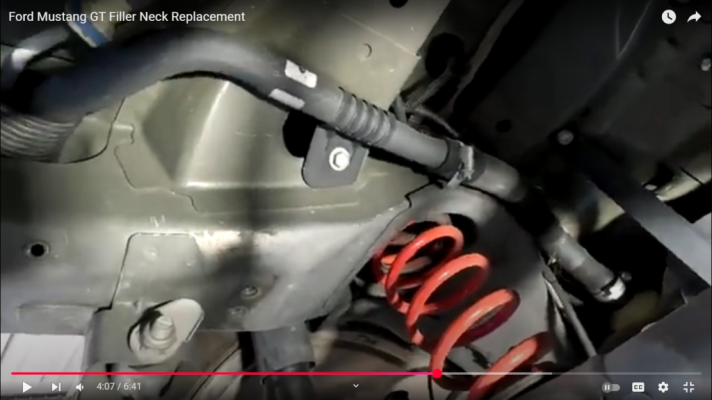
The filler pipe starts in the filler cap goes downwards under a longitudinal beam, and then a little upwards over the rear axle, then angle down and drop into the tank
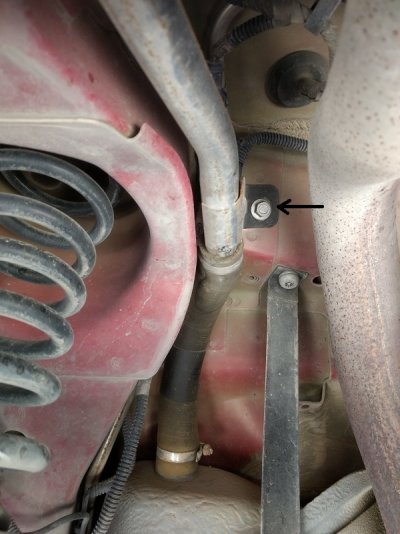
THIS is the fundamental problem! I believe air gets trapped in the highest part of the filler neck that curves around the spring perch when the driver's side of the tank is full because it simply has nowhere to go.

Fuel Filler Pipe Stock.jpg

Ford only fixed the problem on models built from May 2008 onwards when they added an integral vent tube to the filler neck. I don't know if it can be retrofitted to earlier models like mine though.
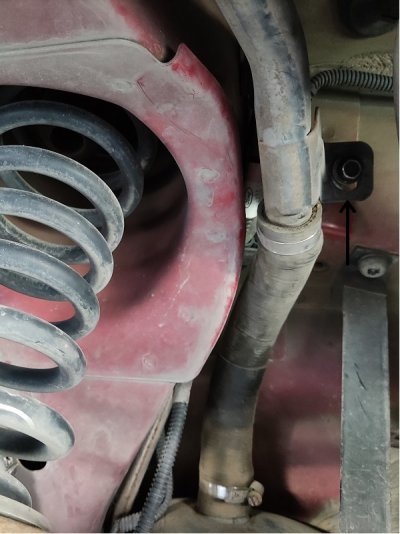
I did come up with a partial remedy though by simply adding a 1" spacer underneath that black mounting bracket in the center of the photo and used a 1" longer bolt. This lowered that highest part of the filler neck just enough to make the fuel filler nozzle click less frequently once the tank is past half full.

Fuel Filler Pipe Modified.jpg

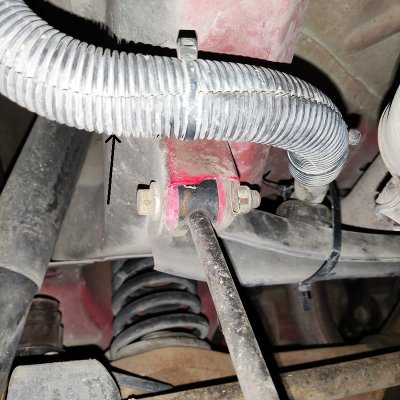
Keep in mind that this IS only a band aid. The fuel filler neck itself also needs to be cut above the point marked by the arrow in the picture below and shortened so that the section further down at the zip tie to the right of the arrow can sit higher and tighter to the frame rail. This will make that section level with the section that curves around the spring perch and might just solve the fuel filling problem altogether.

Fuel Filler Neck.jpg
 

GriffX

Senior Member
Joined
Sep 28, 2017
Posts
1,575
Reaction score
1,096
Location
Rural Germany
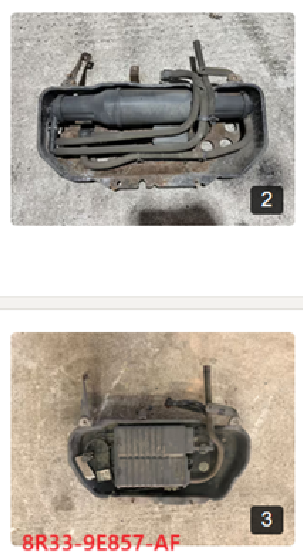
I can fill up the tank on full open nozzle speed when it was below 1/4 full. If it is above 1/4 it stops at half a tank and above 1/2 it is very slow and can throw up fuel. No solution, no explanation, beside that the filling pumps and nozzles in Germany have a integrated fume scavenger system and the European cars deliver the fumes back to the pump and not into the carbon canister.

They changed the EVAP part over the years, too. I have type no 2:
1745516564380.png
 
Last edited:

Laga

Senior Member
Joined
Aug 10, 2019
Posts
1,132
Reaction score
656
Location
Chicago
That may be, but the biggest issue is TOPPING OFF YOUR TANK AFTER THE PUMP SHUTS OFF. Once you break yourself of this ridiculous habit and simply hang up the nozzle when the pump shuts off instead of trying to squeeze in another 50 cents of fuel, the problem simply goes away.
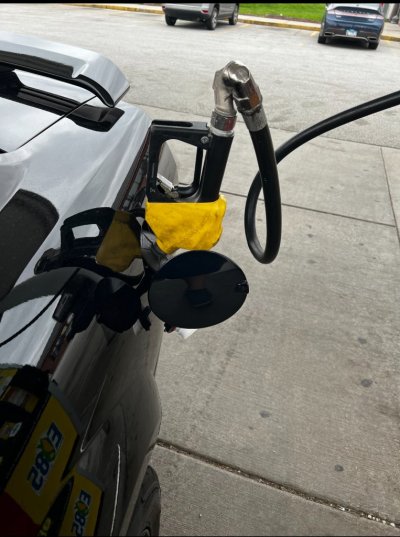
It’s not a ridiculous habit. If I did what you suggest, I would be leaving with a half a tank. This way I get a full tank.
I have an 2005, all the lines appear to be normal from the outside. No melting, no pinching.

IMG_0737.jpeg
 

MrBhp

Senior Member
Joined
Sep 12, 2013
Posts
1,840
Reaction score
1,529
FYI. Based on years of design in refineries.
If you notice that the pump clicks too soon/easily at one station but not another, only fill up at the one where it does not. Federally mandated oxygenation components are designed to test at a higher octane than your engine will ever see. Ie, your gas may test 93 at the source, but if you were to sample straight out of your tank, it would probably test closer to 91. Not all refineries use this process. Most that did, have now gotten away from it. However a few still do. Those oxygenation products gas-off when they are agitated and exposed to atmosphere. As in, when you fill the tank. It's all that product coming out of solution that clicks off the despenser.
 

Laga

Senior Member
Joined
Aug 10, 2019
Posts
1,132
Reaction score
656
Location
Chicago
FYI. Based on years of design in refineries.
If you notice that the pump clicks too soon/easily at one station but not another, only fill up at the one where it does not. Federally mandated oxygenation components are designed to test at a higher octane than your engine will ever see. Ie, your gas may test 93 at the source, but if you were to sample straight out of your tank, it would probably test closer to 91. Not all refineries use this process. Most that did, have now gotten away from it. However a few still do. Those oxygenation products gas-off when they are agitated and exposed to atmosphere. As in, when you fill the tank. It's all that product coming out of solution that clicks off the despenser.
The problem was much more pronounced when I was burning gas. Once I switched to E85, it was less but still happened. The yellow handle indicates E85. Some stations have faster pumps than others. Which cause the issue.
I have 6 stations within a 5 mile radius of my house and this is the time of the year they change ethanol percentages. Lito has given me 3 tunes for 70%,75%,80%. 75% is the most common, so I have to sample who is pumping what and when. Or else I have to blend my own. I always keep around 10 gallons of 98% ethanol just in case. One time I stopped to fill up away from home and the E85 was in the low 50’s.
 

Dino Dino Bambino

I have a red car
Super Moderator
Joined
Aug 11, 2014
Posts
4,545
Reaction score
2,672
Location
Cyprus
Here's a picture of the 11-14 Mustang fuel filler neck.

1745784114488.png
1745784322845.png
1745783519997.png

Notice how the filler neck goes through a hole in the top of the frame rail instead of going underneath it. That makes all the difference because the fuel doesn't have to go down, up, and then down again.
 
Last edited:
Back
Top