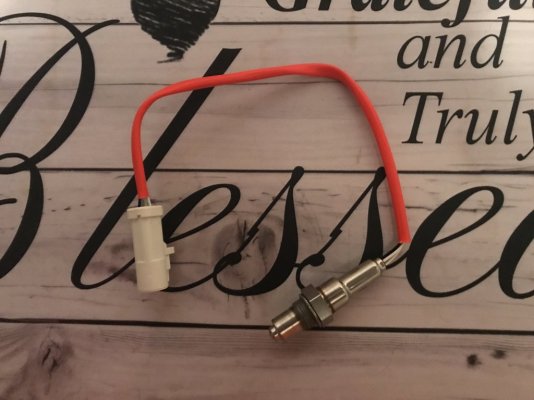
Picked up a pair of these off Amazon to test out...............
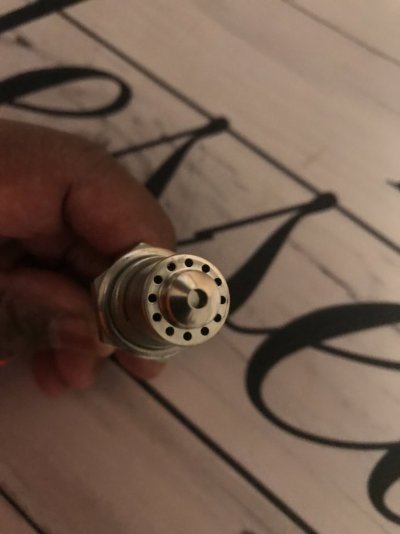
Marsflex 4-Wire NB O2 Sensors (BOSCH 15717 Spec) w\ what looks to be the element shield design of a BOSCH LSU 4.2\4.9 HUEGO WB O2 Sensor........in which this NB O2 sensor would need to be equipped w\ a nerst cell (mini electronic sampling pump powered off heater circuit) to continuously draw exhaust gas sampling inside shield, across the zirconium element then exhaust it back out (the only way any exhaust gasses can enter it..........all the 4-wire NB O2 sensors I've seen, outside of this part design, use a passive shield design--shields have either holes or slots in the side of the shield to allow exhaust gasses to passively enter inside of\thru the shield to access the element as they flow by while providing protection from contamination, thus no continuous sampling).
If this is the case, this would\should be a very accurate\sensitive NB O2 sensor @ CL Lambda 1.0 so I had to find out. An Italian company named Facet also made a 4-wire NB O2 sensor that is identical to this 1 (Facet Oxygen Sensor 10.7319.....O'Reilly's carries it, but they can't get restock......been trying to get them for the last 2 yrs to do the same testing) & fits all early Fords from 1990 thru 2014 that uses a 4-wire NB O2 sensor (also fit early 2002-2004 Aston Martin DB7 & 2000-2002 Jaguar S-Type) as well.
These are the only 2 brands of 4-wire NB O2 sensors for early MY Fords that have this BOSCH HUEGO design element shielding that I've run across to date.
Also makes a good test of my modified tune calibration settings for NB O2 sensor operations (increased CL sensor enable temp, CL delay timer & sensor heater DC settings from OEM to accommodate the use of any 4-wire NB O2 sensor, whether NTK or BOSCH spec--heater DC settings are main reason why BOSCH spec 4-wire NB O2 sensors are so finicky w\ Spanish Oaks ECU's......OEM set too low--work fine w\ NTK's but BOSCH's need more heater DC to effectively heat up & operate. See here for reference of what I'm talking about:
https://www.s197forum.com/threads/lunati-voodoo-21270700-camshafts.136257/page-7 post #140.
The current OEM Ford F85F-9G4444-BD NB O2 sensors are a base BOSCH 15717 4-wire NB O2 sensor (these were the NB O2 sensors having the issues heating up during cold start OL-to-CL transition).
Pulled my NTK 22060's & put the Marsflex's in this morning then set up laptop & HPTuners VCM Scanner & datalogged all thru a full cold start, full hot idle, hot starts & subsequent drive.........all checked out good, so my tune calibration NB O2 sensor CL enable settings are more than enough as set........sensors came online quickly, w\o issue & operated flawlessly..............found that these Marsflex's have a much faster & wider (amplitude at .9v range) switching rate response than the NTK's so these Marsflex's must have a nerst cell inside to operate\respond this fast. This had the LTFT's responding much quicker to EVAP operations thus maintained a tighter STFT switching cycle pattern around EQ Ratio CMD (Lambda) 1.0 which is what I was hoping would happen as this action should markedly improve NB O2 sensor feedback fueling correction accuracy\consistency.
Engine response was very clean & crisp during drive........good sign of improved NB O2 sensor feedback performance. Checked IM Readiness afterwards.........all 7 good--0 INC's w\ Cat CE Ratios holding established pattern (between .035-.071...........this drive B1 @ .043, B2 @ .059) thus another good sign of stable NB O2 sensor feedback & combustion efficiency thru these MagnaFlow #5461336 CARB-cert EO# D-193-140 TWC aftermarket OEM grade cats......in Oct these cats will have been in service for 4 yrs w\o issue--knock on wood............). LTFT's at idle prior shutdown were B1 @ -1.6%, B2 @ 0.0%............another good sign of improved NB O2 sensor feedback performance.
Looking good so far.
Just might have a winner on hand..........................
View attachment 104926
View attachment 104927
Provided below are 2 copies of the IM Readiness reports from my car........... 1 dated 3-22-25 (last 1 using the NTK 22060 4-wire pre-cat NB O2 sensors) & 1 dated 3-30-25 (pulled after changeout to the Marsflex BOSCH 15717 Spec 4-wire pre-cat NB O2 Sensors w\ Nerst Cell Sampling Pump on 3-24-25 & after putting 7 drive cycles on them) w\ no changes made to the tune calibration.
These results are proof of the reasoning why I bought & installed them........
Proves the concept of what a more accurate pair of pre-cat NB O2 sensors can provide..........if you can only envision this from a POV of emissions alone, then you entirely are missing the point that these results are pointing to the engine's efficiency improvements in converting fuel & air into heat\expansion energy which can\will also increase engine HP\TQ output.......not IF.
Only need to harness it........
The only reason others are not getting this is due to a LOT of tuners not using some type\method of exhaust analysis to check exhaust while tuning........such as a 5-gas exhaust analyzer for real time usage.........or in my case, using at a minimum, the very same CARB-cert cats (thus legally tested\certified) w\ the ECU's '09 MY emissions controls fully active & unaltered in tune calibration along w\ both rear NB O2 sensors (NTK 22500 post-cat) active in tune & fully inserted into cats.......thus a level of accuracy w\ the results rechecked post each tune reflash to monitor engine operating efficiency as well as cat efficiency over time.
Cats can only treat the expelled leftover HC, CO & any NOx laden exhaust created from
incomplete, inefficient combustion that occurs within the combustion chambers\cylinders........any incomplete combustion exhaust that is treated (meaning oxidized, reduced or burned post combustion if preferred) inside of a cat (or just blown away into the atmosphere running FFE) is lost energy thus lost HP\TQ potential........pure, plain & simple. The Catalyst #1 & #2 CE Ratio numbers are a measurement of engine combustion efficiency as well- measured thru a cat's ability to clean the exhaust. Less HC, CO & NOx in exhaust to start with.......the less work a cat needs to do thus is more efficient......thus the less amount of O2 the ECU needs to put in post exhaust to feed the cat.......thus more O2 is available to be mixed w\ fuel to make more heat\expansion energy........thus a more efficient thus powerful engine.
Rinse, repeat................
The Catalyst #1 & #2 CE Ratio results differences show this..........was just as surprising to me to see these results get even better over time of operation just from using a pair of 4-wire pre-cat NB O2 sensors that can continuously sample exhaust instead of passively doing the same..........
All this is being done thru the exact same set of cats (MagnaFlow #5461336 CARB-cert EO# D-193-140 TWC aftermarket OEM grade cats) that have been in service since Oct 2021........provided below is an IM Readiness report dated 10-5-2021 for context.
Just think............this design of Ford-compatible 4-wire NB O2 sensor has been out in the wild since the late 90's\early 2000's.........just not widely known\available in the same US MY production models (mostly in UK\Europe & Australia) ...........
Am blessed to be in a position to have learned\made the necessary front NB O2 sensor heater DC setting changes\heater eng run time scaling changes in my tune calibration to take full advantage of them............
Posted for those so interested...................
Would like to have your knowledge and tuning capabilities. BTW, Walther Nernst, German Chemist one of the founders of physical chemistry.
Not that hard to do\get\obtain...........just have to go after it & be willing to do what it takes to get there, learn from good sources, be willing to unlearn\discard bad\wrong info cause it's out here & ignore all the negative noise you'll most certainly hear\run into along the way......only you know your true capabilities......no one else.
Just never stop learning once you do decide to jump in, no matter how much knowledge or skill you gain.................complacency always kills the cat\stunts growth.
My 2 cents worth of pep talk...........
Yes, it's Walther Nernst's pioneering work called the Nernst effects that is the fundamental scientific basis behind this little electronic gadget's operations inside of these Marsflex NB O2 sensors as well as in all WB O2 sensors.