What have you done to your mustang today?

GlassTop09

Senior Member
Joined
May 24, 2019
Posts
1,361
Reaction score
834
Location
Farmington, NM
Checked LCA angle pre\post install.........LCA's are now running right at +1" pivot bolt height (front LCA chassis mount bolt height difference vs LCA axle bolt height from ground) in 1st hole........according to MM's chart, this puts the rear axle at 74% anti-squat--up from the OEM 08-09 Bullitt ride height of -0.5" pivot bolt height @ 5% anti-squat, so may have some roll oversteer tendency induced.
Rechecked all this............found I had misread\misinterpreted MM's LCA anti-squat instructions ((misread the chart, should've just used my initial measured pivot bolt height difference (-.5" at normal OEM 08-09 Ford Bullitt ride height) prior bracket installation only, then read the anti-squat% applied to right of this measurement, based on the bracket's chosen hole use. I made the mistake of remeasuring the pivot bolt height difference after moving the LCA's into the 1st bracket hole then used this new measurement to look up the amount of anti-squat% applied........which I realized later was wrong since the original ride height didn't change, the original front LCA chassis pivot bolt height measurement also didn't change.......only the LCA axle pivot bolt height changed thus the LCA centerline axis changed in relation to UCA centerline axis thus IC changed......)) so the correct amount of LCA anti-squat% applied from the 1st hole in the MM relocation brackets based off the initial LCA pivot bolt height difference is 62% instead of the 74% I originally typed (if put in the 2nd hole, this will hit 74% anti-squat). This also now moves the rear axle roll steering tendency back closer to OEM neutral\slight roll understeer.......which I'm already used to feeling........according to MM's chart (all based off the OEM Ford-set rear axle UCA geometry for 05-10 S197's.......which the Roush 3rd Link UCA I have installed retains as it is made using an OEM Ford 05-10 GT\07-09 GT500 rear axle UCA assembly including the OEM UCA chassis bracket).

This now is closely matching the MM-recommended anti-squat setting of 60% for dual purpose street\strip usage...........which is more than good enough for how I intend to use my car (MM-recommended anti-squat setting for dual purpose street\road course usage is 50%.......which is my intended usage w\ my Stang thus my purpose\reasoning for buying these).

Making correction for those so interested......................
 

GlassTop09

Senior Member
Joined
May 24, 2019
Posts
1,361
Reaction score
834
Location
Farmington, NM
Finally put car thru an extended test drive today across my established tuning\drive cycle 37 mi route to get a better feel for how she does w\ these MM 05-14 S197 Rear LCA Relocation Brackets installed (using the 1st hole under OEM position) ..........this is my 1st time driving\experiencing a vehicle w\ these installed & setup.

Right off the bat, I can easily feel\detect a very noticeable difference overall for the better in the rear suspension travel.........rear axle is more secure & stable under the chassis when traversing thru potholes\over bumps in road surfaces & feels more planted & stable when accelerating, but not harsh in any measurable way.......ride quality is still very smooth & GT500-stockish--even though the rear suspension is noticeably firmer during vertical travel arc movements but normal Ford-designed axle articulation\rotation is still present........using the 1st hole lower than OEM @ 62% anti-squat.

I've read of others stating that these things do help these 8.8" 3-Link trailing arm suspensions improve traction & handling but have never actually driven a vehicle w\ these brackets installed to see for myself...........until now.

These things do what MM says they'll do.........even when using the OEM Ford-designed rear LCA's..........thus geometry is indeed geometry regardless of materials used in LCA's........only differences will be in the LCA component's unsprung weight & bushing deflection amounts under load but not alter the base geometry........as I understand it, the closer the IC intersection point gets to chassis CoG, the firmer the 3-Link rear suspension will get thru vertical travel arc thus imparts more downward force on the axle thus tires under acceleration........which is the whole point of these LCA relocation brackets........using these rear LCA adjustable relocation brackets w\ fixed UCA geometry instead of using an adjustable IC UCA chassis bracket w\ fixed LCA geometry seems IMHO to be the overall better method of adjusting\applying the IC on these Ford 8.8" 3-Link trailing arm rear suspensions.

YMMV............

As a bonus, it also seems that the rear axle thus car is rolling even easier now than prior.......this seems irregular\irrational to me initially as nothing else is affected\changed on rear axle from using these rear LCA relocation brackets.......outside of some potential driveline angle correction from the pinion getting slightly pitched further upward which will reduce both of the CV joint operating angles somewhat. From my understanding, this shouldn't change anything thru the 2 CV joints rear driveline section of this 2-piece DS but can potentially change the deflection\phase loading thru the front U-joint thru center CV joint driveline section thru a center CV joint operating angle reduction to the rear driveline section which could allow this front driveline section to "straighten out" in the center carrier under load & naturally realign\center front U-joint to the trans flange\output shaft centerline thus further reduce the operating angle thru the front U-joint causing this front driveline section to unload more thus roll\rotate easier.

Only thing I can think of that can\could contribute to the car rolling easier outside of the new brake pads\rotors reducing rear axle drag..........a quick driveline check using an angle finder should prove\deny this theory since I have prior set driveline operating angles recorded pre-MM relocation bracket installation from installation of the JXBPerformance 05-09 S197 GT\GT500 DS Center Carrier assembly & subsequent reshim of trans crossmember to reduce the front U-joint operating angle to trans flange\output shaft centerline........which I'm not in any hurry to do ATM thus may happen in due time when I need to put the car in the air for some other reason in the future.

Checked the rear brakes.......all looking & feeling good. Noticed that the cross hatching on both new rotor's braking surfaces isn't being phased\affected from the new pads bedding in.......yet...........and yes, I did spray\wipe the rotors down on both sides w\ some brake cleaner pre brake pad\caliper install thus were verified clean.

In closing, I give the MM 05-14 Ford S197 8.8" Rear LCA Relocation Brackets an A+.........in hindsight I should've done this sooner.
 

Blue03Cobra

Member
Joined
Nov 6, 2024
Posts
297
Reaction score
464
Location
Baton Rouge, La.
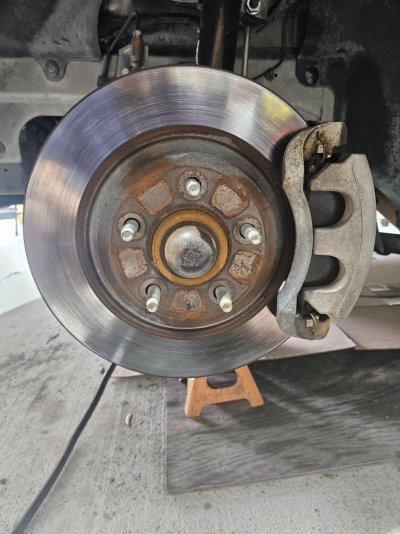
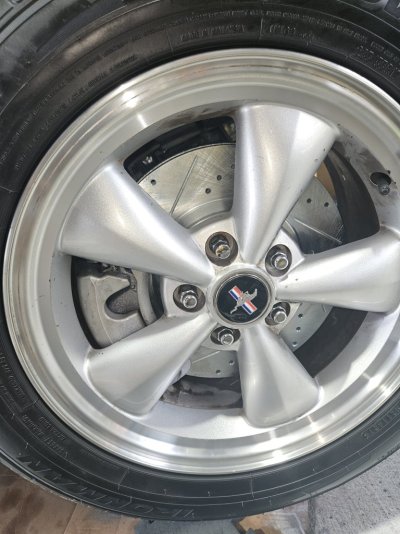
Autozone has a buy the Duralast brake discs, get the ceramic pads for free. While the dealership replaced the pads at 110K, prior to selling to me@ 112K (now at 115K), I couldn't pass up the opportunity to replace the 17 y.o. rusted discs, getting "free" ceramic pads in the deal. I also took the opportunity to "rebuild"...(read high-temp rattle can metallic silver paint) the caliper bracket and caliper frame, and have new rear brakes. Gonna order the front slotted/drilled discs, getting the front pads for free, as well. The deal is until the 4th...

View attachment 104101

View attachment 104102
Finished the fronts with Drilled/Slotted rotors. Before and after:

20250315_152750.jpg

1000010650.jpg
 

GriffX

Senior Member
Joined
Sep 28, 2017
Posts
1,511
Reaction score
1,035
Location
Rural Germany
Interesting, my 07 rear are smaller than the GT500 rotors, calipers are the same.
The rear rotor part number is for all GTs and V6 from 2005 up to 2014 is according to tascaparts 5R3Z-2C026-A, so the diameter is the same.

And, If i drive in the city with max 35 MPH and I find higher rear disk temps than in the front, TCS ist not involved.
 

JC SSP

Senior Member
Joined
Nov 8, 2022
Posts
2,283
Reaction score
1,351
Location
FL
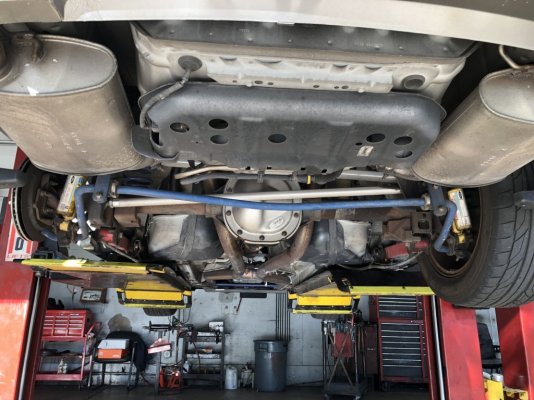
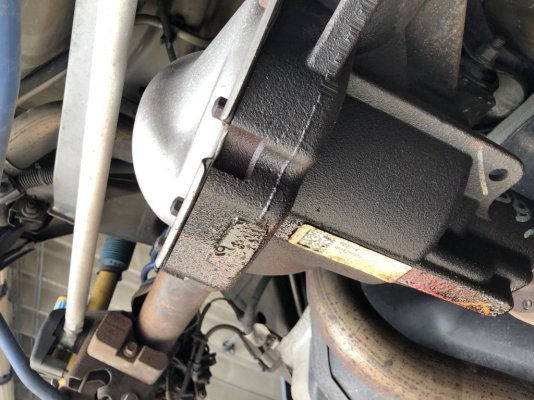
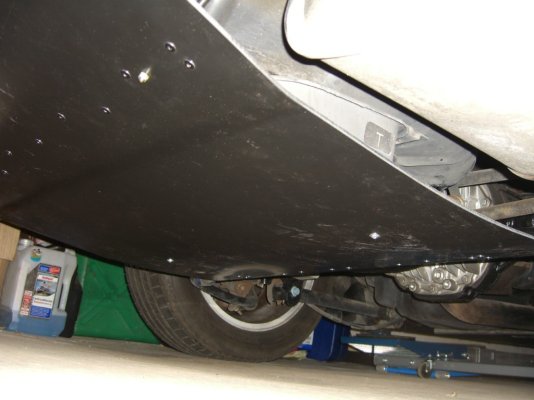
Had to get a flat repair done today and while on the lift notice rearend pinion seal weeping. Now deciding between just replacing the seal or doing 4:10…

IMG_1034.jpeg
 

JC SSP

Senior Member
Joined
Nov 8, 2022
Posts
2,283
Reaction score
1,351
Location
FL
I have them in my little coupe just on the fence with this daily driver. Bye the way Rick never got back to me on the rear???
 

GlassTop09

Senior Member
Joined
May 24, 2019
Posts
1,361
Reaction score
834
Location
Farmington, NM
PS--Sorry, didn't take any pictures.........intended to take pictures of finished install but forgot (more focused on arthritis acting up in both shoulder joints, hip joints & lower back, carpal tunnel in both wrists over time & needing to pick up\clean up after work was completed. Surprised that I had no gout flareups in my big toe joints this time), so once I recover from all this, I'll try to remember to take a couple of pics.
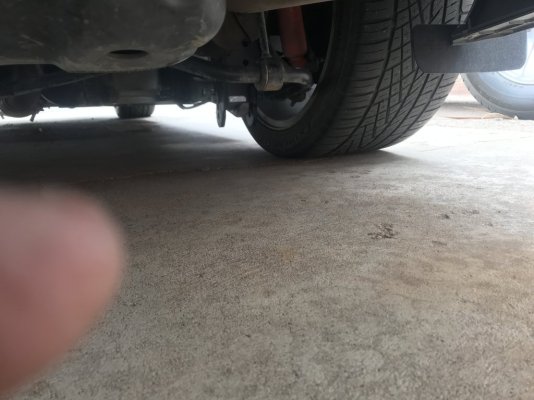
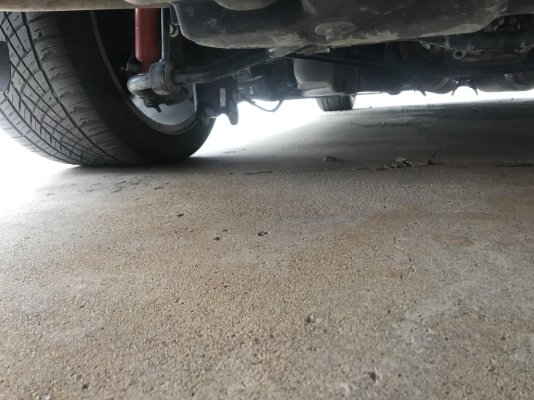
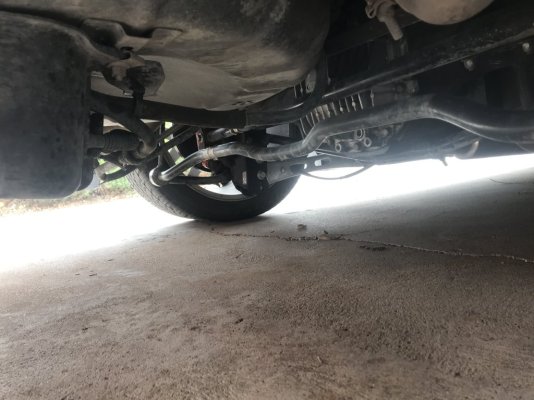
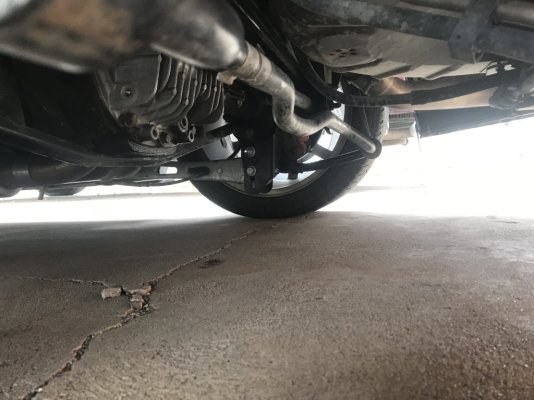
Here are some pics of these Maximum Motorsports 05-14 S197 8.8" 3-Link Rear LCA Relocation Brackets I recently installed provided below for those so interested .....................

Enjoy!

Maximum Motorsports 05-14 S197 Rear LCA Relocation Brackets (1).JPG

Maximum Motorsports 05-14 S197 Rear LCA Relocation Brackets (2).JPG

Maximum Motorsports 05-14 S197 Rear LCA Relocation Brackets (4).JPG

Maximum Motorsports 05-14 S197 Rear LCA Relocation Brackets (3).JPG
 
Joined
Sep 11, 2022
Posts
167
Reaction score
255
Location
Dover, PA
Bought a lot of goodies for my 3-2-1 swap

Cobra jet manifold
PMAS intake
BBK 1 7/8” headers with catted mid pipe
Exert Mach 500 clutch and Exedy flywheel
340 lph fuel pump
47lb injectors
Boss 302 alternator kit
Various hoses and such
Ordered the harness from Make-it-Modular

Still need a bunch of small things but the more expensive items are falling off the list.
 

GlassTop09

Senior Member
Joined
May 24, 2019
Posts
1,361
Reaction score
834
Location
Farmington, NM
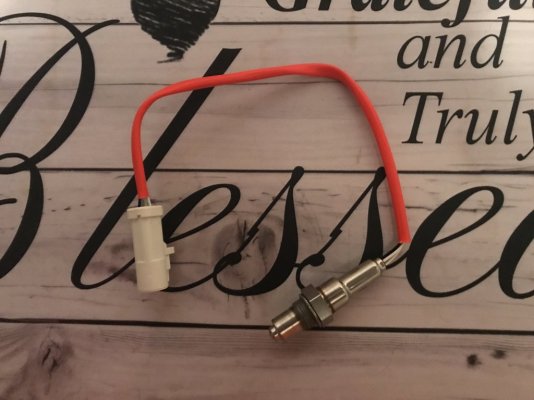
Picked up a pair of these off Amazon to test out...............

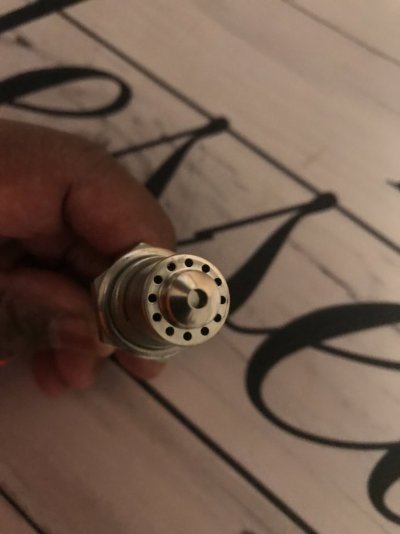
Marsflex 4-Wire NB O2 Sensors (BOSCH 15717 Spec) w\ what looks to be the element shield design of a BOSCH LSU 4.2\4.9 HUEGO WB O2 Sensor........in which this NB O2 sensor would need to be equipped w\ a nerst cell (mini electronic sampling pump powered off heater circuit) to continuously draw exhaust gas sampling inside shield, across the zirconium element then exhaust it back out (the only way any exhaust gasses can enter it..........all the 4-wire NB O2 sensors I've seen, outside of this part design, use a passive shield design--shields have either holes or slots in the side of the shield to allow exhaust gasses to passively enter inside of\thru the shield to access the element as they flow by while providing protection from contamination, thus no continuous sampling).

If this is the case, this would\should be a very accurate\sensitive NB O2 sensor @ CL Lambda 1.0 so I had to find out. An Italian company named Facet also made a 4-wire NB O2 sensor that is identical to this 1 (Facet Oxygen Sensor 10.7319.....O'Reilly's carries it, but they can't get restock......been trying to get them for the last 2 yrs to do the same testing) & fits all early Fords from 1990 thru 2014 that uses a 4-wire NB O2 sensor (also fit early 2002-2004 Aston Martin DB7 & 2000-2002 Jaguar S-Type) as well.

These are the only 2 brands of 4-wire NB O2 sensors for early MY Fords that have this BOSCH HUEGO design element shielding that I've run across to date.

Also makes a good test of my modified tune calibration settings for NB O2 sensor operations (increased CL sensor enable temp, CL delay timer & sensor heater DC settings from OEM to accommodate the use of any 4-wire NB O2 sensor, whether NTK or BOSCH spec--heater DC settings are main reason why BOSCH spec 4-wire NB O2 sensors are so finicky w\ Spanish Oaks ECU's......OEM set too low--work fine w\ NTK's but BOSCH's need more heater DC to effectively heat up & operate. See here for reference of what I'm talking about: https://www.s197forum.com/threads/lunati-voodoo-21270700-camshafts.136257/page-7 post #140.

The current OEM Ford F85F-9G4444-BD NB O2 sensors are a base BOSCH 15717 4-wire NB O2 sensor (these were the NB O2 sensors having the issues heating up during cold start OL-to-CL transition).

Pulled my NTK 22060's & put the Marsflex's in this morning then set up laptop & HPTuners VCM Scanner & datalogged all thru a full cold start, full hot idle, hot starts & subsequent drive.........all checked out good, so my tune calibration NB O2 sensor CL enable settings are more than enough as set........sensors came online quickly, w\o issue & operated flawlessly..............found that these Marsflex's have a much faster & wider (amplitude at .9v range) switching rate response than the NTK's so these Marsflex's must have a nerst cell inside to operate\respond this fast. This had the LTFT's responding much quicker to EVAP operations thus maintained a tighter STFT switching cycle pattern around EQ Ratio CMD (Lambda) 1.0 which is what I was hoping would happen as this action should markedly improve NB O2 sensor feedback fueling correction accuracy\consistency.

Engine response was very clean & crisp during drive........good sign of improved NB O2 sensor feedback performance. Checked IM Readiness afterwards.........all 7 good--0 INC's w\ Cat CE Ratios holding established pattern (between .035-.071...........this drive B1 @ .043, B2 @ .059) thus another good sign of stable NB O2 sensor feedback & combustion efficiency thru these MagnaFlow #5461336 CARB-cert EO# D-193-140 TWC aftermarket OEM grade cats......in Oct these cats will have been in service for 4 yrs w\o issue--knock on wood............). LTFT's at idle prior shutdown were B1 @ -1.6%, B2 @ 0.0%............another good sign of improved NB O2 sensor feedback performance.

Looking good so far.

Just might have a winner on hand..........................

Marsflex 4-Wire NB Nerst Cell Sampling HUEGO O2 Sensor (BOSCH 15717 Specs) (1).JPG

Marsflex 4-Wire NB Nerst Cell Sampling HUEGO O2 Sensor (BOSCH 15717 Specs) (2).JPG
 

GriffX

Senior Member
Joined
Sep 28, 2017
Posts
1,511
Reaction score
1,035
Location
Rural Germany
Pulled my NTK 22060's & put the Marsflex's in this morning then set up laptop & HPTuners VCM Scanner & datalogged all thru a full cold start, full hot idle, hot starts & subsequent drive.........all checked out good, so my tune calibration NB O2 sensor CL enable settings are more than enough as set......
Would like to have your knowledge and tuning capabilities. BTW, Walther Nernst, German Chemist one of the founders of physical chemistry.
 

GlassTop09

Senior Member
Joined
May 24, 2019
Posts
1,361
Reaction score
834
Location
Farmington, NM
Picked up a pair of these off Amazon to test out...............

Marsflex 4-Wire NB O2 Sensors (BOSCH 15717 Spec) w\ what looks to be the element shield design of a BOSCH LSU 4.2\4.9 HUEGO WB O2 Sensor........in which this NB O2 sensor would need to be equipped w\ a nerst cell (mini electronic sampling pump powered off heater circuit) to continuously draw exhaust gas sampling inside shield, across the zirconium element then exhaust it back out (the only way any exhaust gasses can enter it..........all the 4-wire NB O2 sensors I've seen, outside of this part design, use a passive shield design--shields have either holes or slots in the side of the shield to allow exhaust gasses to passively enter inside of\thru the shield to access the element as they flow by while providing protection from contamination, thus no continuous sampling).

If this is the case, this would\should be a very accurate\sensitive NB O2 sensor @ CL Lambda 1.0 so I had to find out. An Italian company named Facet also made a 4-wire NB O2 sensor that is identical to this 1 (Facet Oxygen Sensor 10.7319.....O'Reilly's carries it, but they can't get restock......been trying to get them for the last 2 yrs to do the same testing) & fits all early Fords from 1990 thru 2014 that uses a 4-wire NB O2 sensor (also fit early 2002-2004 Aston Martin DB7 & 2000-2002 Jaguar S-Type) as well.

These are the only 2 brands of 4-wire NB O2 sensors for early MY Fords that have this BOSCH HUEGO design element shielding that I've run across to date.

Also makes a good test of my modified tune calibration settings for NB O2 sensor operations (increased CL sensor enable temp, CL delay timer & sensor heater DC settings from OEM to accommodate the use of any 4-wire NB O2 sensor, whether NTK or BOSCH spec--heater DC settings are main reason why BOSCH spec 4-wire NB O2 sensors are so finicky w\ Spanish Oaks ECU's......OEM set too low--work fine w\ NTK's but BOSCH's need more heater DC to effectively heat up & operate. See here for reference of what I'm talking about: https://www.s197forum.com/threads/lunati-voodoo-21270700-camshafts.136257/page-7 post #140.

The current OEM Ford F85F-9G4444-BD NB O2 sensors are a base BOSCH 15717 4-wire NB O2 sensor (these were the NB O2 sensors having the issues heating up during cold start OL-to-CL transition).

Pulled my NTK 22060's & put the Marsflex's in this morning then set up laptop & HPTuners VCM Scanner & datalogged all thru a full cold start, full hot idle, hot starts & subsequent drive.........all checked out good, so my tune calibration NB O2 sensor CL enable settings are more than enough as set........sensors came online quickly, w\o issue & operated flawlessly..............found that these Marsflex's have a much faster & wider (amplitude at .9v range) switching rate response than the NTK's so these Marsflex's must have a nerst cell inside to operate\respond this fast. This had the LTFT's responding much quicker to EVAP operations thus maintained a tighter STFT switching cycle pattern around EQ Ratio CMD (Lambda) 1.0 which is what I was hoping would happen as this action should markedly improve NB O2 sensor feedback fueling correction accuracy\consistency.

Engine response was very clean & crisp during drive........good sign of improved NB O2 sensor feedback performance. Checked IM Readiness afterwards.........all 7 good--0 INC's w\ Cat CE Ratios holding established pattern (between .035-.071...........this drive B1 @ .043, B2 @ .059) thus another good sign of stable NB O2 sensor feedback & combustion efficiency thru these MagnaFlow #5461336 CARB-cert EO# D-193-140 TWC aftermarket OEM grade cats......in Oct these cats will have been in service for 4 yrs w\o issue--knock on wood............). LTFT's at idle prior shutdown were B1 @ -1.6%, B2 @ 0.0%............another good sign of improved NB O2 sensor feedback performance.

Looking good so far.

Just might have a winner on hand..........................

View attachment 104926

View attachment 104927
Provided below are 2 copies of the IM Readiness reports from my car........... 1 dated 3-22-25 (last 1 using the NTK 22060 4-wire pre-cat NB O2 sensors) & 1 dated 3-30-25 (pulled after changeout to the Marsflex BOSCH 15717 Spec 4-wire pre-cat NB O2 Sensors w\ Nerst Cell Sampling Pump on 3-24-25 & after putting 7 drive cycles on them) w\ no changes made to the tune calibration.

These results are proof of the reasoning why I bought & installed them........

Proves the concept of what a more accurate pair of pre-cat NB O2 sensors can provide..........if you can only envision this from a POV of emissions alone, then you entirely are missing the point that these results are pointing to the engine's efficiency improvements in converting fuel & air into heat\expansion energy which can\will also increase engine HP\TQ output.......not IF.

Only need to harness it........

The only reason others are not getting this is due to a LOT of tuners not using some type\method of exhaust analysis to check exhaust while tuning........such as a 5-gas exhaust analyzer for real time usage.........or in my case, using at a minimum, the very same CARB-cert cats (thus legally tested\certified) w\ the ECU's '09 MY emissions controls fully active & unaltered in tune calibration along w\ both rear NB O2 sensors (NTK 22500 post-cat) active in tune & fully inserted into cats.......thus a level of accuracy w\ the results rechecked post each tune reflash to monitor engine operating efficiency as well as cat efficiency over time.

Cats can only treat the expelled leftover HC, CO & any NOx laden exhaust created from incomplete, inefficient combustion that occurs within the combustion chambers\cylinders........any incomplete combustion exhaust that is treated (meaning oxidized, reduced or burned post combustion if preferred) inside of a cat (or just blown away into the atmosphere running FFE) is lost energy thus lost HP\TQ potential........pure, plain & simple. The Catalyst #1 & #2 CE Ratio numbers are a measurement of engine combustion efficiency as well- measured thru a cat's ability to clean the exhaust. Less HC, CO & NOx in exhaust to start with.......the less work a cat needs to do thus is more efficient......thus the less amount of O2 the ECU needs to put in post exhaust to feed the cat.......thus more O2 is available to be mixed w\ fuel to make more heat\expansion energy........thus a more efficient thus powerful engine.

Rinse, repeat................

The Catalyst #1 & #2 CE Ratio results differences show this..........was just as surprising to me to see these results get even better over time of operation just from using a pair of 4-wire pre-cat NB O2 sensors that can continuously sample exhaust instead of passively doing the same..........

All this is being done thru the exact same set of cats (MagnaFlow #5461336 CARB-cert EO# D-193-140 TWC aftermarket OEM grade cats) that have been in service since Oct 2021........provided below is an IM Readiness report dated 10-5-2021 for context.

Just think............this design of Ford-compatible 4-wire NB O2 sensor has been out in the wild since the late 90's\early 2000's.........just not widely known\available in the same US MY production models (mostly in UK\Europe & Australia) ...........

Am blessed to be in a position to have learned\made the necessary front NB O2 sensor heater DC setting changes\heater eng run time scaling changes in my tune calibration to take full advantage of them............

Posted for those so interested...................

Would like to have your knowledge and tuning capabilities. BTW, Walther Nernst, German Chemist one of the founders of physical chemistry.
Not that hard to do\get\obtain...........just have to go after it & be willing to do what it takes to get there, learn from good sources, be willing to unlearn\discard bad\wrong info cause it's out here & ignore all the negative noise you'll most certainly hear\run into along the way......only you know your true capabilities......no one else.

Just never stop learning once you do decide to jump in, no matter how much knowledge or skill you gain.................complacency always kills the cat\stunts growth.

My 2 cents worth of pep talk...........

Yes, it's Walther Nernst's pioneering work called the Nernst effects that is the fundamental scientific basis behind this little electronic gadget's operations inside of these Marsflex NB O2 sensors as well as in all WB O2 sensors.

 

Attachments

  • obdiimode6data32225.txt
    7.2 KB · Views: 0
  • obdiimode6data33025.txt
    7.2 KB · Views: 0
  • obdiimode6data10521.txt
    7.2 KB · Views: 0

Gabe

Whippled Coyote
Joined
Aug 7, 2011
Posts
8,599
Reaction score
1,820
Location
NC
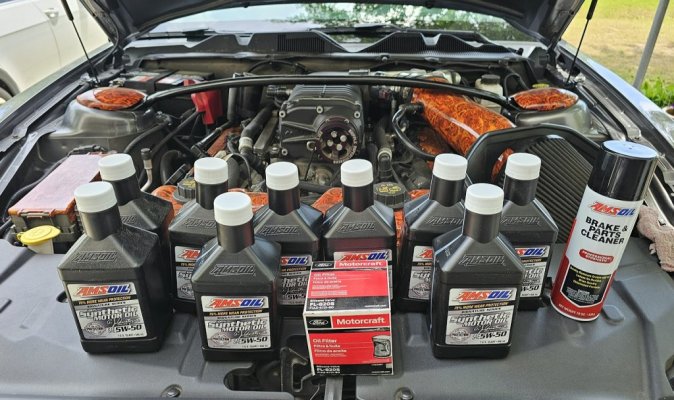
I'm still amazed that the Coyote can use 5w20 and 5w50 oil.

The '13-'14 Track Pack and the Boss engine got spec'd for 5W50, just like the GT500.
I can say that using this oil, I've never heard the ticking sound that so many Coyote owners complain about.
 

ghunt81

New parts on old junk!
Joined
Jan 20, 2016
Posts
1,193
Reaction score
274
Location
Clarksburg, WV
Here are some pics of these Maximum Motorsports 05-14 S197 8.8" 3-Link Rear LCA Relocation Brackets I recently installed provided below for those so interested .....................

I did some of these brackets years ago when I lowered my car, and although I have yet to do it, I think at some point you will probably want to weld them on. I found out when I replaced my LCA's that those brackets are able to move around, I don't know how much it affects anything though if you aren't racing.
 

GriffX

Senior Member
Joined
Sep 28, 2017
Posts
1,511
Reaction score
1,035
Location
Rural Germany
The '13-'14 Track Pack and the Boss engine got spec'd for 5W50, just like the GT500.
I can say that using this oil, I've never heard the ticking sound that so many Coyote owners complain about.
I have no doubt about that, but "The Experts (TM)" told me that the oil viscosity has something to do with the bearing clearances and oil jet nozzles. I just changed the roller follower at my 4.6 to the new style with the tiny holes in it compared to the huge one before. Still wondering that it will work at freezing temps too.
 

Support us!

Support Us - Become A Supporting Member Today!

Click Here For Details

Back
Top