Now you're starting to realize that it will depend on which Ford Modular engine series you're working with that will determine the specs you need to refer to. These oil pumps are designed to the Ford Modular engine design parameters.........which can ALLOW different rated OEM oil pumps to be installed in differing Modular engines series.........which, if 1 is not up to understanding the engineering design criteria & engine wear patterns over time, exactly which spec'd oil pump 1 would want to use.........which can cause a LOT of confusion to folks who miss these facts AND is a problem on sites where folks don't clearly explain these specs & usage cases w\ the reasoning why certain spec'd oil pumps should be considered......and also the accompanying components that were designed to be used w\ these said oil pumps to retain system integrity in the process to help prevent self-induced operational issues\problems.
Ford designed these parts originally for these engines.......the 13-14 Ford 5.8L GT500 oil pump is a classic case of a Modular part getting used in a Modular engine series (4.6L 3V....) that it was not originally designed for just because it will physically fit & operate.........but due to its ORIGINAL DESIGN by Ford, it is a good choice to use for a usage case where a higher volume thus pressure oil delivery in a 4.6L 3V Modular engine that wasn't originally designed for it can provide some useful benefits (ie, higher performance protection from higher bearing loads, better bearing cooling from higher oil volume flow--both performance metrics, countering increased engine bearing clearances thus wear due to normal wear over time to regain\retain proper crank\rod journal support\alignment to help further protect the bearings, ie, high mileage--yes, this is a real thing IF the engine is also getting pushed periodically meaning high loads--your specific usage case since your 3V has 200K+ miles on her, etc......) but also, Ford knew that, w\ these Modular engines designed specifically for performance (includes the 03-04 Terminator 4.6L as well as the 07-12 5.4L SC & 13-14 5.8L SC......all use the EXACT same OEM Ford designed cast iron chain tensioner.....thus why these same cast iron chain tensioners will also work in a 4.6L 2V or 3V Modular as well.....), STABLE cam-to-crank timing synchronization is PARAMOUNT, thus why the Ford cast iron chain tensioner design that can harness this oil pump's higher volume\pressure output w\o issue to help stabilize these Modular engine's dual SOHC cam-to-crank timing synchronization at all engine RPM's--especially during high RPM where this is absolutely necessary........especially if 1 uses higher rated valve springs than OEM causing increased chain load\tension requirements thus NEEDS increased guide stabilizing to retain proper & ACCURATE cam-to-crank timing, the plungers in these cast iron tensioners are DESIGNED by Ford to semi "hydrolock" once they are fully pumped up off oil pressure\volume to provide this chain stabilization.......the plunger ratchets are a SECONDARY failsafe--to this PRIMARY plunger function........they are DESIGNED to allow the plungers to depress enough to relieve the induced chain tension from momentary oil pressure reduction or loss (what occurs when engine is either decelerated or shut down......oil pump is crankshaft driven thus RPM affected....) but NOT allow the CHAIN GUIDES to depress enough to ALLOW the chains to PHYSICALLY FLOP around.....unlike the plastic chain tensioners......which is what destroys the stationary chain guides, damages the timing covers, causes excess lateral loading on the guide pivot pins thus breakage, etc.......ESPECIALLY if folks intentionally bypass the ECU's ETC TB primary rev limiter in the calibrations to use the secondary fuel\spark cut for primary rev limiting OR use 2-steps (that use spark cut rev limiting to do what they do......) during drag racing to stage engine RPM's while keeping the ETC TB control fully depressed while staging at the tree...........or what some folks use to shoot flames out the exhaust (the NM2B WOT box) along w\ excessively retarded ignition timing during decel\DFCO because it's "cool"...........
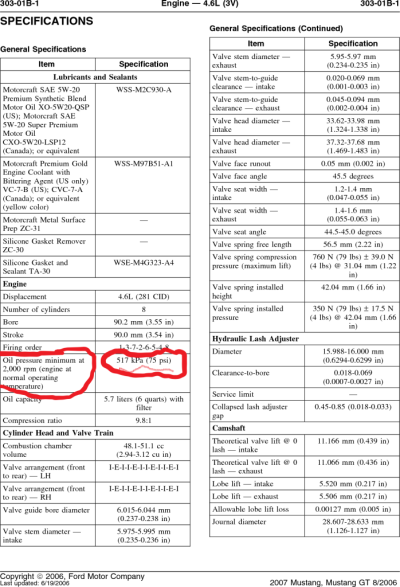
Thus, you also need to really consider exactly HOW this engine is gonna be used to THEN properly apply what is actually needed\required as a system application..........not individually..........meaning IMHO, if this 13-14 Ford 5.8L GT500 oil pump is gonna be used in a 4.6L 3V, the accompanying cast iron chain tensioners also SHOULD be used if performance is your primary goal\usage or secondary if high mileage replacement\reliability\longevity use IF the already existing damage\wear isn't too far gone (the main reason why 1 should 1st run an oil pressure survey w\ a physical oil pressure gauge.......including using a higher viscosity oil during this survey as well on their 4.6L 3V according to Ford's specs to see where their engine's operating condition is at prior spending any money)..........they solve all of the current timing\component issues noted w\ the 4.6L 3V, both in NA & FI form w\o any downside........if used in tandem.
The main issue w\ the Ford 5.4L 3V Triton Modular engine is the LENGTH of the timing chains due to this engine's increased deck height.......too much chain mass for the plastic chain tensioners to properly manage...........the remedy for these engines is using the same part that most folks keep on demeaning........the cast iron chain tensioners along w\ a high volume\pressure oil pump..........the EXACT same thing the 07-12 5.4L SC Modular is using.
Sorry for this long posting so take it for what it's worth to you..............hope this helps.
All good points. And, yes, I did fall into the internet engineering trap I strive to avoid. On any forum (I do not include Facebook/social media in this as it is the most untrustworthy source for anything), over time you can usually get a feel for which members actually know what they are talking about. And which ones don't.
Piecing together that information is a risk prone task. You don't know what you don't know until you know it, but try to know enough to recognize that and ask questions.
In this case, I spent quite a bit of time searching and reading. Not just on this forum. The pump did come with many recommendations....but not the full story of the how's and why's.
Add into that a little mental inertia on my part. A bit of information can get stuck in your head and even though you have the contradictory information, it still stays there or does not register enough to dislodge the unconfirmed ideas.
I can look back and see exactly how it worked in this instance.
So, I agree that parts designed to work as a system should be judged carefully. First, is to know what conditions/variables are they addressing. How does that differ from your application?...etc.
The '13 GT500 pump physically fits the same as the stock 3V pump. The newer pump is designed for higher capacity and higher pressure. Presumably for sustained higher rpm use with built in oil leaks (the piston squirters). You are losing volume and pressure right there, so the new pump takes care of that.
Too high of a pressure can cause issues. Scouring bearings and accelerating wear.
Hypothetical thinking:
Does the pressure drop the further you get from the pump and the pressure sensor? If so, does that alone reduce the accelerated wear issue? Not something I can answer. If not, and if the GT500 was actually seeing that 90-100psi, was the switch to cast iron tensioners made because of the pressure they would be subjected to? Along with the shocks coming thru the chain from accelerating/deccelerating and rev limiter, the plastic tensioners or seals that are fine at 75psi may not hold up at 100psi.
If that is true, then installing the pump as is into a 3V without a lower psi spring, might be asking for trouble. Recommendations of the pump are not necessarily paired with the cast iron tensioner suggestion. Usually those are two separate discussions for different reasons. The connection you've made to them both is a good one and logical and worth exploring for the exact 'why'.
Some extra volume, but at 3V 75psi pressure could be a good balance point on a high mileage motor.
I should have done pressure readings before disassembly. Then I'd have a data point to compare to.
My plan at this point is to do a little backtracking. I have an itch in my head I need to scratch regarding the o-ring. Even though it looked good and was not rock hard, I should change it. It will make me feel better.
At the same time, since the pump will be out, I intend on getting accurate measurements of both pumps to make some comparisons. If everything in the pressure relief bore is the same or nearly so, then the 3V spring stays in. If not the same, then its time for a refigure or just get a new 3V pump.
Maybe I can add to the body of confirmed knowledge on this swap.
Pan and pickup are a future concern.
My use is a daily commute of 60 miles and occassional spirited back road driving, but not on the level of a roadrace. And I am definitely not a drag guy, on the street of the track.