What they are is a bunch of physicists, and English is not the first language of all of the participants. Even among the English-as-the-first/only-language folks, it's not all "American English". "Crown wheel" is definitely of England/Great Britain origin. You kind of get used to the language difference thing when there have been people from all over the world working in your office for 30 years or so.
What they aren't is engineers (vehicle dynamicists, to be more specific), and what they're trying to describe requires some knowledge of suspension kinematics (think instant center locations and anti-squat). In a roundabout way I think the discussion finally stumbled across the concept that the speed at which the initial loading hits the tires - and how suspension stiffness affects that - might matter.
I didn't thoroughly read it all, but it seems like way too much is being made of minor effects. Energy loss does happen in the shocks (not the springs), because you can't recover the energy spent by forcing the shock oil through tiny passages which heats it up. But that's a tiny amount compared to what's available.
Just to pick a few nits with one of the main players,
Mr Robin Parsons said:
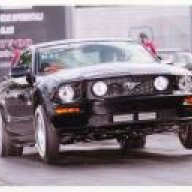
for inertia to be the effective lifter of the car, the car MUST travel forward, if you have ever watched drag racing you will have observed that dragsters lift their front ends RIGHT FROM THE START LINE, (not enough forward motion for inertia to have worked with the kind of force required) torque from the axle/chassis combination (matches, same as, the ring/pinion example)
He is missing the point that a large acceleration happens before there is much visible forward motion, that the body inertia force is directly in response to that, and that it is purely rearward/parallel to the track surface. He's a LONG way from realizing that the chassis of a rail can intentionally be made flexible for the front wheel droop condition.
Mr Robin Parsons said:
Oh yes, BTW russ, I learned aout COG's in High school physics classes that occured when I was in grade 10. That was waaaaaaay back when I was ~15/16 years old, or ~1971/72, OOOOOooops that's right, you were not even born yet!
Please, forgive my overt rudeness, (or not, your choice) and beware OLDER MEN (and Women!) as they have had more time to learn more "things".
He got the gloves a little loose at that point. But he's still a kid relative to some of us, and I hope that he's been paying attention to his own advice. Never mind that he should at least remain open to learning regardless of the source.
Mr Robin Parsons said:
PS Russ, from the start line, to the finish line, the real, and actual, 'COG' moves towards the rear of the car(!!), without question!
Except for rearward fluid slosh, rearward compression of the driver's body against the seat, and compression of any seat padding, he's way off base. I could tell him that a microscopic amount of longitudinal chassis compression actually does occur, but that he'd need to know more in order to be able to say whether that effect by itself would increase or decrease the rear tire loading.
Norm