Relocation Brackets: Effect on Handling?

Norm Peterson

corner barstool sitter
Joined
Feb 5, 2011
Posts
3,615
Reaction score
326
Location
RIP - You will be missed
if you get adjustable lower control arms, make sure that you get an alignment and have them zero the thrust angle.
If thrust angle changes by as little as 0.05°, you should be able to notice the steering wheel not being in the same place as it was before, when you're driving on a straight and level road. If it is off, which way it's off will tell you which LCA adjustments would bring it back straight (either lengthen one side or shorten the other; which would be better for pinion angle is a separate matter).

Finding adjustment errors like this is part of what test drives are for, and you need to do them or at least treat your early drives with the new parts as test drives before you get used to something being "off" and write it off as being somehow normal. If it matters, I had to take up one full turn on one of my LCAs very shortly after installing them, about 0.1° worth in terms of thrust angle with my particular brand.


Norm
 

Sky Render

Stig's Retarded Cousin
Joined
Feb 24, 2011
Posts
9,463
Reaction score
358
Location
NW of Baltimore, MD
I forgot to tighten the jam nuts on my LCAs, and they slipped shortly after install. I know my thrust angle is a little off; I've gotten it as close as possible without putting it on a rack.
 

Norm Peterson

corner barstool sitter
Joined
Feb 5, 2011
Posts
3,615
Reaction score
326
Location
RIP - You will be missed
Durometer for durometer - I really don't see that poly ball system being much more efficient in terms of articulation.

large_43_mustang_lower_control_arm_3_piece_polyball_bushing_1_1_1.jpg


There is still a substantial amount of material on each side that the sleeve has to work with. The ball seems to just be taking up space, IMO. If those end pieces were the same 85 durometer, then.....I don't think the measurements would have ended up like they did. I could be wrong, but, I am skeptical. The only way I see the poly ball system allowing for much less resistance, is if it is much lower durometer. Like, 65 for example. I guess my point is, I don't see why the poly ball is any more effective, "durometer for durometer".
This ↑↑↑ . I'd sort of considered the poly-ball LCAs several years ago, but that abruptly ended after hearing of them not coping very well with hard cornering (don't recall if I heard it here or on some other Mustang forum, not that it really mattered). The only ways they'd work would be if the holes in the poly for the inner sleeves were slightly cone-shaped, or of there were some other designed-in features in the poly to permit easier articulation.

If it matters any, I'm running poly/spherical LCAs, with a little DIY tweaking of the poly ends to free them up a bit and eliminate at least one potential source of squeaks.


We have been offering 3-piece bushings for years, and years. We also release our 11+ UCA with a 3-piece bushing. Then, it failed - epically.
I'm a bit curious about how it failed and what kind of loading was most likely to blame.


If someone reaches the point in which a poly bushing isn't the right choice, I don't see why a poly/bearing combo wouldn't be the next logical choice. I've got daily drivers all over the world rolling around on our poly/bearing components.
For most peoples' daily drivers, I'll recommend poly/spherical LCAs first, mainly because most people aren't likely to DIY-modify their brand-new LCA bushings even if they were to understand that there is at least a ride quality benefit from doing so.


Here's what about 2.5° of total roll looks like. It measures closer to 3°, but since it's not a head-on picture the roll angle gets exaggerated (think cosine of the angle that the camera is looking in relative to the car's centerline). Anyway, of that 2.5°, at least 0.8° is due to the effect of load transfer and tire vertical stiffness, making 1.7° the amount of visible roll that the rear LCAs and their bushings need to accommodate under that specific cornering situation - which I'm estimating to be about 0.8g at that particular instant. That's reasonably consistent with the amount of roll that you could calculate - think somewhere in the 1.5°/g to 2.5°/g range for a Mustang GT with big springs and aftermarket sta-bars, maybe 2.5°/g to 3°/g as OE, and probably under 1.5°/g for cars like csamsh's.

norm-peterson-albums-my-cars-picture9569-2012-run-shore-autocross-023.jpg


Kelly - I've been interested in the technical side of car performance for as long as I can remember, so when I run across things like Ehren's test results I'll save a copy. It's lots easier now to save things magnetically than it was back in the days when a one-sheet-at-a-time flatbed wet copier was the only means readily available. Never mind the difference between searching electronically for a file vs poking through boxes of paper by hand.


Norm
 

sheizasosay

Alive
Joined
Jun 28, 2011
Posts
1,024
Reaction score
4
Also for the sake of conversation, 5 degrees of roll is a lot, like '86 Grand Marquis slaloming.

Yeah it appears the joint doesn't articulate as much as I thought. I was thinking it did and was thinking how you move a snub nose pistol an inch and it will vary impact a lot more than a long-barrel rifle. That's the way I was thinking the joint would be. Small movement, larger degree variation. That apparently not the case and changes things a good bit from my perspective.

Hmmmm....


Also, something else about that "test". I see mention of the two-piece bushing "only" being 85 durometer. Well, 85 durometer is actually pretty stiff. We use some of the highest durometer bushings out there, at 90 and 95 on some pieces. I can tell you, in your hand....it is hard to differentiate an 85 from 90-95.

Durometer for durometer - I really don't see that poly ball system being much more efficient in terms of articulation.

large_43_mustang_lower_control_arm_3_piece_polyball_bushing_1_1_1.jpg


There is still a substantial amount of material on each side that the sleeve has to work with. The ball seems to just be taking up space, IMO. If those end pieces were the same 85 durometer, then.....I don't think the measurements would have ended up like they did. I could be wrong, but, I am skeptical. The only way I see the poly ball system allowing for much less resistance, is if it is much lower durometer. Like, 65 for example. I guess my point is, I don't see why the poly ball is any more effective, "durometer for durometer".

QUOTE]

The street extreme joint is what I am referring to. I don't see much use for the polyball, which is why I suggested to get the extreme joint. If you look at the extreme joint axle side connection I think it will become clear that articulation is there. And Kelly, you make sense in your observations about the polyball.

I have never tried a poly/poly other than the polyball and I could tell a difference between it and the extreme joint, specifically in rate. And that's why I believe the "trend" of J&M's figures. I believe the increase in wheel rate due to bushings resisting articulation. At least that is what I accounted for in the difference I felt. It just appears that there is only a small amount of travel that should even be considered relevant and I appreciate you guys pointing that out. It's important. No reason to be looking at "10 degrees of articulation" just to get a number that has no relevance.

Right now, you have me wondering if I fooled myself. Maybe not have a clear mind when I put the extreme joints on. I obviously don't "think" I fudged it, but no one ever does. I sold the polyball arms long ago, so I can't go back and check again.

Edit- that pic below...the axle side is on the left. You gotta point these things out these days.....

 

Attachments

  • jm.jpg
    jm.jpg
    144.1 KB · Views: 22
Last edited:

BMR Tech

Traction Vendor
Joined
Dec 15, 2009
Posts
4,863
Reaction score
13
Location
Tampa, FL
Sheiza, sir - there is DEFINITELY a good chance that you indeed felt a difference there.

That extreme joint is definitely a better design for articulation. I don't even think that is debatable. I wonder why they don't do a test with the Poly-Ball VS the Extreme Joint? Maybe you could contact Brian over there and see what he has, maybe he's compared?

I don't think you fooled yourself, necessarily. I can, without a doubt, feel the difference between a poly/poly combo....and a poly/bearing combo.

My point is, I don't really know, honestly, where to draw that line when speaking in terms of what is "better"

It's like anything else relating to suspension. On paper, it can be better. In the real world, it may not "be" better, nor perform better.

In simple terms: I am not so sure that the average person would "gain" performance, by swapping from a poly/poly to a poly/bearing, etc. Especially after acquiring the feel of each combo.

Csamh for example - I don't believe he would decrease time by throwing a bearing on the LCA.
 

sheizasosay

Alive
Joined
Jun 28, 2011
Posts
1,024
Reaction score
4
Sheiza, sir - there is DEFINITELY a good chance that you indeed felt a difference there.

That extreme joint is definitely a better design for articulation. I don't even think that is debatable. I wonder why they don't do a test with the Poly-Ball VS the Extreme Joint? Maybe you could contact Brian over there and see what he has, maybe he's compared?

I don't think you fooled yourself, necessarily. I can, without a doubt, feel the difference between a poly/poly combo....and a poly/bearing combo.

My point is, I don't really know, honestly, where to draw that line when speaking in terms of what is "better"

It's like anything else relating to suspension. On paper, it can be better. In the real world, it may not "be" better, nor perform better.

In simple terms: I am not so sure that the average person would "gain" performance, by swapping from a poly/poly to a poly/bearing, etc. Especially after acquiring the feel of each combo.

Csamh for example - I don't believe he would decrease time by throwing a bearing on the LCA.

I asked Brian about the extreme joint long ago in regards to bushing bind and his reply was that there is zero bind on the extreme joint.

As far as "what is better" and the line, that's your line based off what you have gathered. Knowing the reasons for it is really where it gets good/enjoyable for discussion.
 

BMR Tech

Traction Vendor
Joined
Dec 15, 2009
Posts
4,863
Reaction score
13
Location
Tampa, FL
^ Absolutely (line)

As for the bind - yeah, I can see that, in a fixture.

On pavement, though, that is not true. It can't be. If you have a metal sleeve housed within an elastomer/poly, delrin, teflon, race, etc.....it will have resistance. Maybe not much, but it is measurable, for sure.
 

Norm Peterson

corner barstool sitter
Joined
Feb 5, 2011
Posts
3,615
Reaction score
326
Location
RIP - You will be missed
"Bind" is probably an unfortunate choice of terminology that somebody made a long time ago, and now we're pretty much stuck with it out of common usage. Ehren tried to define it more accurately, but I don't think his report ever got a wide enough audience for people to start thinking about "roll bind" more in terms of added roll resistance caused by bushing stiffnesses.

I suppose you could say an LCA was "bound up" if you had twisted it so far that there was no compliance left in the bushing material (regardless of what stuff it happened to be made of). But even that isn't strictly true, as the metal outer sleeve containing the poly or whatever still has a finite stiffness, as does the body of the LCA itself. Just that when the (at least relatively) soft bushing stiffness gets all used up the torque required for further twisting picks up only the high stiffness of the metal, so adding still more torque does not result in noticeably more twisting. By eyeball observation, most LCAs stop twisting when the bushing material has essentially stopped squishing, and "all bound up" would be a reasonable description.


Norm
 
Last edited:

sheizasosay

Alive
Joined
Jun 28, 2011
Posts
1,024
Reaction score
4
Norm, I think any considerations for added rate via bushings are no different than worrying about hitting the bumpstops in a corner. A quick ramp of wheel rate and a very fast change in weight transfer leading to abrupt loss of traction aka "snap oversteer". That's where my focus would be anyway. The only other thing I would consider is longevity for tracking it. If this whole wheel rate thing is not a problem then all that's left is longevity.
 
Last edited:

Norm Peterson

corner barstool sitter
Joined
Feb 5, 2011
Posts
3,615
Reaction score
326
Location
RIP - You will be missed
As long as you choose a bushing material that has at least a little compliance, a poor design that allows some but not enough easy angular freedom would encourage snap oversteer, which would likely be the most serious consequence.

A really high rate material such as Delrin would add a huge amount of rear roll stiffness - even polyurethane adds somewhere around half as much roll stiffness as Fords smaller Mustang rear bars. Incidentally, I doubt that Ehren's numbers include anything for the stiction you get with poly once the lubrication isn't adequate, and this is an effect that in the Mustang can be clearly felt in the smoothness with which the rear suspension moves and in the increased likelihood of getting a little wheelspin on a sharp slow turn. Things I've actually noticed.

Initially, load transfer is through the roll centers, and with the rear RC being higher the early lateral load transfer is a mild oversteer effect. As roll continues to develop, the front roll couple being much stiffer than the rear drags this balance back to what's hopefully only mild understeer. But as the total effective rear roll couple gets larger while the front roll couple is held constant the car will get looser, just as it would if you left the LCAs alone and kept installing ever stiffer rear bars. Simply put, if you carry it far enough the roll stiffness distribution might not remain front-biased enough to be able to overcome the rear-biased roll center effect, and you'd have to count on things like front camber loss to maintain a little understeer.


Norm
 
Last edited:

J.Kidd

Member
Joined
Jun 24, 2010
Posts
327
Reaction score
15
Location
Suffield, CT
FOLLOW UP:

Thanks to all for the education, advice and opinions.

I lowered the car a couple years ago but didn't go with relocation brackets because my wheel hop was gone (replaced by moderate tire slip...which I found more predictable than the wheel hop). As I have gotten used to the car and the set up, I did start to notice a difference in straight line acceleration (car almost seems to slowly bounce when accelerating hard - almost like a very drawn out wheel hop where the springs compress, rebound, compress, rebound - makes it feel like going over wavy pavement).

I also noticed a difference during harder cornering - primarily on longer sweeping curves where I could gradually start to accelerate once past the apex coming out of the turn. Time for relocation brackets (thanks to the input from many here).

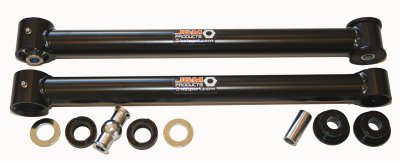
Figure while I'm doing the brackets, I might as well to the LCAs and BMR has a set that suits my needs and budget. I went with the TCA032. I know there are better, heavier-duty arms available but for the driving I do, I doubt I will exceed the capabilities of these parts. If and/or when that happens, other steps will be needed for the car as well.

Really can't beat the pricing for the quality of these arms and a big thanks to Kelly for recommending them (and the extended discussion on the phone). Great guy to talk with!

For those not familiar with these arms (apparently such a new release they haven't spread across the internet yet), I'm including a picture. I got everything (brackets and arms) in black hammertone to match my BMR panhard bar.
 

Attachments

  • TCA032_large.jpg
    TCA032_large.jpg
    44.9 KB · Views: 24

Dubstep Shep

WUB WUB VROOM VROOM
Joined
Jun 22, 2013
Posts
3,382
Reaction score
0
Location
Houston, TX
If you're doing lower control arms, you might as well do an upper.

I went back with a torque arm instead of a UCA, but that's a different monster all together.
 

Norm Peterson

corner barstool sitter
Joined
Feb 5, 2011
Posts
3,615
Reaction score
326
Location
RIP - You will be missed
I don't see much point in doing the upper unless you're trying to solve a wheel hop problem. Mostly that's a dragstrip and street-hooning difficulty, though you can get into hop at autocross. If you're a HPDE / big track enthusiast, there's little need until or unless the bushings in the stock upper start to deteriorate.


Norm
 
Last edited:

Sky Render

Stig's Retarded Cousin
Joined
Feb 24, 2011
Posts
9,463
Reaction score
358
Location
NW of Baltimore, MD
I don't see much point in doing the upper unless you're trying to solve a wheel hop problem. Mostly that's a dragstrip and street-hooning difficulty, though you can get onto hop at autocross. If you're a HPDE / big track enthusiast, there's little need until or unless the bushings in the stock upper start to deteriorate.


Norm

I agree with Norm. Even Terry said it isn't necessary unless you're REALLY running it hard.
 

BMR Tech

Traction Vendor
Joined
Dec 15, 2009
Posts
4,863
Reaction score
13
Location
Tampa, FL
I don't see much point in doing the upper unless you're trying to solve a wheel hop problem. Mostly that's a dragstrip and street-hooning difficulty, though you can get into hop at autocross. If you're a HPDE / big track enthusiast, there's little need until or unless the bushings in the stock upper start to deteriorate.


Norm

I view the necessity for an UCA slightly different.

IMO, the pros far outweigh the cons, when installing a "properly engineered" UCA System.

I feel it is very important to correct drivetrain working angles on a performance oriented S197, especially when upgrading to a 1-Piece DS. Unfortunately, trying to accomplish this without adjustable UCA on this Chassis is a TON of work (trial and error). I have done it, though.

Changing your AS/IC position, IMO, is also better done (typically) with the UCA - compared to the LCA, in handling applications. Of course, having the ability to adjust the UCA and LCA pivot points, both, is going to yield the best results.

And as you stated, the bushing system is definitely lacking within the OEM UCA Bushing System, and quite often gets damaged when under abuse. I cannot begin to tell you how many customers call me with broken UCA / Diff bushings.

IMO, axle stability is extremely important when it comes to dialing in an S197 suspension both on the road course, and on the drag strip. Upgrading from the OEM control arms, is one of the best methods in increasing rear axle stability.

I like both, UCA and LCA. But, I am a little bias.
 

csamsh

Senior Member
Joined
Apr 9, 2012
Posts
1,598
Reaction score
3
Location
OKC
What do UCAs run these days?

Anywhere from a few hundred to a thousand installed. My spherical BMR UCA with bracket, hardware, and axle-side spherical bearing, all professionally installed, ran about $850 all said and done.

My stock UCA was surprisingly not damaged. Then again, I don't really do any stupid shifting, which , from the videos I've seen of UCA's, is what I guess hurts them.

I agree, changing the UCA can make a huge difference, but we're a little stuck (in my opinion) when it comes to bushing material and articulation ability.
 

Norm Peterson

corner barstool sitter
Joined
Feb 5, 2011
Posts
3,615
Reaction score
326
Location
RIP - You will be missed
Trust me, Kelly, if I start seeing the UCA bushings coming apart I'll be in the market for something other than a direct OE replacement off the dealer's parts shelf. Maybe even something that uses the newer UCA length . . .


Norm
 

Norm Peterson

corner barstool sitter
Joined
Feb 5, 2011
Posts
3,615
Reaction score
326
Location
RIP - You will be missed
I agree, changing the UCA can make a huge difference, but we're a little stuck (in my opinion) when it comes to bushing material and articulation ability.
Stuck as much by the thing being so damn short. Some custom 3-links I've seen pictures of are multiple times as long, screw the back seat more room for tires.


Norm
 

Latest posts

Support us!

Support Us - Become A Supporting Member Today!

Click Here For Details

Back
Top