Should I get a tune?

Laga

Senior Member
Joined
Aug 10, 2019
Posts
1,120
Reaction score
636
Location
Chicago
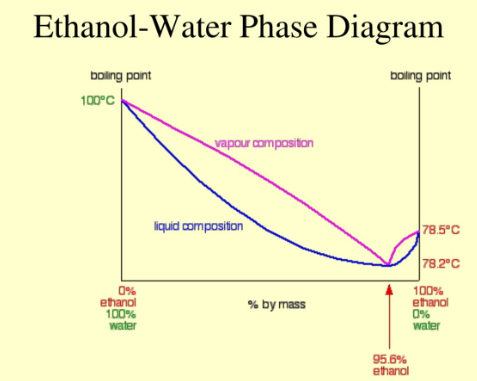
I marked the E10 in the diagram with the green dot. That means if you increase the water content only a few percent, the fuel will separate into two phases. Therefore you must use 100% water free ethanol for production. Destillation gives you only 96% of ethanol (azeotropic mixture). When E10 absorbs water from the air it separates into two phases when it reaches around 2%, that is the reason why it is only stable for 3-6 month. Then you have a Ethanol/Water phase which ignites bad and a low octane fuel phase.

View attachment 116063
For E10 to reach phase separation, a 20 gallon gas tank would have to have over 1.5 cups of water added.
E10 actually prevents water buildup in fuel tanks by binding and removing the water. Years ago, people had to manually add alcohol in the form of “Heet” or “Seafoam” to remove water.
I used to run “Gasahol” in the late 1970’s during the oil embargo. If it didn’t hurt cars back then, it’s not going to hurt today’s cars.
I’ve been running E85 for almost 4 years now. Nothing bad has happened.
 

brasil

Member
Joined
Sep 14, 2019
Posts
391
Reaction score
142
Location
Germany
@ Laga. You are running E 85 ? So what did you do to be able to use that stuff ? Different Motormanagment ? PCM reprogramed ?
 

GriffX

Senior Member
Joined
Sep 28, 2017
Posts
1,512
Reaction score
1,036
Location
Rural Germany
E10 actually prevents water buildup in fuel tanks by binding and removing the water.
Without ethanol you would have not water in the fuel in the first place. Had the wrong number in my mind, phase separation starts at 0.5% water content (just looked into my documentation). Every time you handle the fuel, water from the air will be absorbed.
 

Kev555

Member
Joined
Dec 12, 2021
Posts
374
Reaction score
170
Location
Ireland
I marked the E10 in the diagram with the green dot. That means if you increase the water content only a few percent, the fuel will separate into two phases. Therefore you must use 100% water free ethanol for production. Destillation gives you only 96% of ethanol (azeotropic mixture). When E10 absorbs water from the air it separates into two phases when it reaches around 0.5% (I had a wrong number in my mind, sorry), that is the reason why it is only stable for 3-6 month. Then you have a Ethanol/Water phase which ignites bad and a low octane fuel phase.

View attachment 116063
What your explaining is what I was seeing in small 2 or 4 stroke engines that don't get used regular or stored over winter with fuel in their tanks like gardening equipment. Makes common sense about the 3-6 month storage rule in certain climates.
 

GriffX

Senior Member
Joined
Sep 28, 2017
Posts
1,512
Reaction score
1,036
Location
Rural Germany
What your explaining is what I was seeing in small 2 or 4 stroke engines that don't get used regular or stored over winter with fuel in their tanks like gardening equipment. Makes common sense about the 3-6 month storage rule in certain climates.
For my small engines and emergency power generator I use 98, which is often ethanol free here in Germany. A good test is to fill 10 ml in a measuring cylinder, add 1 ml water and mix. The water phase will get out the ethanol compartment.

Some video I found
 

GriffX

Senior Member
Joined
Sep 28, 2017
Posts
1,512
Reaction score
1,036
Location
Rural Germany
I have a question to the people who can tune:
What is the difference between a 91 and 93 octane tune, when our 4.6 was designed for 87?
 

Laga

Senior Member
Joined
Aug 10, 2019
Posts
1,120
Reaction score
636
Location
Chicago
Without ethanol you would have not water in the fuel in the first place. Had the wrong number in my mind, phase separation starts at 0.5% water content (just looked into my documentation). Every time you handle the fuel, water from the air will be absorbed.
So if I leave a half filled bottle of vodka out on the counter with the cap off, it will absorb water and slowly refill?
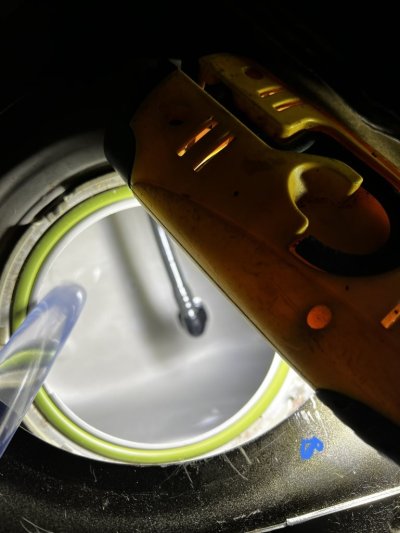
I’m in Chicago area. We have had E10 since 2000. In 2020, I had electrical short with my gas gauge. I opened up the gas tank. Here is what 12 years of E10 and 3 years of E85 did to my stock gas tank. See any evidence of water?
This is really a nonissue.

IMG_0239.jpeg
 

Laga

Senior Member
Joined
Aug 10, 2019
Posts
1,120
Reaction score
636
Location
Chicago
@ Laga. You are running E 85 ? So what did you do to be able to use that stuff ? Different Motormanagment ? PCM reprogramed ?
Larger fuel pump and injectors, along with a set of tunes from Lito. Since it is a 05, it is not flex-fuel nor is the ECM set up for different percentages of ethanol. I have 5 stations within a two mile radius that sell E85. Sometimes the ethanol varies. I carry my SCT4 in the car. It has tunes for 70%-75% (most common) and 75%+. Along with a 93 octane tune. I have installed a digital ethanol content sensor in the fuel line.
 

Laga

Senior Member
Joined
Aug 10, 2019
Posts
1,120
Reaction score
636
Location
Chicago
Biggest difference is ignition timing.
Correct. The stock tune is actually designed as a compromise between performance, warranty, and emissions. Going to a higher octane tune shifts priority to performance.
Edit: I also remember a better throttle response.
 
Last edited:

Dino Dino Bambino

I have a red car
Joined
Aug 11, 2014
Posts
4,509
Reaction score
2,601
Location
Cyprus
I have a question to the people who can tune:
What is the difference between a 91 and 93 octane tune, when our 4.6 was designed for 87?
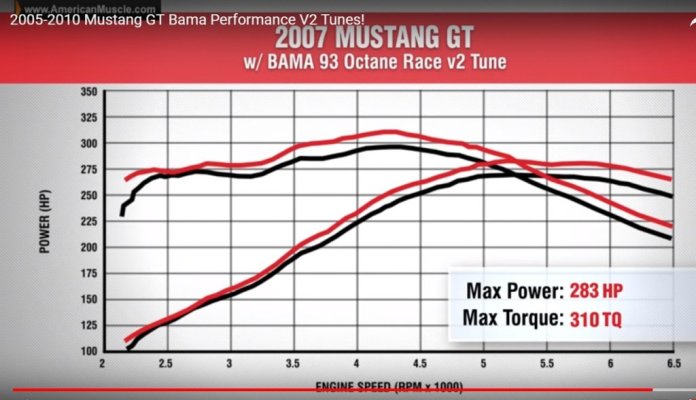
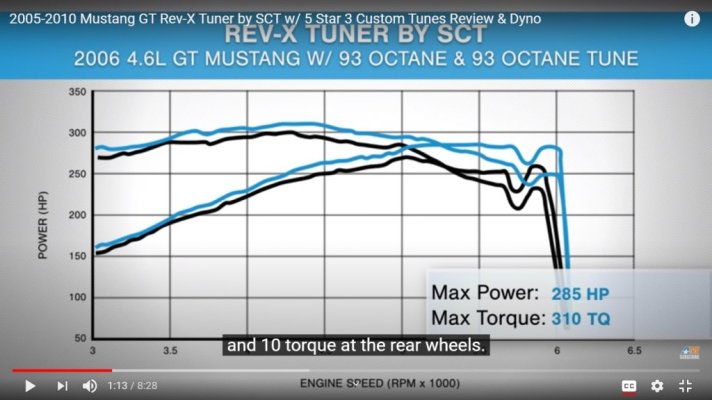
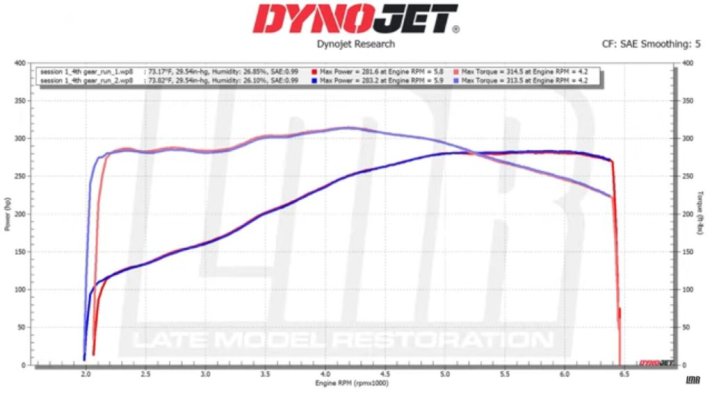
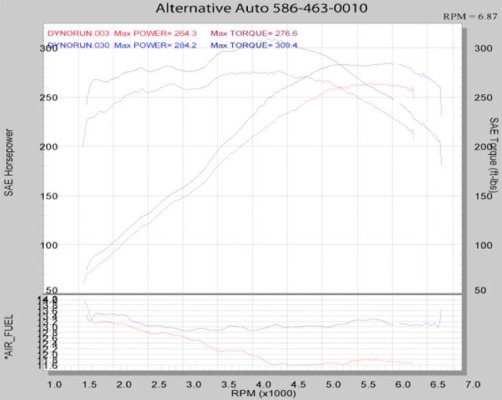
The stock tune only allows for a maximum WOT ignition advance of 26 degrees, which allows the engine to run on 87 octane. However this limits performance and blunts throttle response.
A 91 or 93 octane tune increases maximum WOT ignition advance to 30 or 32 degrees respectively. Part throttle ignition advance is also increased from low rpm right up to the rev limiter, and this is why the torque increase is so impressive compared to stock.

93 Octane BAMA Race Tune.jpg93 Octane Rev-X Tune.jpg93 Octane SCT Tune.jpg93 Octane Tune.jpg
 

GriffX

Senior Member
Joined
Sep 28, 2017
Posts
1,512
Reaction score
1,036
Location
Rural Germany
So if I leave a half filled bottle of vodka out on the counter with the cap off, it will absorb water and slowly refill?
No, because your Vodka has already more water than 4% inside. And, the EtOH/H2O phase doesn't sink to the ground, the fuel just gets cloudy.

1779040600432.png
 
Last edited:

GriffX

Senior Member
Joined
Sep 28, 2017
Posts
1,512
Reaction score
1,036
Location
Rural Germany
A 91 or 93 octane tune increases maximum WOT ignition advance to 30 or 32 degrees respectively.
That I don't understand. It is still NA so no change in compression, if you ignite earlier this is independent from the octane number. Does the 91/93 burns slower? Or, with 91 you can lower the safety margin and the possible ignition angle is also 31 with 87?
 

StockishS197

Member
Joined
Dec 24, 2024
Posts
434
Reaction score
379
Location
Houston
That I don't understand. It is still NA so no change in compression, if you ignite earlier this is independent from the octane number. Does the 91/93 burns slower? Or, with 91 you can lower the safety margin and the possible ignition angle is also 31 with 87?
93 is more knock stable than 91, so it resists pre-detonation (knock) better than 91.

When you advance the timing, you are moving the ignition event further BTDC, thus more push down, however at the tradeoff of higher cylinder pressure and likelihood of knock.

Most 93 tunes for 3vs run up to 32 degrees of WOT spark (+\- 2 degrees). Outside of WOT, part throttle tuning is greatly improved with higher spark advance too.

The stock tune is super conservative at 26 degrees to run 87 safely.

This is a gross oversimplification of tuning, but you get the idea.
 
Last edited:

GriffX

Senior Member
Joined
Sep 28, 2017
Posts
1,512
Reaction score
1,036
Location
Rural Germany
When you advance the timing, you are moving the ignition event closer to pistons TDC, thus more push down, however at the tradeoff of higher cylinder pressure and likelihood of knock.
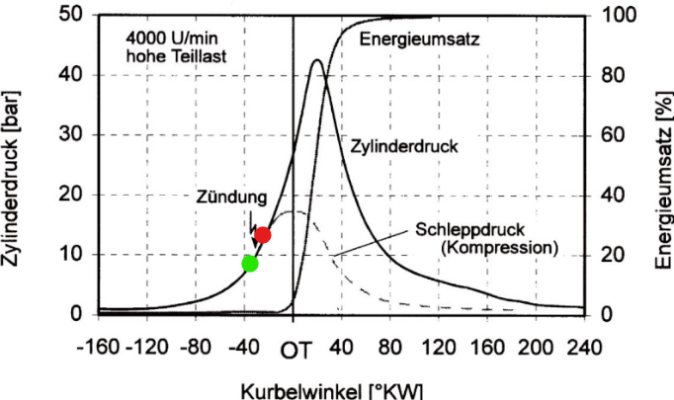
I think 31 means 31 degree before TDC, so the compression is lower than at 26 when the spark comes?

PS: found diagram

1779041890148.png
 
Last edited:

Juice

Senior Member
Joined
Aug 24, 2017
Posts
5,024
Reaction score
2,149
Its not as much the octane, but the physical engine itself that determines max power timimg. This is not when detonation is most likely happen. (Sure you can granade wot with too much timing,but thats not the point).
If you seen the fuel episode of engine masters, fuel didnt matter. 87, 91,116,e85) Max power was made at the same exact timing on all those fuels.
All things equal, too low octane will knock worst on tip-in, like passing without downshifting.
 

GriffX

Senior Member
Joined
Sep 28, 2017
Posts
1,512
Reaction score
1,036
Location
Rural Germany
Its not as much the octane, but the physical engine itself that determines max power timimg. This is not when detonation is most likely happen. (Sure you can granade wot with too much timing,but thats not the point).
If you seen the fuel episode of engine masters, fuel didnt matter. 87, 91,116,e85) Max power was made at the same exact timing on all those fuels.
All things equal, too low octane will knock worst on tip-in, like passing without downshifting.
So, the ignition angle @max power is a function of compression ratio and IAT. E.g. at 9.5:1 you need 87 and 91 at 10.5:1
When you use 91 at 9.5:1 you have more room for higher IAT and sudden load variation ?

BTW: I do not like the "race" tunes, way too aggressive (and not linear) throttle response. You press the pedal 50% down and the TB opens to 100%. You think you have more power, but you don't. (My diesel Audi does the same from the factory, awful to drive)
 
Last edited:
Back
Top