I have a question to the people who can tune:
What is the difference between a 91 and 93 octane tune, when our 4.6 was designed for 87?
Ok I'll bite....................also for others who are interested..........
According to Greg Banish..............
Most all modern OEM vehicle production engines, since the OBDII emissions stds were released after 1996, are designed to be
octane limited..........due to the fact that higher static compression engines are more efficient--both power wise, MPG-wise & emissions-wise than lower ones. This is why the advent of more sophisticated PCM's using knock sensors systems, better cyl head port & chamber designs--includes pistons as well, better IM & exhaust systems design to take full advantage of higher compression ratios.
Thus, modern engines are
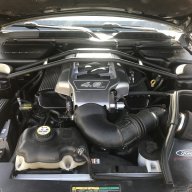
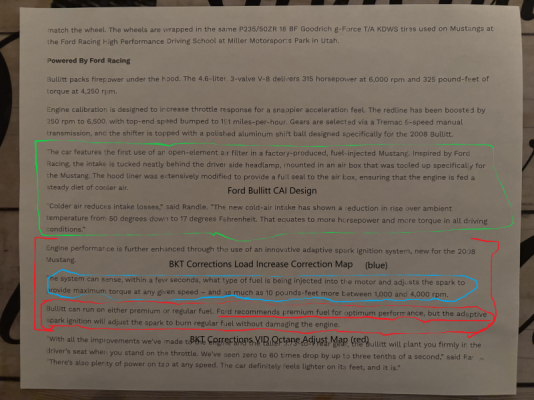
tuned to operate using a specific fuel octane rated fuel. As for this Ford Modular 4.6L 3V engine, it's 9.8:1 static compression design allows for effective fuel octane usage between 87 oct to 93 oct. This is set in the base calibration from the factory for 2 reasons: 1. to determine when the Octane Function flag is enabled to use fuel octane 91 to 93 (this enables the Spanish Oaks PCM to use the BKT Corrections\VID Octane Adjust map--HPTuners lingo--in base calibration so the engine can be set up to use higher octane fuel but can still run off lower octane fuel if desired--think 08-09 Bullitt--but is also present in all 05-10 Spanish Oaks base calibrations......just disabled due to these are set to use 87 oct fuel only
in the calibration......not the engine's design) & 2. to determine the specific KHz frequency range based on the cyl bore dia size that corresponds to a fuel's specific AKI index, or octane rating. The knock sensor algorithm used in our 05-10 Spanish Oaks PCMs uses the earliest version of the now common 2-wire, non-resonant knock sensor design that is tuned to resonate within a specific frequency band--like a tuning fork, usually between 10KHz-12KHz, unlike the earlier resonate knock sensor designs that would constantly resonate w\ the frequency band changing as engine load & RPM changes, to be more discriminate (or accurate if preferred.....) during cyl knock detection window (Ford knock detection systems use the PIP spout CKP rising signal for ignition timing to know when the knock detection window starts & ends for every cyl after it is fired---usually @ 10* BTDC start thru 40* ATDC end, thus a typical 50* knock detection window......helps system to be even more discriminate when detecting cyl knock. Expected operating cyl pressure & temps will mostly determine the fuel octane rating to use (knock frequency changes\scales due to cyl pressure & temp.....), based on how the OEM's go about setting an engine's operational MBT (maximum best torque) curve for the intended usage.
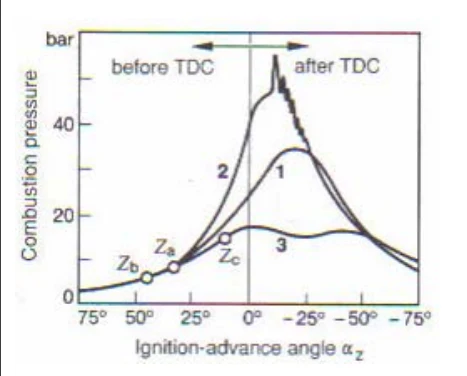
OEMs do not go off of dynos specifically to determine an engine's MBT.........they specifically use AVL plots (cyl pressure vs cyl volume against crank angle\piston position relative to TDC......) to effectively determine an engine's MBT.........which will be within a specific crank angle\piston position range that will be able to most effectively extract the most work out of the highest cyl pressure\expansion from the mass fraction burn rate of a fuel plotted against crank angle\piston position to reach the expected target of what is called CA50.......the point at which 50% of the total air\fuel volume in cyl has been burned......usually between 7*-9* ATDC......to then hit the expected max best torque where the cyl pressure is at its highest\expansion greatest within the optimum CA range between 12*-15* ATDC for the most work to get extracted into the crankshaft's rotation (or velocity if preferred......).
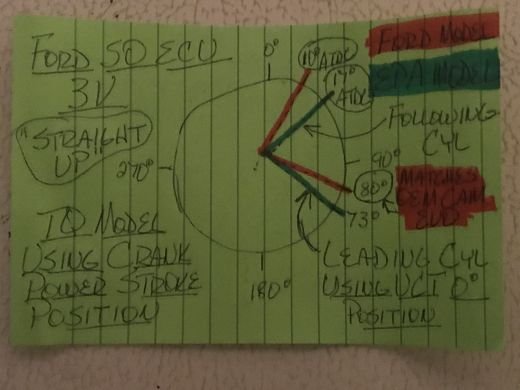
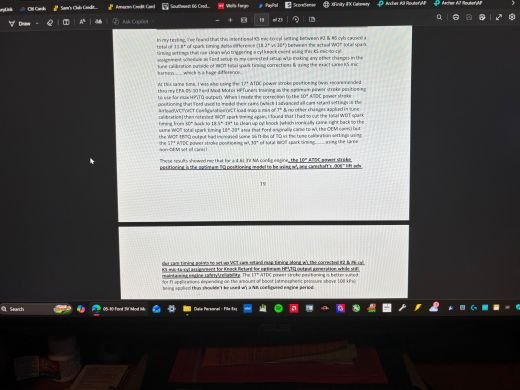
It is this aspect that makes continuously variable cam timing (VCT) the game changer that it is..........IF folks actually use it to REFERENCE the crank angle\piston position (the only variable that is a constant.......) during a power stroke cycle using a cam's .006" adv dur EVO event into this optimum window, THEN set ignition timing RELATIVE to it to achieve true MBT as it WILL be dependent on the
fuel's octane rating as well as other operating conditions as to where it will end up being. This is 1 of the areas where good knock sensor systems can be of efficient use......is why Ford Modular engines expressly operate USING them & is why they can make the power they can put out using smaller displacements thus also being very fuel efficient & emissions friendly at the same time........if TUNED properly based off the engine's CA50 target crank angle window.
Most aftermarket dyno tuning is empirical in nature using either knock sensors or charted TQ\HP outputs w\o any input of crank angle\piston position relative.......thus is essentially akin to "throwing mud against the wall" until a number is settled on as being "MBT" or "knock limited" to represent max best TQ thus HP, so if 1 is tuning an engine equipped w\ any form of continuous VCT & the CA50 hasn't been referenced relative when setting spark timing, what 1 sees on a dyno sheet as max TQ\HP may not actually BE max TQ\HP........most of the time this will be LESS, not MORE......regardless of the fuel octane rating used.
Thus, by using this CA50 method, the OEMs usually choose\determine the engine's rated flywheel HP\TQ out to post, using the desired fuel octane rated fuel
they choose to use, not necessarily by the actual engine's design as most are intentionally
over designed on purpose.........allows them to
choose what the power output will be using fewer engines thus saving them huge amounts of overhead costs.
This Ford Modular family is a classic case of this............especially the Coyote engine.
Hope this helps.






 A used SCT tuner has to be divorced from one vehicle before it can be married to another.