@GlassTop09 Thanks bro! You made me wonder why I didn't just slip a hose over that nipple on the IM. Would have been a lot cleaner.
No problem........

As for the direct application of the hose to the IM nipple(s), that would suffice.........but I myself am a big fan of the quick connect\positive locking type of connector thus I was looking at\for other types of connectors that would provide the same design application but also provide increased pressure holding capacity.
Bad habit of my civil\petroleum engineering mindset\aptitude.......once I see\figure out how a part\system is\was designed, I always try to see\envision an improvement to it then look for and if warranted\able, try to redesign\build it myself if I can't find where someone else has already done so...........engineering is always pushing the boundaries of what is possible...........automotive engineering is always also using similarity in design concepts as well to address various situations......is what keeps the overall costs down industry-wide. Certain parts that will work on a Ford will also work on a GM or Dodge & vice versa so I don't overlook them for remedies either............no need to always try to reinvent the wheel itself so to speak, but you COULD endeavor to always try to make it better than it already is..........some may call this nitpicking, I call it progress........
Never would've thought those OEM plastic PCV & EVAP hose quick connectors could hold the boost pressures that you & others are demonstrating they can hold...........now I've witnessed\I know better.
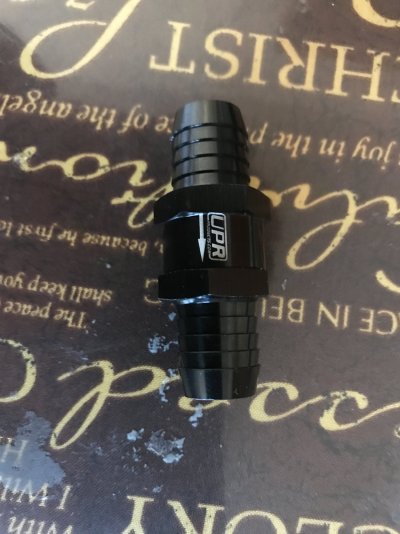
Just had a thought remembering you posted you may have issues w\ the PCV check valves failing under boost...........have you looked at using a UPR 5\8" inline metal check valve? They're rated for 125 psi service for use in high boost pressure service & are serviceable. I provided a picture of 1 below for your consideration.........bought it direct off UPR's web site.
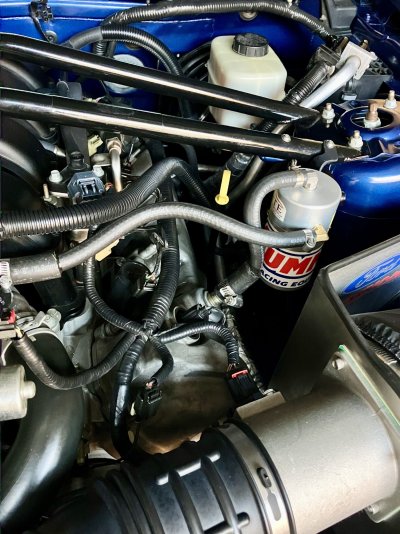
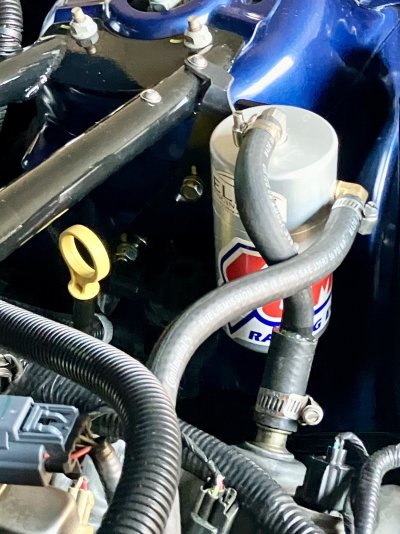
I bought 1 of these for use in my car's PCV return line.......not specifically for the check valve part (but knew it could be used w\ a centri\turbo FI application if warranted........) but to use as a secondary adjustable inline PCV airflow metering orifice (has a 1\8" plate orifice installed inside of it.......doesn't interfere w\ the inner 1 way sliding valve's operation thus the check valve is still fully operational if warranted.....) to specifically & intentionally redirect a small portion of the pre-TB MAF PCV airflow drawn thru the engine crankcase system back into IM post-TB to be redrawn back thru my FP 62mm TB's butterfly blades to help it to better control engine idle\off idle routines thru ECU's IAC control w\o negatively affecting the PCV system operation (part of the potential issue I've noted w\ these engines that most folks don't understand when a TB >55mm is used in tandem w\ the current PCV system design.........an adjustable inline PCV metering orifice is a remedy to this--the Ford-designed inner DS B2 valve cover PCV spring loaded orifice slider plug will auto adjust to this downstream external metering orifice to not overly restrict this system's total airflow thruput thus remains viable in its original operational design, but will allow redirecting enough of it back thru the TB to achieve the intent desired........my car's ECU IAC can control engine idle\off idle transitions thru my FRPP 62mm TB w\ this PCV metering setup installed just as good or better than the OEM 55mm TB can w\o it........no transitional dips during decel back to idle (the TB over closing\stumbling at return to idle that a lot of folks report having once been tuned.......), no transitional delays in either direction (the excessive idle\off idle TB hunting as well......), no IPC Wheel TQ errors incurred whatsoever in ETC operations while taking full advantage of FP's pre blade internal TB porting work to improve instant throttle accel\decel response........while in the process also helps to further slowdown the drawn PCV airflow velocity thru engine crankcase\DS B2 valve cover helping more of the misted oil droplets entrained in PCV airflow to drop out inside the DS B2 valve cover's inner baffle prior exiting....also further increasing the amount of misted oil droplets that got missed thru the DS valve cover's baffle to also drop out into my Evil Energy catch can as well (PCV metering orifice is mounted downstream of catch can between it & IM.........) during high IM vacuum intervals, thus a win-win scenario & has been recorded\is proven to work as advertised (been in continuous service for at least 5-6 yrs now........installed prior start of my tuning days thus ran this setup w\ a BBK #1763 62mm TB prior this FRPP 62mm TB......).
Had posted about all this in another thread I started back in the day at the time I came up w\ this.
Most don't realize the OEM TB size Ford used was to also work in tandem w\ this PCV system's current design\intent to retain sufficient ECU IAC control thus smooth idle routines........when designing this FRPP 62mm TB, Ford knew that they were at the ragged edge of this PCV system's design limitations....as currently designed, thus the sensitivity to these potential issues concerning smooth engine idle\off idle control........this FRPP 62mm TB--like the FRPP IM that was designed along w\ it--wasn't originally intended for normal street usage but strictly racing usages where smooth idle control routines weren't a priority......
Just giving you a sample of me seeing\identifying potential design issues that most is\are overlooking, then designing\implementing a working remedy for it that I couldn't find someone else doing\had done prior........as I typed in para #2.





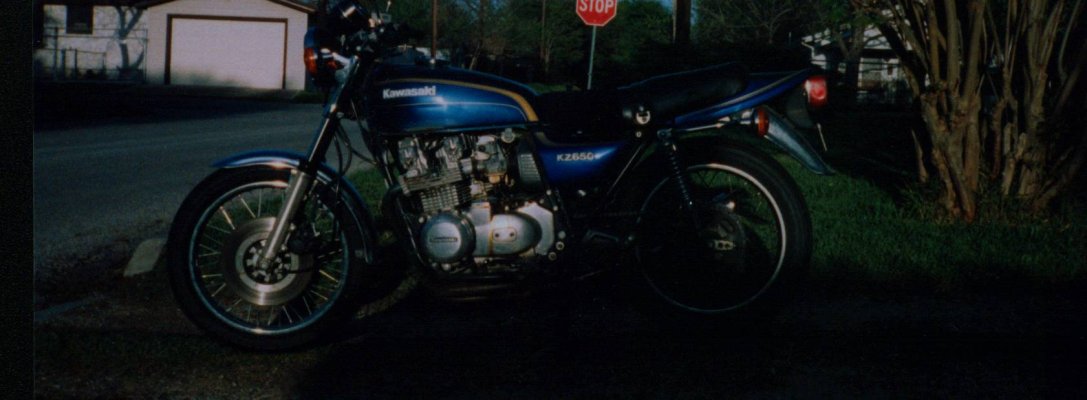
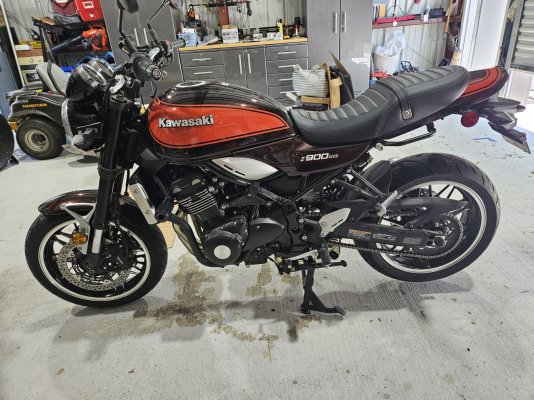


 Amazes me the cheap speed you can get with a bike TBH. The Sabre woulda done the 1/4 in low 12's back when it was new, but of course having it run good enough to hit that now is a big ask. Part of the reason I was looking at the same Kawi a couple years ago. And besides the modern reliablity, there's that modern power. Newer bikes are absolute monsters compared to the vintage stuff


