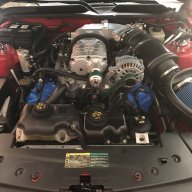
FRPP vs CMDPs

StockishS197

Member
Joined
Dec 24, 2024
Posts
434
Reaction score
379
Location
Houston
I know this is a long debated topic and mostly covered with dynos…the CMDPs make power everywhere, FRPP makes more above 5500 RPM.

Curious….has anyone regretted going from CMDPs to the FRPP mani on a bolt on, cammed car running up to 6800 RPM? I like the look of the FRPP and looking to see if the loss in low end is that dramatic, especially for a non DD weekend car.
 

Badd GT

Senior Member
Joined
May 19, 2013
Posts
813
Reaction score
410
Location
wake forest nc
my experience with the ford racing manifold was that it made less thru the power band till 6200 or so and then just matched the performance of delete plates to 6800. That was with spr cams, ported heads, headers etc. I returned it for refund and put my delete plates back on.
 

Dino Dino Bambino

I have a red car
Joined
Aug 11, 2014
Posts
4,509
Reaction score
2,601
Location
Cyprus
I know this is a long debated topic and mostly covered with dynos…the CMDPs make power everywhere, FRPP makes more above 5500 RPM.

Curious….has anyone regretted going from CMDPs to the FRPP mani on a bolt on, cammed car running up to 6800 RPM? I like the look of the FRPP and looking to see if the loss in low end is that dramatic, especially for a non DD weekend car.
The loss of low rpm torque with the FRPP manifold compared to the stock intake manifold with delete plates is an internet myth.
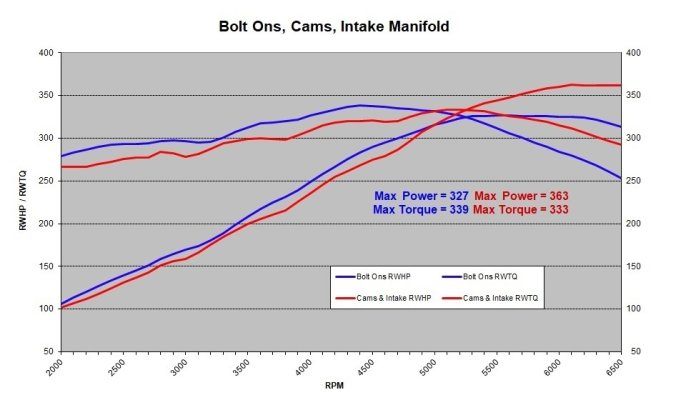
In reality the two perform similarly up to 3300rpm. From 3300 to 5200rpm, the stock manifold with delete plates performs better and it's only above 5200rpm where the FRPP manifold gains any advantage. If your rev limit is 6500rpm, that's a mere 1300rpm window. Peak to peak there's a ~13hp gain.
Therefore on a primarily street driven car, it's best to keep the stock manifold with delete plates.
Here's an example on a 3V that has essentially full bolt ons (CAI, CMDPs, UDPs, Kooks headers, 62mm TB, FRPP driveshaft) plus Detroit Rocker cams before and after the FRPP manifold was added:

Ford Performance Intake Manifold.jpg
The same car with "before" as stock cams & stock manifold with CMDPs, and "after" when the Detroit Rocker cams & FRPP manifold are added.
Four Eyes Cams Intake.jpg
While you lose some midrange torque with the FRPP manifold alone, adding cams results in an additional midrange torque loss AND a loss of torque at lower rpm. This combined loss of torque below 5000rpm is the reason why cars with cams/intake manifold feel more sluggish until you swap in 4.10 axle gears to increase the torque multiplication to the wheels.
If your car spends much of its life cruising around with the engine between 1500-3000rpm, going for that bigger HP number for bragging rights is going to cost you a lot of money without any benefit.

 

Dino Dino Bambino

I have a red car
Joined
Aug 11, 2014
Posts
4,509
Reaction score
2,601
Location
Cyprus
When does the charge motion valve opens?
From my page below:


The intake manifold features computer-controlled charge motion control valves (CMCV) that are placed in each intake runner path. Below 3250rpm and at low engine loads, ~75% of each intake runner is closed off. This accelerates and tumbles incoming air, homogenizing the air/fuel mixture for improved fuel economy and reduced hydrocarbon emissions especially after a cold start. Above 3250rpm and at higher engine loads, the valves swing wide open as the engine's demand for air increases to provide maximum performance.
 

JC SSP

Senior Member
Joined
Nov 8, 2022
Posts
2,283
Reaction score
1,352
Location
FL
If I recall correctly 05-09 CM plates are sandwiched between the intake plenum and engine. Making it easy to buy or convert them to a deleted CMP.

2010 they are integrated into the manifold itself, requiring a complete manifold change out.
 

StockishS197

Member
Joined
Dec 24, 2024
Posts
434
Reaction score
379
Location
Houston
If I recall correctly 05-09 CM plates are sandwiched between the intake plenum and engine. Making it easy to buy or convert them to a deleted CMP.

2010 they are integrated into the manifold itself, requiring a complete manifold change out.
05-08 had bolted in CMCVs. 09-10 had molded in CMCVs.

The former can use Steeda CMDPs (plates), the latter have to use delete plugs (or use the FRPP mani).
 

StockishS197

Member
Joined
Dec 24, 2024
Posts
434
Reaction score
379
Location
Houston
The loss of low rpm torque with the FRPP manifold compared to the stock intake manifold with delete plates is an internet myth.
In reality the two perform similarly up to 3300rpm. From 3300 to 5200rpm, the stock manifold with delete plates performs better and it's only above 5200rpm where the FRPP manifold gains any advantage. If your rev limit is 6500rpm, that's a mere 1300rpm window. Peak to peak there's a ~13hp gain.
Therefore on a primarily street driven car, it's best to keep the stock manifold with delete plates.
Here's an example on a 3V that has essentially full bolt ons (CAI, CMDPs, UDPs, Kooks headers, 62mm TB, FRPP driveshaft) plus Detroit Rocker cams before and after the FRPP manifold was added:

View attachment 108068
The same car with "before" as stock cams & stock manifold with CMDPs, and "after" when the Detroit Rocker cams & FRPP manifold are added.
View attachment 108069
While you lose some midrange torque with the FRPP manifold alone, adding cams results in an additional midrange torque loss AND a loss of torque at lower rpm. This combined loss of torque below 5000rpm is the reason why cars with cams/intake manifold feel more sluggish until you swap in 4.10 axle gears to increase the torque multiplication to the wheels.
If your car spends much of its life cruising around with the engine between 1500-3000rpm, going for that bigger HP number for bragging rights is going to cost you a lot of money without any benefit.

Yeah the factory mani with CMDPs and cams have solid range torque, especially at part throttle and would suck to give that up for a bit more peak.

The car currently pulls really well up to 6500 RPM so it seems the mani would only be a piece of bling and would actually make the car slower.
 

StockishS197

Member
Joined
Dec 24, 2024
Posts
434
Reaction score
379
Location
Houston
Circling back on this thread after doing the FRPP mani swap and a new tune from JDM, the car seems to be running better everywhere.

Car definitely pulls harder in the 4500+ range up to 6800 and down low, I struggle to feel any loss at all. The change in induction sound is worth it on its own, not including how good it looks in the engine bay. The induction and exhaust note did change noticeably

All in all, I am impressed with the changes and was worthwhile for me, even coming from CMDPs. I’m not sure how much of the gain was from the new tune from JDM over the mani, but the car really loves to rev which is cool.
 

Support us!

Support Us - Become A Supporting Member Today!

Click Here For Details

Back
Top