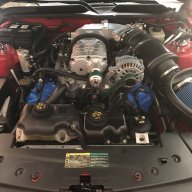
The loss of low rpm torque with the FRPP manifold compared to the stock intake manifold with delete plates is an internet myth.
In reality the two perform similarly up to 3300rpm. From 3300 to 5200rpm, the stock manifold with delete plates performs better and it's only above 5200rpm where the FRPP manifold gains any advantage. If your rev limit is 6500rpm, that's a mere 1300rpm window. Peak to peak there's a ~13hp gain.
Therefore on a primarily street driven car, it's best to keep the stock manifold with delete plates.
Here's an example on a 3V that has essentially full bolt ons (CAI, CMDPs, UDPs, Kooks headers, 62mm TB, FRPP driveshaft) plus Detroit Rocker cams before and after the FRPP manifold was added:
View attachment 108068
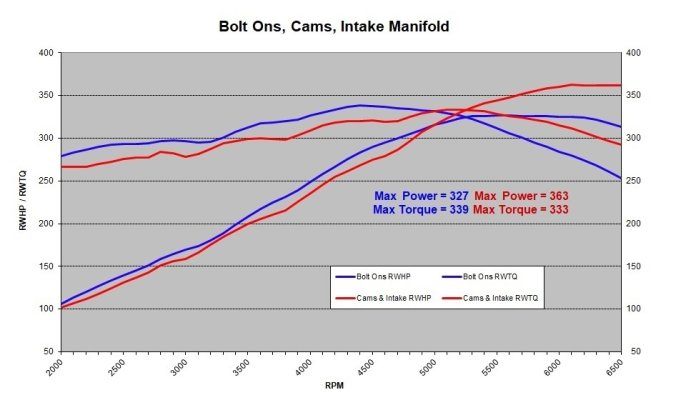
The same car with "before" as stock cams & stock manifold with CMDPs, and "after" when the Detroit Rocker cams & FRPP manifold are added.
View attachment 108069
While you lose some midrange torque with the FRPP manifold alone, adding cams results in an additional midrange torque loss AND a loss of torque at lower rpm. This combined loss of torque below 5000rpm is the reason why cars with cams/intake manifold feel more sluggish until you swap in 4.10 axle gears to increase the torque multiplication to the wheels.
If your car spends much of its life cruising around with the engine between 1500-3000rpm, going for that bigger HP number for bragging rights is going to cost you a lot of money without any benefit.