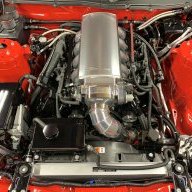
Having taken a FRPP apart, the reason why it has flex is because the entire top section is essentially a shell. I have a post burried in tech somewhere with pics of it torn down. The top shell is relatively thin, so under vacuum conditions it is actually sucked in a bit. When you open the throttle and get more toward atmosphere or positive pressure, it's actually relaxing to its original shape, which is why it appears to flex/bulge when people show videos of it while tapping the throttle. I wouldn't want to see a nitrous backfire through one, but boost should be optimal. The intake runners are super short and meet at the center-bottom of the manifold. This does allow the rear runners to be fed air more readily than a stock or similar manifold, since the air has more direction changes to make in a stock manifold.
As far as good for a turbo specifically, I was always under the impression that turbo's desired long runner intake manifolds for spooling purposes. Other than that, the FRPP will surely shine in any FI system and particularly up top. BruceH has a post with some technical data regarding airflow and where the FRPP starts to out-flow the OEM.
For those who have swapped to the FRPP in their FI setups, I think the question to ask would not be what their peak gain was, but what their gain/loss was through the entire powerband, where gains started and how far did they hold.